
Depression
... Clinical depression can be difficult to identify and people with MS themselves may not always recognise it. It can be hard to talk about feelings and the stigma associated with mental health problems may also be a barrier to discussion. Family and friends can play a key role in helping to identify o ...
... Clinical depression can be difficult to identify and people with MS themselves may not always recognise it. It can be hard to talk about feelings and the stigma associated with mental health problems may also be a barrier to discussion. Family and friends can play a key role in helping to identify o ...
Chapter 14- Psychological disorders
... conditioned phobic responses Neuro-chemical: decreases in GABA activity and serotonin activity are associated with anxiety disorders Cognitive: people who suffer from anxiety disorders may chronically overestimate the severity of a perceived threat ...
... conditioned phobic responses Neuro-chemical: decreases in GABA activity and serotonin activity are associated with anxiety disorders Cognitive: people who suffer from anxiety disorders may chronically overestimate the severity of a perceived threat ...

Cultural Barriers to Adequate Detection and Management of Major
... EIP (I):Elicit patient’s illness narratives It is important to listen to the patients’ narratives, to understand the framework, conception, and the language they use to describe their illness Patient’s narratives of his/her illness can be used as a platform to develop co-constructed illness narrati ...
... EIP (I):Elicit patient’s illness narratives It is important to listen to the patients’ narratives, to understand the framework, conception, and the language they use to describe their illness Patient’s narratives of his/her illness can be used as a platform to develop co-constructed illness narrati ...

Mental Disorders - Interboro School District
... preoccupied by a perceived defect in his or her physical features ...
... preoccupied by a perceived defect in his or her physical features ...
Presynaptic Questions
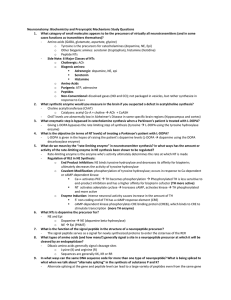
... glutamine (glutamine synthetase) The glutamine is then transferred back to the pre-synaptic nerve ending where it is used to produce new GABA What enzymes are involved in the degradative metabolism of catecholamines? Monoamine oxidase and catechol-o-methyltransferase Catecholamines can be further de ...
... glutamine (glutamine synthetase) The glutamine is then transferred back to the pre-synaptic nerve ending where it is used to produce new GABA What enzymes are involved in the degradative metabolism of catecholamines? Monoamine oxidase and catechol-o-methyltransferase Catecholamines can be further de ...

Physiology 2
... stress disorder, such as: anxiety. Norepinephrine works on types of receptors : β1 receptors , α2 receptors In addition to the function of norepinephrine in enhancing attention , it will also affects mood regulation , learning and memory . Learning and memory , attention stimuli activation of post ...
... stress disorder, such as: anxiety. Norepinephrine works on types of receptors : β1 receptors , α2 receptors In addition to the function of norepinephrine in enhancing attention , it will also affects mood regulation , learning and memory . Learning and memory , attention stimuli activation of post ...

Heroin - WordPress.com
... You can think of a brain pathway as a power line that connects two brain regions. Brain pathways are made up of interconnected neurons along which signals are transmitted from one brain region to another. Dopamine is the neurotransmitter used by the reward pathway. But there are other important pat ...
... You can think of a brain pathway as a power line that connects two brain regions. Brain pathways are made up of interconnected neurons along which signals are transmitted from one brain region to another. Dopamine is the neurotransmitter used by the reward pathway. But there are other important pat ...
Mood Disorders
... Presence of the following symptoms > 2 weeks: – ↑↑ Sadness – Anhedonia- inability to feel pleasure – Psychomotor retardation – ↓/↑ Appetite & weight – ↓ Energy Level Hopelessness ↓ Self-Esteem – ↓/↑ Sleeping ↓ Concentration/Decision Making – Worthlessness & guilt – Recurrent thoughts of death or s ...
... Presence of the following symptoms > 2 weeks: – ↑↑ Sadness – Anhedonia- inability to feel pleasure – Psychomotor retardation – ↓/↑ Appetite & weight – ↓ Energy Level Hopelessness ↓ Self-Esteem – ↓/↑ Sleeping ↓ Concentration/Decision Making – Worthlessness & guilt – Recurrent thoughts of death or s ...

Mental disorders in Life and Health Insurance
... sing drugs are essentially lithium salts but some anti-epileptic treatments and certain tranquilisers have recently come on the market which have also been found to be effective in treating bipolar disorder. A healthy lifestyle is at least as important as medication. For example, patients must be ...
... sing drugs are essentially lithium salts but some anti-epileptic treatments and certain tranquilisers have recently come on the market which have also been found to be effective in treating bipolar disorder. A healthy lifestyle is at least as important as medication. For example, patients must be ...
Neuroeconomics and the Social Brain Henrik Walter (-frankfurt.de) Peter Kenning (-muenster.de)
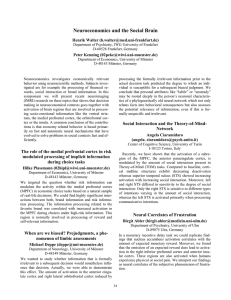
... may be rooted deeply in the person’s neuronal characteristics of a phylogenetically old neural network which not only relates facts into behavioral consequences but also assesses the potential relevance of information, even if this is formally unspecific and irrelevant. ...
... may be rooted deeply in the person’s neuronal characteristics of a phylogenetically old neural network which not only relates facts into behavioral consequences but also assesses the potential relevance of information, even if this is formally unspecific and irrelevant. ...

psychological disorders - Bremerton School District
... Two types are: conversion disorders – anxiety is presumably converted into a physical symptom hypochondriasis – normal physical sensations are interpreted as symptoms of a disease ...
... Two types are: conversion disorders – anxiety is presumably converted into a physical symptom hypochondriasis – normal physical sensations are interpreted as symptoms of a disease ...

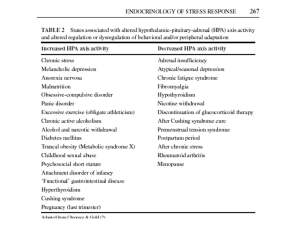
5104_b4
... The dorsal raphé nucleus (DRN) is a major source of ascending serotonergic (5-HT) input to forebrain structures such as the neocortex, the dorsal (DS) and ventral (VS) striatum, and the amygdala (Amyg)11. The ventromedial prefrontal cortex (PFC) (including the infralimbic and prelimbic regions in th ...
... The dorsal raphé nucleus (DRN) is a major source of ascending serotonergic (5-HT) input to forebrain structures such as the neocortex, the dorsal (DS) and ventral (VS) striatum, and the amygdala (Amyg)11. The ventromedial prefrontal cortex (PFC) (including the infralimbic and prelimbic regions in th ...

Mood Disorder - Santa Barbara Therapist
... Chronic, fluctuating mood Symptoms do not have to meet criteria for hypomania or dysthymia, but must demonstrate symptoms similar to both disorders ...
... Chronic, fluctuating mood Symptoms do not have to meet criteria for hypomania or dysthymia, but must demonstrate symptoms similar to both disorders ...

ADAP-Booklet FINAL
... the chance that another family member will have similar symptoms. Through family, adoption, and twin studies, researchers have located genes which appear to play a role in increasing one’s risk for Depression. Finally, there is some evidence that particular parts of the brain are linked to the illne ...
... the chance that another family member will have similar symptoms. Through family, adoption, and twin studies, researchers have located genes which appear to play a role in increasing one’s risk for Depression. Finally, there is some evidence that particular parts of the brain are linked to the illne ...
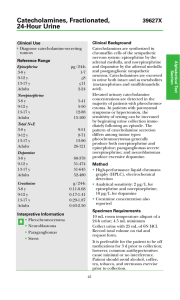
Catecholamines, Fractionated, 24-Hour Urine
... adrenal medulla, and norepinephrine and dopamine by the adrenal medulla and postganglionic sympathetic neurons. Catecholamines are excreted in urine both intact and as metabolites (metanephrines and vanillylmandelic acid). Elevated urinary catecholamine concentrations are detected in the majority of ...
... adrenal medulla, and norepinephrine and dopamine by the adrenal medulla and postganglionic sympathetic neurons. Catecholamines are excreted in urine both intact and as metabolites (metanephrines and vanillylmandelic acid). Elevated urinary catecholamine concentrations are detected in the majority of ...
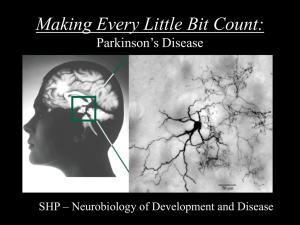
MPTP - Columbia University
... where the drug seems to stop working in between doses. Now the effect of the drug is dependent on serum concentration (known as the short duration effect. • Longterm use is associated with levodopa-induced dyskinesias. • Taking too much of the drug will induce a schizophrenialike syndrome (character ...
... where the drug seems to stop working in between doses. Now the effect of the drug is dependent on serum concentration (known as the short duration effect. • Longterm use is associated with levodopa-induced dyskinesias. • Taking too much of the drug will induce a schizophrenialike syndrome (character ...

BIOPSYCHOLOGY notes
... the recepter and float back into the synapse. When this happens, the receptor stops sending chemical signals to the cell body, and it waits for another serotonin molecule to ...
... the recepter and float back into the synapse. When this happens, the receptor stops sending chemical signals to the cell body, and it waits for another serotonin molecule to ...

Q and A about Dysthymic Disorder (Chronic Depression) —David
... dysthymia (or as the DSMIV put it, dysthymic disorder; and, as the DSM-5 now puts it, Persistent Depressive Disorder) does respond to antidepressant medicines. [See here for a Cochrane review of medication studies of dysthymia, which reviews the 17 double-blind placebo controlled studies that had be ...
... dysthymia (or as the DSMIV put it, dysthymic disorder; and, as the DSM-5 now puts it, Persistent Depressive Disorder) does respond to antidepressant medicines. [See here for a Cochrane review of medication studies of dysthymia, which reviews the 17 double-blind placebo controlled studies that had be ...

Jeopardy
... a presynaptic receptor, serotonin post synaptic receptors, and this post synaptic receptor ...
... a presynaptic receptor, serotonin post synaptic receptors, and this post synaptic receptor ...

Chapter 13 Review Question Answers
... 1. An electronegative group (e.g., Cl, CF3, or SCH3) is required at the 2-position of the phenothiazine ring for antipsychotic activity. A three-carbon bridge separating the N-10 nitrogen of the phenothiazine ring and the side chain amine is necessary. The basic side chain nitrogen can be a tertiary ...
... 1. An electronegative group (e.g., Cl, CF3, or SCH3) is required at the 2-position of the phenothiazine ring for antipsychotic activity. A three-carbon bridge separating the N-10 nitrogen of the phenothiazine ring and the side chain amine is necessary. The basic side chain nitrogen can be a tertiary ...
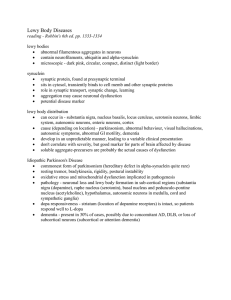
Lewy Body Diseases
... synaptic protein, found at presynaptic terminal sits in cytosol, transiently binds to cell memb and other synaptic proteins role in synaptic transport, synaptic change, learning aggregation may cause neuronal dysfunction potential disease marker lewy body distribution can occur in - subs ...
... synaptic protein, found at presynaptic terminal sits in cytosol, transiently binds to cell memb and other synaptic proteins role in synaptic transport, synaptic change, learning aggregation may cause neuronal dysfunction potential disease marker lewy body distribution can occur in - subs ...


depression?
... 4.What is the pharmacologic agent of choice in the disorder described? A) a selective serotonin reuptake inhibitor (SSRI) B) a tricyclic antidepressant C) a non selective MOA inhibitor D) a selective MAO inhibitor E) Lithium carbonate ...
... 4.What is the pharmacologic agent of choice in the disorder described? A) a selective serotonin reuptake inhibitor (SSRI) B) a tricyclic antidepressant C) a non selective MOA inhibitor D) a selective MAO inhibitor E) Lithium carbonate ...

Common Psychological Histories
... •Normal mood interspersed with depression and manic episodes •Mania episodes: irritable, elevated mood, fast speech, flight of ideas, grandiosity, excessive spending/drinking, insomnia, auditory hallucinations, delusions of wealth/power/religion •Triggered by stressful life event •Stress, upset, anx ...
... •Normal mood interspersed with depression and manic episodes •Mania episodes: irritable, elevated mood, fast speech, flight of ideas, grandiosity, excessive spending/drinking, insomnia, auditory hallucinations, delusions of wealth/power/religion •Triggered by stressful life event •Stress, upset, anx ...
Biology of depression

Scientific studies have found that numerous brain areas show altered activity in patients suffering from depression, and this has encouraged advocates of various theories that seek to identify a biochemical origin of the disease, as opposed to theories that emphasize psychological or situational causes. Several theories concerning the biologically based cause of depression have been suggested over the years, of which the most prominent and widely researched is the monoamine hypothesis.