Depression
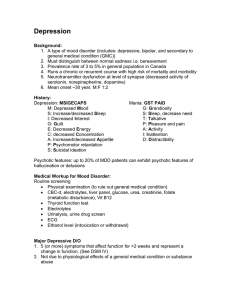
... 1. A type of mood disorder (includes: depressive, bipolar, and secondary to general medical condition (GMC)) 2. Must distinguish between normal sadness i.e. bereavement 3. Prevalence rate of 3 to 5% in general population in Canada 4. Runs a chronic or recurrent course with high risk of mortality and ...
... 1. A type of mood disorder (includes: depressive, bipolar, and secondary to general medical condition (GMC)) 2. Must distinguish between normal sadness i.e. bereavement 3. Prevalence rate of 3 to 5% in general population in Canada 4. Runs a chronic or recurrent course with high risk of mortality and ...
Electrode Placement for Chest Leads, V1 to V6
... 9. Recurrent thoughts of death or suicide Note. The symptoms cause clinically significant distress or impairment, are not caused by the effects of a substance or general medical condition, and are not better accounted for by bereavement or another psychiatric disorder. ...
... 9. Recurrent thoughts of death or suicide Note. The symptoms cause clinically significant distress or impairment, are not caused by the effects of a substance or general medical condition, and are not better accounted for by bereavement or another psychiatric disorder. ...

Mood Disorders - Association for Academic Psychiatry
... • Leads to shorter well periods, increased frequency and severity of illness ...
... • Leads to shorter well periods, increased frequency and severity of illness ...
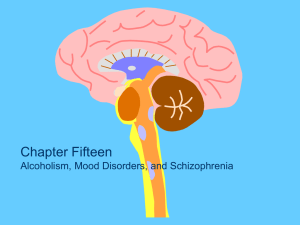
Mood Disorders and Schizophrenia
... Tricyclics block the reuptake of dopamine, norepinephrine, or serotonin. SSRIs specifically block the reuptake of serotonin. MAOIs block the enzyme MAO, which converts dopamine, norepinephrine, or serotonin into inactive chemicals. Atypical antidepressants have varying effects. ...
... Tricyclics block the reuptake of dopamine, norepinephrine, or serotonin. SSRIs specifically block the reuptake of serotonin. MAOIs block the enzyme MAO, which converts dopamine, norepinephrine, or serotonin into inactive chemicals. Atypical antidepressants have varying effects. ...
Depression 101
... Combination therapy (medication and psychotherapy/counseling) are more effective than either one alone Antidepressants restore the former balance of brain chemistry, so the person returns to their pre-depressed state Many individuals respond to antidepressants but remission of symptoms is the g ...
... Combination therapy (medication and psychotherapy/counseling) are more effective than either one alone Antidepressants restore the former balance of brain chemistry, so the person returns to their pre-depressed state Many individuals respond to antidepressants but remission of symptoms is the g ...
Biology of depression

Scientific studies have found that numerous brain areas show altered activity in patients suffering from depression, and this has encouraged advocates of various theories that seek to identify a biochemical origin of the disease, as opposed to theories that emphasize psychological or situational causes. Several theories concerning the biologically based cause of depression have been suggested over the years, of which the most prominent and widely researched is the monoamine hypothesis.