HERE.
... Jefferson hoped an embargo (a ban on exporting goods to other countries) would hurt Britain and other European countries and force them to respect American neutrality. Instead the embargo hurt American businesses. As a result, Congress ended the embargo. ...
... Jefferson hoped an embargo (a ban on exporting goods to other countries) would hurt Britain and other European countries and force them to respect American neutrality. Instead the embargo hurt American businesses. As a result, Congress ended the embargo. ...
8-4 The War of 1812
... After Attacking Washington DC, Great Britain turned to the south to control the Mississippi River ...
... After Attacking Washington DC, Great Britain turned to the south to control the Mississippi River ...
Causes for the War of 1812 - Greensboro Academy 8th Grade History
... attempts to unify Indian tribes that have been removed from the Ohio River Valley His brother, the Prophet preached that Indians should reject White ways and embrace their heritage The brothers have a large following but their hopes are destroyed at the battle of fallen Timbers ...
... attempts to unify Indian tribes that have been removed from the Ohio River Valley His brother, the Prophet preached that Indians should reject White ways and embrace their heritage The brothers have a large following but their hopes are destroyed at the battle of fallen Timbers ...
Results of the war
... Hull in Detroit, and frightened Brock into surrendering his entire army without a fight. He said the Indians would be “uncontrollable in an attack.” ...
... Hull in Detroit, and frightened Brock into surrendering his entire army without a fight. He said the Indians would be “uncontrollable in an attack.” ...
Topic 18 Why did America go to war in 1812
... Chesapeake’s captain to permit a search of British deserters. When the captain refused, the Leopard opened fire. Three Americans were killed and 18 wounded. The British allegedly took four deserters. C. What conflict arose with the Indians prior to the War of 1812? 1. In the Ohio river valley many d ...
... Chesapeake’s captain to permit a search of British deserters. When the captain refused, the Leopard opened fire. Three Americans were killed and 18 wounded. The British allegedly took four deserters. C. What conflict arose with the Indians prior to the War of 1812? 1. In the Ohio river valley many d ...

Ch. 11 People
... 10. ___________________________ Shoshone woman who joined the Corps of Discovery in 1805, served as a guide and interpreter for the expedition ...
... 10. ___________________________ Shoshone woman who joined the Corps of Discovery in 1805, served as a guide and interpreter for the expedition ...
6.4 War of 1812 Outline
... Unfortunately for the US, they would never obtain the vast Canadian country it wanted. 2.) Native Americans fight for Indian Territory: In 1809, General William Henry Harrison, governor of the Indiana Territory, invited several Native American chiefs to Fort Wayne, Indiana and asked them to sign awa ...
... Unfortunately for the US, they would never obtain the vast Canadian country it wanted. 2.) Native Americans fight for Indian Territory: In 1809, General William Henry Harrison, governor of the Indiana Territory, invited several Native American chiefs to Fort Wayne, Indiana and asked them to sign awa ...
War of 1812
... two wars. The war between the Americans and the British ended with the treaty of Ghent. The war between the Big Knives [American frontiersmen] and the Indians began at Tippecanoe, and arguably did not run its course until the last Red Sticks were defeated in the Florida swamps in 1818 (Sugden ...
... two wars. The war between the Americans and the British ended with the treaty of Ghent. The war between the Big Knives [American frontiersmen] and the Indians began at Tippecanoe, and arguably did not run its course until the last Red Sticks were defeated in the Florida swamps in 1818 (Sugden ...
slide show - Etiwanda E
... Canada • American policy is to invade and conquer Canada • Land forces not successful due to poor training/equipment ...
... Canada • American policy is to invade and conquer Canada • Land forces not successful due to poor training/equipment ...
The War of 1812 - El Segundo Middle School
... of Native American tribes • Battle of Tippecanoe increases hostilities – Prophetstown rebuilt ...
... of Native American tribes • Battle of Tippecanoe increases hostilities – Prophetstown rebuilt ...
The War of 1812 The Star
... Fearing an attack from the Americans, the Indians did attack first. During the Battle of Tippecanoe, neither side clearly won the battle. The Americans destroyed the Indian village. Indians throughout the Northwest continued attacking settlers hoping they would return east. ...
... Fearing an attack from the Americans, the Indians did attack first. During the Battle of Tippecanoe, neither side clearly won the battle. The Americans destroyed the Indian village. Indians throughout the Northwest continued attacking settlers hoping they would return east. ...
Chapter 9 The Jefferson Era (1800
... • Tecumseh and his warriors met Hull, and Hull surrendered Detroit to the British • William Henry Harrison also made an unsuccessful attempt to invade Canada • Harrison decided that the Americans could not do anything as long as the British controlled Lake Erie ...
... • Tecumseh and his warriors met Hull, and Hull surrendered Detroit to the British • William Henry Harrison also made an unsuccessful attempt to invade Canada • Harrison decided that the Americans could not do anything as long as the British controlled Lake Erie ...

Chapter 6- Vocabulary - Riverside Local Schools
... Many tribes gave up their land, received $20,000 in goods for moving to Ohio’s NW corner A partnership or alliance for a specific purpose ownership ...
... Many tribes gave up their land, received $20,000 in goods for moving to Ohio’s NW corner A partnership or alliance for a specific purpose ownership ...
09-04 The Jefferson Era 1800-1816 The War of 1812
... was not prepared for war. The regular army had less than 7,000 troops. The states had between 50,000 and 100,000 militia, but they were poorly trained, and many states were against the war. ...
... was not prepared for war. The regular army had less than 7,000 troops. The states had between 50,000 and 100,000 militia, but they were poorly trained, and many states were against the war. ...
War of 1812 PPt
... After 30 years of independence, the United States found themselves drawn into a second war with Great Britain. How did this happen????? • British ships were stopping American ships and impressing (seizing) U.S. sailors and supplies, claiming that many were deserters from the British Navy. One such e ...
... After 30 years of independence, the United States found themselves drawn into a second war with Great Britain. How did this happen????? • British ships were stopping American ships and impressing (seizing) U.S. sailors and supplies, claiming that many were deserters from the British Navy. One such e ...
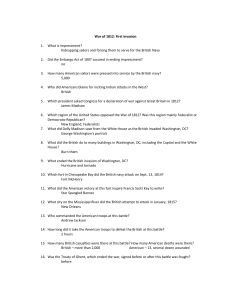
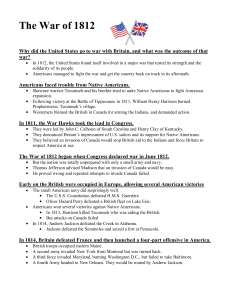
The War of 1812
... Americans managed to fight the war and get the country back on track in its aftermath. ...
... Americans managed to fight the war and get the country back on track in its aftermath. ...
File - TBRMS
... The attack from Detroit failed when the British and Native Americans led by Tecumseh captured Fort Detroit. The other planned attacks failed when state militia soldiers refused to cross the Canadian border, arguing that they did not have to fight in a foreign country. ...
... The attack from Detroit failed when the British and Native Americans led by Tecumseh captured Fort Detroit. The other planned attacks failed when state militia soldiers refused to cross the Canadian border, arguing that they did not have to fight in a foreign country. ...
Madison
... territory, nor was border and trade disputes solved. But there were three important consequences. 1.) The United States proved it could defend itself against the mightiest military of the time, the heroism of Americans increased patriotism. 2.) The war weakened Native Americans, who had sided with t ...
... territory, nor was border and trade disputes solved. But there were three important consequences. 1.) The United States proved it could defend itself against the mightiest military of the time, the heroism of Americans increased patriotism. 2.) The war weakened Native Americans, who had sided with t ...
The War of 1812
... 5. What is a “privateer”? 6. What American led an attack on the Creek in March 1814? What was this battle called? 7. What was the result of this battle? 8. Who wrote the Star-Spangled Banner? 9. What led the British to decide that to continue fighting would cost them too much? 10.Name the peace trea ...
... 5. What is a “privateer”? 6. What American led an attack on the Creek in March 1814? What was this battle called? 7. What was the result of this battle? 8. Who wrote the Star-Spangled Banner? 9. What led the British to decide that to continue fighting would cost them too much? 10.Name the peace trea ...
File - MrFurgione.com
... valleys and pushed Indians off their lands. Two Shawnee Indians—a chief named Tecumseh and his brother, the Prophet— tried to fight back by uniting Indians along the Mississippi River into one great Indian nation. On November 7, 1811, Shawnee warriors fought against a militia force led by Indiana go ...
... valleys and pushed Indians off their lands. Two Shawnee Indians—a chief named Tecumseh and his brother, the Prophet— tried to fight back by uniting Indians along the Mississippi River into one great Indian nation. On November 7, 1811, Shawnee warriors fought against a militia force led by Indiana go ...
The War of 1812
... which the United States was unprepared. It became known as “Mr. Madison’s War.” Conquering Canada was a disaster for the United States. The attacks were totally uncoordinated. Detroit surrendered to British troops in August 1812, and in October the American troops lost the Battle of Queenston Height ...
... which the United States was unprepared. It became known as “Mr. Madison’s War.” Conquering Canada was a disaster for the United States. The attacks were totally uncoordinated. Detroit surrendered to British troops in August 1812, and in October the American troops lost the Battle of Queenston Height ...
William Henry Harrison
... Pre War – Shawnee Chief Tecumseh and his brother, the Prophet, try to form a confederacy of tribes to oppose American expansion westward. The Prophet was crazy and led an attack against William Henry Harrison, the governor of Indiana. Battle of Tippecanoe – Harrison and his troops burned the Shawnee ...
... Pre War – Shawnee Chief Tecumseh and his brother, the Prophet, try to form a confederacy of tribes to oppose American expansion westward. The Prophet was crazy and led an attack against William Henry Harrison, the governor of Indiana. Battle of Tippecanoe – Harrison and his troops burned the Shawnee ...
War of 1812 Brochure
... War of 1812 Brochure Left Panel-Pre War: Create a cause and effect chart of events leading up to the War of 1812. You should include: o Impressment o Embargo Act o Battle of Tippecanoe List and identify the “major players” involved in the pre-war activities o War Hawks o Tecumseh o William Henry ...
... War of 1812 Brochure Left Panel-Pre War: Create a cause and effect chart of events leading up to the War of 1812. You should include: o Impressment o Embargo Act o Battle of Tippecanoe List and identify the “major players” involved in the pre-war activities o War Hawks o Tecumseh o William Henry ...
Battle of Frenchtown

The Battle of Frenchtown, also known as the Battle of the River Raisin or the River Raisin Massacre, was a series of conflicts that took place from January 18–23, 1813 during the War of 1812. It was fought between the United States and a British and Native American alliance near the River Raisin in Frenchtown, Michigan Territory (present-day Monroe, Michigan). The battle on January 22 had the highest number of fatalities of any battle during this war.On January 18, 1813 the Americans forced the retreat of the British and their Native American allies from Frenchtown, which they had earlier occupied, in a relatively minor skirmish. The movement was part of a larger United States plan to advance north and retake Fort Detroit, following its loss in the Siege of Detroit the previous summer. Despite this initial success, the British and Native Americans rallied and launched a surprise counterattack four days later on January 22. Ill prepared, the Americans lost 397 soldiers in this second battle, while 547 were taken prisoner. Dozens of wounded prisoners were murdered the next day in a massacre by the Native Americans. More prisoners were killed if they could not keep up on the forced march to Fort Malden. This was the deadliest conflict recorded on Michigan soil, and the casualties included the highest number of Americans killed in a single battle during the War of 1812.Parts of the original battlefield were designated as a state historic park and added to the National Register of Historic Places. In 2009 Congress authorized its upgrade into the River Raisin National Battlefield Park, one of four such parks in the nation and the only one commemorating the War of 1812.