Lesson Kit: The War of 1812: Who Has the Advantage?
... Most of the top military leaders in the United States were older and only had experience fighting during the ...
... Most of the top military leaders in the United States were older and only had experience fighting during the ...
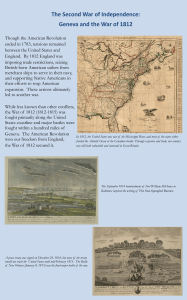
The Second War of Independence
... depositories for military stores, supplies, ammunition and men. They became gathering points for militia units before they went to the Niagara frontier. When the British burned the village of Black Rock (near Buffalo) in late ...
... depositories for military stores, supplies, ammunition and men. They became gathering points for militia units before they went to the Niagara frontier. When the British burned the village of Black Rock (near Buffalo) in late ...
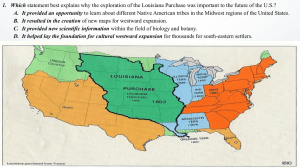
1. Which statement best explains why the exploration of the
... “Why would the country of England want to go back to war with America?” England’s Industrial Revolution Social and economic reorganization -> machines replaced hand tools; streams and coal to power factories from inventions. ...
... “Why would the country of England want to go back to war with America?” England’s Industrial Revolution Social and economic reorganization -> machines replaced hand tools; streams and coal to power factories from inventions. ...
Warof1812
... the United States. • This battle forced British commanders to retreat and return back to Canada. • The British had to abandon their plans to invade New York. ...
... the United States. • This battle forced British commanders to retreat and return back to Canada. • The British had to abandon their plans to invade New York. ...
War of 1812 - 4th Grade Page
... the United States. • This battle forced British commanders to retreat and return back to Canada. • The British had to abandon their plans to invade New York. ...
... the United States. • This battle forced British commanders to retreat and return back to Canada. • The British had to abandon their plans to invade New York. ...
Chapter 12 - Ludlow Independent Schools
... 3. The Federalist Party died out forever, and new war heroes, like Andrew Jackson and William Henry Harrison, emerged. 4. Manufacturing also prospered during the British blockade, since there was nothing else to do. 5. Incidents like the burning of Washington added fuel to the bitter conflict with B ...
... 3. The Federalist Party died out forever, and new war heroes, like Andrew Jackson and William Henry Harrison, emerged. 4. Manufacturing also prospered during the British blockade, since there was nothing else to do. 5. Incidents like the burning of Washington added fuel to the bitter conflict with B ...

War of 1812 Trilogy - Robin Brass Studio
... And All Their Glory Past, Graves follows the action from the siege of Fort Erie on the Niagara Peninsula to the battle of Plattsburgh and Lake Champlain in the Adirondack region of New York State and back to Upper Canada for the last skirmishes of 1814. In Field of Glory, Graves sets the tone for hi ...
... And All Their Glory Past, Graves follows the action from the siege of Fort Erie on the Niagara Peninsula to the battle of Plattsburgh and Lake Champlain in the Adirondack region of New York State and back to Upper Canada for the last skirmishes of 1814. In Field of Glory, Graves sets the tone for hi ...
9.4 War of 1812 1 September 24, 2012 Privateer 9/20/12
... defeated British ships several times in oneonone duels. ...
... defeated British ships several times in oneonone duels. ...
The War of 1812
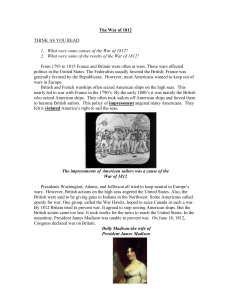
... The new American navy did much better than the army. Britain had the largest and best-trained navy in the world. In spite of this, American warships won many victories at sea. The most famous American warship was the Constitution. It won the name of “Old Ironsides” because in spite of much battle da ...
... The new American navy did much better than the army. Britain had the largest and best-trained navy in the world. In spite of this, American warships won many victories at sea. The most famous American warship was the Constitution. It won the name of “Old Ironsides” because in spite of much battle da ...
PowerPoint - Speaking of History
... 2) April of 1814 and on after the British have defeated the French ...
... 2) April of 1814 and on after the British have defeated the French ...
The War of 1812
... Battle of Tippecanoe, 1811 Q General William Henry Harrison governor of the Indiana Territory. Q Invited Native Indian chiefs to Ft. Wayne, IN to sign away 3 mil. acres of land to the US government. Q Tecumseh organized a confederacy of Indian tribes to fight for their homelands. ...
... Battle of Tippecanoe, 1811 Q General William Henry Harrison governor of the Indiana Territory. Q Invited Native Indian chiefs to Ft. Wayne, IN to sign away 3 mil. acres of land to the US government. Q Tecumseh organized a confederacy of Indian tribes to fight for their homelands. ...

Chapter 10 Section 4
... *Not enough tents, food or supplies were provided and heavy rain and snow caused enormous suffering. Cherokee Removal *The Cherokees held out until after Jackson was out of office. President Martin Van Buren, in 1838, forced the Cherokees to move. *In the winter of 1838-39 they were guarded by 7,00 ...
... *Not enough tents, food or supplies were provided and heavy rain and snow caused enormous suffering. Cherokee Removal *The Cherokees held out until after Jackson was out of office. President Martin Van Buren, in 1838, forced the Cherokees to move. *In the winter of 1838-39 they were guarded by 7,00 ...

10 War of 1812
... 3. America declared war on this nation in 1812. 5. This man wrote America’s national anthem. 9. This man led American forces at the Battle of New Orleans. 10. This outpost was the first permanent U.S. settlement on the Pacific coast. Down: 2. In 1808 it became illegal to import these into the United ...
... 3. America declared war on this nation in 1812. 5. This man wrote America’s national anthem. 9. This man led American forces at the Battle of New Orleans. 10. This outpost was the first permanent U.S. settlement on the Pacific coast. Down: 2. In 1808 it became illegal to import these into the United ...
War of 1812 Review Power Point
... • I conducted raids in the Chesapeake Bay area in both 1813 and 1814. • I was involved in the burning of Washington. • I helped eat the dinner prepared for the President before my troops burned the ...
... • I conducted raids in the Chesapeake Bay area in both 1813 and 1814. • I was involved in the burning of Washington. • I helped eat the dinner prepared for the President before my troops burned the ...

A project of Sponsored by
... Aboriginal warriors captured an American fort American sailors deserted their ship A British force invaded the ...
... Aboriginal warriors captured an American fort American sailors deserted their ship A British force invaded the ...

RP 12 The War of 1812 - Friends of the Canadian War Museum
... The Americans easily took Fort Erie and then inflicted a defeat on the British at Chippewa. However, American failure to follow-up quickly on their success at Chippewa, allowed the British to regroup and, on 25 July, under the command of General Phineas Riall, they stopped the American advance in a ...
... The Americans easily took Fort Erie and then inflicted a defeat on the British at Chippewa. However, American failure to follow-up quickly on their success at Chippewa, allowed the British to regroup and, on 25 July, under the command of General Phineas Riall, they stopped the American advance in a ...
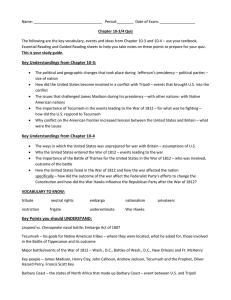
Name: Period:______ Date of Exam: Chapter 10
... The following are the key vocabulary, events and ideas from Chapter 10-3 and 10-4 – use your textbook, Essential Reading and Guided Reading sheets to help you take notes on these points to prepare for your quiz. This is your study guide. ...
... The following are the key vocabulary, events and ideas from Chapter 10-3 and 10-4 – use your textbook, Essential Reading and Guided Reading sheets to help you take notes on these points to prepare for your quiz. This is your study guide. ...


twenty-seven monuments worldwide commemorating twentieth
... New England states. General William Hull had to surrender Detroit on 16 August 1812, Generals Stephen van Rensselaer and Alexander Smyth failed dismally on the Niagara River in October, and General Henry Dearborn broke off a feeble attempt to march on Montreal in November. On Lake Erie, U.S. forces ...
... New England states. General William Hull had to surrender Detroit on 16 August 1812, Generals Stephen van Rensselaer and Alexander Smyth failed dismally on the Niagara River in October, and General Henry Dearborn broke off a feeble attempt to march on Montreal in November. On Lake Erie, U.S. forces ...
Chapter 7 – The Jefferson Era
... • Set fire to White House, Capitol, and other buildings • British shelled Fort McHenry at Baltimore, Maryland • Americans refused to surrender, and British retreated ...
... • Set fire to White House, Capitol, and other buildings • British shelled Fort McHenry at Baltimore, Maryland • Americans refused to surrender, and British retreated ...

Battle of Horseshoe Bend
... Horseshoe Bend was the major battle of the Creek War, in which Andrew Jackson sought to "clear" Alabama for American settlement. General Jackson was in command of an army of West Tennessee militia, which he had turned into a well-trained fighting force. To add to these militia units was the 39th Uni ...
... Horseshoe Bend was the major battle of the Creek War, in which Andrew Jackson sought to "clear" Alabama for American settlement. General Jackson was in command of an army of West Tennessee militia, which he had turned into a well-trained fighting force. To add to these militia units was the 39th Uni ...
Battle of Frenchtown

The Battle of Frenchtown, also known as the Battle of the River Raisin or the River Raisin Massacre, was a series of conflicts that took place from January 18–23, 1813 during the War of 1812. It was fought between the United States and a British and Native American alliance near the River Raisin in Frenchtown, Michigan Territory (present-day Monroe, Michigan). The battle on January 22 had the highest number of fatalities of any battle during this war.On January 18, 1813 the Americans forced the retreat of the British and their Native American allies from Frenchtown, which they had earlier occupied, in a relatively minor skirmish. The movement was part of a larger United States plan to advance north and retake Fort Detroit, following its loss in the Siege of Detroit the previous summer. Despite this initial success, the British and Native Americans rallied and launched a surprise counterattack four days later on January 22. Ill prepared, the Americans lost 397 soldiers in this second battle, while 547 were taken prisoner. Dozens of wounded prisoners were murdered the next day in a massacre by the Native Americans. More prisoners were killed if they could not keep up on the forced march to Fort Malden. This was the deadliest conflict recorded on Michigan soil, and the casualties included the highest number of Americans killed in a single battle during the War of 1812.Parts of the original battlefield were designated as a state historic park and added to the National Register of Historic Places. In 2009 Congress authorized its upgrade into the River Raisin National Battlefield Park, one of four such parks in the nation and the only one commemorating the War of 1812.