
Problem Set 5 - from Chapter 6 Exercises 2, 5, 7, 15, 18, 32
... 2. In order for you to get out of bed with the least amount of work, would it be better for your bed to be on the floor or about a meter high? Explain. It would be better if the bed were a meter high, because then you would not have to lift yourself up. (Gravity does the work for you, so you do not ...
... 2. In order for you to get out of bed with the least amount of work, would it be better for your bed to be on the floor or about a meter high? Explain. It would be better if the bed were a meter high, because then you would not have to lift yourself up. (Gravity does the work for you, so you do not ...

energy of motion
... The pull of gravity is a force that might set an object (or a skier) in motion. The pull or push of a magnet is another force that can move objects. The force you exert with your legs or arms can set a ball in motion. ...
... The pull of gravity is a force that might set an object (or a skier) in motion. The pull or push of a magnet is another force that can move objects. The force you exert with your legs or arms can set a ball in motion. ...

What is Energy? - CEC
... Energy is simply the ability to do work. Pretty much everything you do each day requires some type of energy. For example, you can’t run up stairs (work) without energy! It takes a LOT of energy to climb the world’s longest staircase. ...
... Energy is simply the ability to do work. Pretty much everything you do each day requires some type of energy. For example, you can’t run up stairs (work) without energy! It takes a LOT of energy to climb the world’s longest staircase. ...
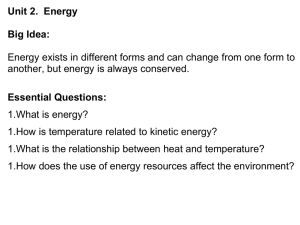
Power
... • Power is often measured in joules per second. The unit of measurement for power is the watt (W). One watt is equal to one joule of energy transferred in one second. ...
... • Power is often measured in joules per second. The unit of measurement for power is the watt (W). One watt is equal to one joule of energy transferred in one second. ...

forms of energy
... Stored mechanical energy is energy stored in objects by the application of a force. Compressed springs and stretched rubber bands are examples of stored mechanical energy. ...
... Stored mechanical energy is energy stored in objects by the application of a force. Compressed springs and stretched rubber bands are examples of stored mechanical energy. ...

chemical energy
... THERMAL ENERGY Thermal energy (or heat) is the internal energy in substances; it is the vibration and movement of atoms and molecules within substances. Geothermal energy is an example of thermal energy. ...
... THERMAL ENERGY Thermal energy (or heat) is the internal energy in substances; it is the vibration and movement of atoms and molecules within substances. Geothermal energy is an example of thermal energy. ...

Semester 1 Study Guide – Chemistry
... 16. This fossil fuel ________ was formed from the remains of plants that were buried and exposed to high pressure and heat over time. a. Coal b. Natural gas c. Diesel fuel d. Propane e. Gasoline 17. Natural gas consists mostly of a. Methane b. Ethane c. Propane d. Butane 18. Water is a greenhouse ga ...
... 16. This fossil fuel ________ was formed from the remains of plants that were buried and exposed to high pressure and heat over time. a. Coal b. Natural gas c. Diesel fuel d. Propane e. Gasoline 17. Natural gas consists mostly of a. Methane b. Ethane c. Propane d. Butane 18. Water is a greenhouse ga ...
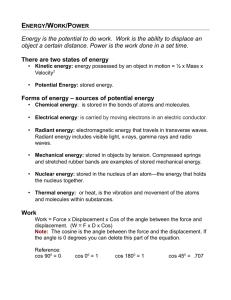
Energy is the potential to do work. Work is the ability to displace an
... Solar power (PV) has a very low power density. If 10% of the electricity generated in the US were to be produced by large PV plants, the area required would be about 5,500 km 2. Wind power has a power density that is lower than solar. If 10% of the US electricity generated were to be produced by lar ...
... Solar power (PV) has a very low power density. If 10% of the electricity generated in the US were to be produced by large PV plants, the area required would be about 5,500 km 2. Wind power has a power density that is lower than solar. If 10% of the US electricity generated were to be produced by lar ...

STUDY GUIDE Multiple Choice Identify the choice that best
... 44. Geologists could use which of the following to compare the age of sedimentary rock layers in Bryce Canyon with sedimentary rock layers in the Grand Canyon? a. radioactive isotopes c. relative dating b. index fossils d. all of the above ...
... 44. Geologists could use which of the following to compare the age of sedimentary rock layers in Bryce Canyon with sedimentary rock layers in the Grand Canyon? a. radioactive isotopes c. relative dating b. index fossils d. all of the above ...

Discovery Education Science Connection ΠElementary School
... associated with a dam, so the electricity is generated by the kinetic energy of falling water. While the water is stored behind the dam, the water has potential energy. The moving water causes generators at the plant to rotate. This movement produces an electrical current, which then moves through a ...
... associated with a dam, so the electricity is generated by the kinetic energy of falling water. While the water is stored behind the dam, the water has potential energy. The moving water causes generators at the plant to rotate. This movement produces an electrical current, which then moves through a ...

CableTEC Corona Treatment of Cables Advantages:
... adhesion properties of printing inks and coatings onto polymer cable insulations such as PE, PP, and PTFE. The in line treating system has been specifically designed by Tantec to facilitate easy installation to new or existing production lines. ...
... adhesion properties of printing inks and coatings onto polymer cable insulations such as PE, PP, and PTFE. The in line treating system has been specifically designed by Tantec to facilitate easy installation to new or existing production lines. ...


File
... How much work is required to lift a 100 kg crate uniformly through a vertical distance of 20 m? W = Fd First, we need to find the force. o Fw = mg o Fw = (100kg)(9.8m/s2) o Fw = 980 N Now, plug in Force into W=Fd o W = Fd o W = (980N)(20m) o W = 19,600 J ...
... How much work is required to lift a 100 kg crate uniformly through a vertical distance of 20 m? W = Fd First, we need to find the force. o Fw = mg o Fw = (100kg)(9.8m/s2) o Fw = 980 N Now, plug in Force into W=Fd o W = Fd o W = (980N)(20m) o W = 19,600 J ...

Energy - Denton ISD
... as they give off heat energy. • Cold objects in a warmer room will heat up to room temperature as they gain heat energy. ...
... as they give off heat energy. • Cold objects in a warmer room will heat up to room temperature as they gain heat energy. ...
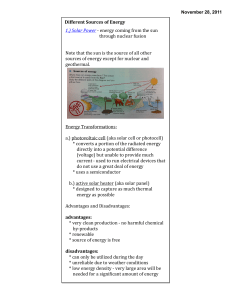

Potential vs. Kinetic Energy
... • http://www.youtube.com/watch?v=7K4V 0NvUxRg • http://www.youtube.com/watch?v=uO5L hU29udk ...
... • http://www.youtube.com/watch?v=7K4V 0NvUxRg • http://www.youtube.com/watch?v=uO5L hU29udk ...

Ch 4 Sect 2
... Machines also transfer chemical energy into kinetic energy Chemical energy used by machines is usually gas or diesel ...
... Machines also transfer chemical energy into kinetic energy Chemical energy used by machines is usually gas or diesel ...

Changing Energy Energy is the ability to do work. The many forms of
... Energy is the ability to do work. The many forms of energy include mechanical (including sound), electrical, thermal, light (radiant), chemical, and nuclear. These forms of energy can be separated into 2 types-Potential and Kinetic Energy. Potential energy is the stored energy of an object based on ...
... Energy is the ability to do work. The many forms of energy include mechanical (including sound), electrical, thermal, light (radiant), chemical, and nuclear. These forms of energy can be separated into 2 types-Potential and Kinetic Energy. Potential energy is the stored energy of an object based on ...

Kinetic energy - Cobb Learning
... Forms of Energy • Chemical – holds atoms and molecules together; released by chemical reactions • Electrical – movement of electrons through matter; electricity • Heat – vibration of particles within matter; faster = more heat • Light – energy carried by light; electromagnetic spectrum • Mechanical ...
... Forms of Energy • Chemical – holds atoms and molecules together; released by chemical reactions • Electrical – movement of electrons through matter; electricity • Heat – vibration of particles within matter; faster = more heat • Light – energy carried by light; electromagnetic spectrum • Mechanical ...

Physics 11 Unit Test – Energy and Society KNOWLEDGE 20 Marks
... 14. A heat ____________________ is a material that allows heat to transfer easily through it. Whereas a heat _________________, such as wood, doesn’t allow easy heat transfer between its molecules. 15. ________________________________ is the amount of heat energy that is needed to increase the tempe ...
... 14. A heat ____________________ is a material that allows heat to transfer easily through it. Whereas a heat _________________, such as wood, doesn’t allow easy heat transfer between its molecules. 15. ________________________________ is the amount of heat energy that is needed to increase the tempe ...

Conservation of energy - Gymnázium Slovanské náměstí
... B) energy nor force… C) work nor matter… D) work nor force… …with its surroundings ...
... B) energy nor force… C) work nor matter… D) work nor force… …with its surroundings ...

energyjaja - Ms. Harbour`s Class
... wave carries energy from one place to another. Frequency is how high or low the sound is. The waves on the top of the picture are a high-pitched sound because the waves are very close together, unlike the bottom one, which is a lower sound. ...
... wave carries energy from one place to another. Frequency is how high or low the sound is. The waves on the top of the picture are a high-pitched sound because the waves are very close together, unlike the bottom one, which is a lower sound. ...

Energy and Energy Resources
... What is the mechanical energy of a goose standing on a rock that has 75 J of potential energy and 60 J of kinetic energy? 75 + 60 = _______________ ...
... What is the mechanical energy of a goose standing on a rock that has 75 J of potential energy and 60 J of kinetic energy? 75 + 60 = _______________ ...


Energy - murraysphysical
... II. Conservation of Energy A. Energy conversions—energy changing from one _________ to another 1. Fuels store energy in the form of _______________________ energy. 2. ______________ energy—the total amount of potential and kinetic energy in a system B. Law of Conservation of Energy—Energy may change ...
... II. Conservation of Energy A. Energy conversions—energy changing from one _________ to another 1. Fuels store energy in the form of _______________________ energy. 2. ______________ energy—the total amount of potential and kinetic energy in a system B. Law of Conservation of Energy—Energy may change ...