energy - Doral Academy Preparatory
... consumed much faster than nature can recreate them. • Energy that cannot be replaced once it is used or energy that is not being replaced as fast as it is being used • Used to describe energy sources that exist in a limited amount on Earth. Thus all available material could eventually be completely ...
... consumed much faster than nature can recreate them. • Energy that cannot be replaced once it is used or energy that is not being replaced as fast as it is being used • Used to describe energy sources that exist in a limited amount on Earth. Thus all available material could eventually be completely ...

Mechanical Energy
... has significance only when it changes— when it does work or transforms to energy of some other type. ...
... has significance only when it changes— when it does work or transforms to energy of some other type. ...

File energy,conservation of energy,work,momentum
... A man expends 200 J of work to move a box up an inclined plane. The amount of work produced is 40 J. What is the efficiency of the inclined plane? Efficiency = (Wout/Win) x 100 % ...
... A man expends 200 J of work to move a box up an inclined plane. The amount of work produced is 40 J. What is the efficiency of the inclined plane? Efficiency = (Wout/Win) x 100 % ...
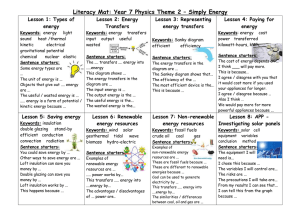
Theme 2 Simply Energ..
... Proper nouns need capital letters. These are unique people, places or things e.g. there are many cities so ‘city’ doesn’t take a capital letter. However there is only one London, therefore it takes a capital letter. Remember don’t mix up ‘was’ and ‘were.’ For example ‘I was (singular)’ and ‘We wer ...
... Proper nouns need capital letters. These are unique people, places or things e.g. there are many cities so ‘city’ doesn’t take a capital letter. However there is only one London, therefore it takes a capital letter. Remember don’t mix up ‘was’ and ‘were.’ For example ‘I was (singular)’ and ‘We wer ...
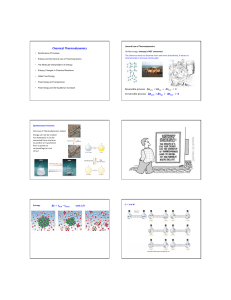

WORK DONE & ENERGY
... Work done • In everyday language,work may mean anything that people do. • In science,it is given a more precise meaning: ...
... Work done • In everyday language,work may mean anything that people do. • In science,it is given a more precise meaning: ...
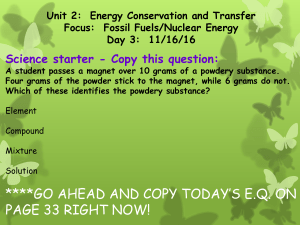


Slide 1
... 4. Distinguish between kinetic and potential energy 5. Classify different types of potential energy. 6. Calculate the potential energy associated with an object’s position. ...
... 4. Distinguish between kinetic and potential energy 5. Classify different types of potential energy. 6. Calculate the potential energy associated with an object’s position. ...

All Kinds of Energy
... didn’t fall on a mirror. That wouldn’t have been useful. Since the hammer was falling, it was moving, It had energy. It did work. But if it landed on a mirror, it would have changed it for the worse. Energy is the ability to do work or cause change. Work is done, or change occurs when energy is tran ...
... didn’t fall on a mirror. That wouldn’t have been useful. Since the hammer was falling, it was moving, It had energy. It did work. But if it landed on a mirror, it would have changed it for the worse. Energy is the ability to do work or cause change. Work is done, or change occurs when energy is tran ...

Dimensions of Energy - ASU Modeling Instruction
... Two objects or systems may be considered to be separate if the energy transferred between them is much larger than the energy stored due to their mutual interaction. ...
... Two objects or systems may be considered to be separate if the energy transferred between them is much larger than the energy stored due to their mutual interaction. ...
Energy transformation
... holding atoms together are broken. Energy is released as the bonds break. For example, when you burn a fuel (like coal) the chemical energy is release to create heat, light and mechanical energy. Other examples of chemical energy include a battery, wood, energy stored in your body. ...
... holding atoms together are broken. Energy is released as the bonds break. For example, when you burn a fuel (like coal) the chemical energy is release to create heat, light and mechanical energy. Other examples of chemical energy include a battery, wood, energy stored in your body. ...

Energy and Energy Resources
... D. Machines transform energy from one form to another. 1. Chemical energy can be transferred to kinetic, radiant, thermal, or electrical. 2. Electrical energy can be transformed to kinetic, chemical, electrical, or thermal energy. 3. Unlike other forms of energy, thermal energy is not easy ...
... D. Machines transform energy from one form to another. 1. Chemical energy can be transferred to kinetic, radiant, thermal, or electrical. 2. Electrical energy can be transformed to kinetic, chemical, electrical, or thermal energy. 3. Unlike other forms of energy, thermal energy is not easy ...

Video Notes #5 – Introduction to Energy
... released during a _______________ change. Examples of chemical energy include: The burning of the chemicals stored in fuel to make heat, using chemicals stored in batteries to operate a toy, the digestion of chemicals found in food to give living things energy (chemical energy is potential energy be ...
... released during a _______________ change. Examples of chemical energy include: The burning of the chemicals stored in fuel to make heat, using chemicals stored in batteries to operate a toy, the digestion of chemicals found in food to give living things energy (chemical energy is potential energy be ...

Energy - SchoolRack
... things) about using these resources? What are the cons (bad things) about using these resources? ...
... things) about using these resources? What are the cons (bad things) about using these resources? ...


ENERGY
... • Total amount of KE and PE in a system • As PE decreases, KE increases • As KE decreases, PE increases m g h 1 + ½ m v 12 = m g h 2 + ½ m v 22 Where h1 & v1 is height & velocity at start and h2 & v2 is height & velocity at end ...
... • Total amount of KE and PE in a system • As PE decreases, KE increases • As KE decreases, PE increases m g h 1 + ½ m v 12 = m g h 2 + ½ m v 22 Where h1 & v1 is height & velocity at start and h2 & v2 is height & velocity at end ...

matter
... concentration • The amount of material dissolved in a volume (measurement) of liquid. ...
... concentration • The amount of material dissolved in a volume (measurement) of liquid. ...
MSE 156 - Solar Cells, Fuel Cells and Batteries: Materials for the
... Macroscopically (and technologically) electrical energy is manifested as electrical currents driving loads. For example a current of one amp through a load of one ohm resistance operating for one second is our old friend a Joule. Electrical energy is also associated with fields (electrical and magne ...
... Macroscopically (and technologically) electrical energy is manifested as electrical currents driving loads. For example a current of one amp through a load of one ohm resistance operating for one second is our old friend a Joule. Electrical energy is also associated with fields (electrical and magne ...

Work, Power and Energy
... potential energy of an object. Horizontal forces cannot cause vertical displacements. The only means by which an external force can contribute to a potential energy change is if the force has a vertical component. Potential energy changes are the result of height changes and only a force with a vert ...
... potential energy of an object. Horizontal forces cannot cause vertical displacements. The only means by which an external force can contribute to a potential energy change is if the force has a vertical component. Potential energy changes are the result of height changes and only a force with a vert ...

Foods II Vocabulary 2.01 Chemistry – The study of the makeup
... 22. Electrical Energy – Energy produced by the movement of electrons. 23. Radiant Energy - Energy transmitted in the form of waves through space or some medium. 24. Microwave – A low-frequency electromagnetic wave of radiant energy. 25. Heat – An energy transfer from one body to another caused by a ...
... 22. Electrical Energy – Energy produced by the movement of electrons. 23. Radiant Energy - Energy transmitted in the form of waves through space or some medium. 24. Microwave – A low-frequency electromagnetic wave of radiant energy. 25. Heat – An energy transfer from one body to another caused by a ...

Energy – Where does it come from and why does it produce waste?
... • What forms does it come in & how do we use it? • Understand that ALL sources of energy have costs and benefits ...
... • What forms does it come in & how do we use it? • Understand that ALL sources of energy have costs and benefits ...

Earth Science
... that is available for release from chemical reactions. The chemical bonds in a matchstick store energy that is transformed into thermal energy when the match is struck. Food is chemical energy that our bodies require. ...
... that is available for release from chemical reactions. The chemical bonds in a matchstick store energy that is transformed into thermal energy when the match is struck. Food is chemical energy that our bodies require. ...