


Virus and Bacteria Unit Study Guide
... Compare the size of viruses, prokaryotic cells and eukaryotic cells. Outline the process of both the lytic and lysogenic cycle, understanding how the two are connected. Identify examples of viruses that go through the lytic/lysogenic cycles. Compare and contrast prokaryotic cells and eukaryotic cell ...
... Compare the size of viruses, prokaryotic cells and eukaryotic cells. Outline the process of both the lytic and lysogenic cycle, understanding how the two are connected. Identify examples of viruses that go through the lytic/lysogenic cycles. Compare and contrast prokaryotic cells and eukaryotic cell ...

College of Medicine Microbiology
... cells are inactive(inert). Therefore viruses fall at linked between living and nonliving things. Viruses can not grow on inanimate culture media(non-living), but grow in tissue cultures(living cells). 4. Viruses can not replicate by binary fission or mitosis ,but they replicate by complex process ...
... cells are inactive(inert). Therefore viruses fall at linked between living and nonliving things. Viruses can not grow on inanimate culture media(non-living), but grow in tissue cultures(living cells). 4. Viruses can not replicate by binary fission or mitosis ,but they replicate by complex process ...


Virus
... in living host cell, and cause disease. · The term virus, which come from the Latin word for poison. · Because the viruses pass through bacterial filters, therefore the viruses were known as (filterable viruses). But some bacteria may be smaller than largest virus, filterability is no longer regarde ...
... in living host cell, and cause disease. · The term virus, which come from the Latin word for poison. · Because the viruses pass through bacterial filters, therefore the viruses were known as (filterable viruses). But some bacteria may be smaller than largest virus, filterability is no longer regarde ...

Chapter 7: Principle of Diseases
... Herd immunity for polio is high. The polio vaccine is routinely administered to children ...
... Herd immunity for polio is high. The polio vaccine is routinely administered to children ...

Teacher
... Messenger RNAs are translated on host ribosomes and all five viral proteins made at the same time. c. RNA REPLICATION d. New negative strands may: (3).Retroviruses ...
... Messenger RNAs are translated on host ribosomes and all five viral proteins made at the same time. c. RNA REPLICATION d. New negative strands may: (3).Retroviruses ...

Unit 3 Microorganisms Viruses Bacteria Protists Fungi PowerPoint
... • Once inside a cell, a virus’s genetic material takes over many of the cell’s functions. • It instructs the cell to produce the virus’s proteins and genetic material. • These proteins and genetic materials then assemble into new viruses. ...
... • Once inside a cell, a virus’s genetic material takes over many of the cell’s functions. • It instructs the cell to produce the virus’s proteins and genetic material. • These proteins and genetic materials then assemble into new viruses. ...

Chapter 18: Infectious Diseases Affecting the Skin and Eyes
... B) Chickenpox symptoms include fever and a rash consisting of macules (small red spots), papules (little bumps), vesicles (small blisters), and finally pustules (pusfilled blisters) 1) The pustules eventually crust over and fall off (scars may occur) 2) The rash radiates in sparse crops to the extr ...
... B) Chickenpox symptoms include fever and a rash consisting of macules (small red spots), papules (little bumps), vesicles (small blisters), and finally pustules (pusfilled blisters) 1) The pustules eventually crust over and fall off (scars may occur) 2) The rash radiates in sparse crops to the extr ...

Chapter 20 Viruses, Bacteria, and Archaea
... an infectious agent smaller than a bacterium existed. With the invention of the electron microscope, these infectious agents could be seen for the first time. ...
... an infectious agent smaller than a bacterium existed. With the invention of the electron microscope, these infectious agents could be seen for the first time. ...


Replication of Viruses
... virus particle becomes infectious; nucleic acids and capsids are assembled together. ...
... virus particle becomes infectious; nucleic acids and capsids are assembled together. ...

Viruses
... reproduce if they are inside a living cell. Do you think viruses evolved before living things or after? Explain your reasoning. Viral Diseases Like a military base, our bodies have many defenses to prevent viruses from infecting our cells. The skin and the mucus lining the respiratory tract help pre ...
... reproduce if they are inside a living cell. Do you think viruses evolved before living things or after? Explain your reasoning. Viral Diseases Like a military base, our bodies have many defenses to prevent viruses from infecting our cells. The skin and the mucus lining the respiratory tract help pre ...

Chapter 12: The Viruses and Virus
... • Transmissible spongiform ecephalopathies (TSEs) can occur in humans and other animals • For example, mad cow disease • TSEs are neurologic degenerative diseases that can be transmitted within or between species • Originally, scientists believed TSEs were caused by a virus • Stanley Prusiner discov ...
... • Transmissible spongiform ecephalopathies (TSEs) can occur in humans and other animals • For example, mad cow disease • TSEs are neurologic degenerative diseases that can be transmitted within or between species • Originally, scientists believed TSEs were caused by a virus • Stanley Prusiner discov ...

“Ne`er the Twain Shall Meet” and Other Great Lies
... • This is just one of many examples. • Same principles apply to the emergence of influenza, MERS-CoV, Ebola, Lyme disease, WNV, malaria etc…. • Emerging diseases are inevitably part of the complex ecosystem we live in. ...
... • This is just one of many examples. • Same principles apply to the emergence of influenza, MERS-CoV, Ebola, Lyme disease, WNV, malaria etc…. • Emerging diseases are inevitably part of the complex ecosystem we live in. ...
Young Person`s Frequently Asked Questions
... simple blood test can detect these antibodies in your blood, and tell if you have had a blood-borne virus. These antibodies can stay in your body even if the virus is cleared. This means that testing positive for antibodies does not necessarily mean that the virus is still there. An ‘antigen’ is a p ...
... simple blood test can detect these antibodies in your blood, and tell if you have had a blood-borne virus. These antibodies can stay in your body even if the virus is cleared. This means that testing positive for antibodies does not necessarily mean that the virus is still there. An ‘antigen’ is a p ...

Characterization of opsonizing antibodies against FMD virus, A. Summerfield
... Group 1: 4 animals full dose vaccine Group 2: 5 animals 1/4 dose Group 3: 5 animals 1/20 dose ...
... Group 1: 4 animals full dose vaccine Group 2: 5 animals 1/4 dose Group 3: 5 animals 1/20 dose ...

1. dia - Figshare
... role in the speciation and evolution of many strains. It also has particular significance for the risk assessment of plants that have been genetically modified for disease resistance by incorporating viral sequences into plant genomes. In the world of RNA viruses the source of recombination during r ...
... role in the speciation and evolution of many strains. It also has particular significance for the risk assessment of plants that have been genetically modified for disease resistance by incorporating viral sequences into plant genomes. In the world of RNA viruses the source of recombination during r ...

Sheet no.: Last year slides, Medical Virology
... there are dengue viruses which is also related to tropical countries which can produce a thousand to a million case of infections only by the inoculation of the virus to the skin by the insect bite. Don’t forget that viruses are not only transmitted from virus aerosols to the respiratory tract by in ...
... there are dengue viruses which is also related to tropical countries which can produce a thousand to a million case of infections only by the inoculation of the virus to the skin by the insect bite. Don’t forget that viruses are not only transmitted from virus aerosols to the respiratory tract by in ...

What is meningitis? - Kenston Local Schools
... • Meningitis is an infection of the fluid in the spinal cord and the fluid that surrounds the brain. Meningitis is usually caused by an infection with a virus, with a bacterium or even with fungi. ...
... • Meningitis is an infection of the fluid in the spinal cord and the fluid that surrounds the brain. Meningitis is usually caused by an infection with a virus, with a bacterium or even with fungi. ...

Lecture #2 PPT
... characterized by chitin and B-glucans in the cell wall, feeding through absorption, reproducing by spores and producing a vegetative structure made up of tubular structures,branched, irregular, and indefinite in growth (modified from B. Kendric 1992) ...
... characterized by chitin and B-glucans in the cell wall, feeding through absorption, reproducing by spores and producing a vegetative structure made up of tubular structures,branched, irregular, and indefinite in growth (modified from B. Kendric 1992) ...
General Medical Microbiology and Infectious Disease
... BLACKBOARD TO STUDY THIS MATERIAL): entry into the human body; adhesion, colonization & invasion; pathogenic actions of bacteria (tissue destruction, toxins, immunopathogenesis); mechanisms for escaping host defenses; spread of disease in populations, reservoirs of infection (human, animal, and non- ...
... BLACKBOARD TO STUDY THIS MATERIAL): entry into the human body; adhesion, colonization & invasion; pathogenic actions of bacteria (tissue destruction, toxins, immunopathogenesis); mechanisms for escaping host defenses; spread of disease in populations, reservoirs of infection (human, animal, and non- ...
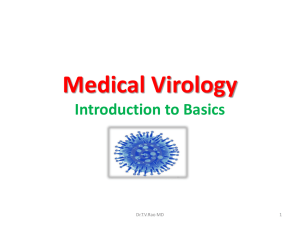

Antiviral Drugs
... • Nucleoside analogs act as competitive inhibitors and dideoxys prevent chain elongation • Non-nucleosides bind at other site, inhibit – Protease inhibitors prevent protein processing – Fusion inhibitors (subcut inj only) – Always given in combination ...
... • Nucleoside analogs act as competitive inhibitors and dideoxys prevent chain elongation • Non-nucleosides bind at other site, inhibit – Protease inhibitors prevent protein processing – Fusion inhibitors (subcut inj only) – Always given in combination ...
Social history of viruses

The social history of viruses describes the influence of viruses and viral infections on human history. Epidemics caused by viruses began when human behaviour changed during the Neolithic period, around 12,000 years ago, when humans developed more densely populated agricultural communities. This allowed viruses to spread rapidly and subsequently to become endemic. Viruses of plants and livestock also increased, and as humans became dependent on agriculture and farming, diseases such as potyviruses of potatoes and rinderpest of cattle had devastating consequences.Smallpox and measles viruses are among the oldest that infect humans. Having evolved from viruses that infected other animals, they first appeared in humans in Europe and North Africa thousands of years ago. The viruses were later carried to the New World by Europeans during the time of the Spanish Conquests, but the indigenous people had no natural resistance to the viruses and millions of them died during epidemics. Influenza pandemics have been recorded since 1580, and they have occurred with increasing frequency in subsequent centuries. The pandemic of 1918–19, in which 40–50 million died in less than a year, was one of the most devastating in history.Louis Pasteur and Edward Jenner were the first to develop vaccines to protect against viral infections. The nature of viruses remained unknown until the invention of the electron microscope in the 1930s, when the science of virology gained momentum. In the 20th century many diseases both old and new were found to be caused by viruses. There were epidemics of poliomyelitis that were only controlled following the development of a vaccine in the 1950s. HIV is one of the most pathogenic new viruses to have emerged in centuries. Although scientific interest in them arose because of the diseases they cause, most viruses are beneficial. They drive evolution by transferring genes across species, play important roles in ecosystems and are essential to life.