
Taxonomy/Microorganisms Test Review Sheet Name: Please
... 20. List the Six Kingdoms. Know the basic characteristics of each of the six kingdoms. Example: Correctly identify the kingdom whose members exhibit these traits: multicellular, true nucleus, possess cell walls, must obtain food, representative organisms include mushrooms and yeast? OR Multicellular ...
... 20. List the Six Kingdoms. Know the basic characteristics of each of the six kingdoms. Example: Correctly identify the kingdom whose members exhibit these traits: multicellular, true nucleus, possess cell walls, must obtain food, representative organisms include mushrooms and yeast? OR Multicellular ...
Viruses - Elgin Local Schools
... Viral Specificity and Adaptation - Infections are highly specific (animal viruses, bacterial viruses, etc.) - Viruses evolve to “jump” species lines - Evolution occurs when the virus takes up DNA from host ...
... Viral Specificity and Adaptation - Infections are highly specific (animal viruses, bacterial viruses, etc.) - Viruses evolve to “jump” species lines - Evolution occurs when the virus takes up DNA from host ...
Viruses - Elgin Local Schools
... Viral Specificity and Adaptation - Infections are highly specific (animal viruses, bacterial viruses, etc.) - Viruses evolve to “jump” species lines - Evolution occurs when the virus takes up DNA from host ...
... Viral Specificity and Adaptation - Infections are highly specific (animal viruses, bacterial viruses, etc.) - Viruses evolve to “jump” species lines - Evolution occurs when the virus takes up DNA from host ...
Viruses - saddlespace.org
... How can a viral infection be cured? • There is NO cure for a viral infection. • Vaccines must be taken before you are infected! • Once infected, body must fight off the infection. ...
... How can a viral infection be cured? • There is NO cure for a viral infection. • Vaccines must be taken before you are infected! • Once infected, body must fight off the infection. ...
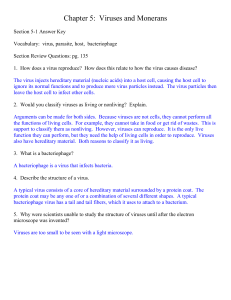
Chapter 5: Viruses and Monerans
... ignore its normal functions and to produce more virus particles instead. The virus particles then leave the host cell to infect other cells. 2. Would you classify viruses as living or nonliving? Explain. Arguments can be made for both sides. Because viruses are not cells, they cannot perform all the ...
... ignore its normal functions and to produce more virus particles instead. The virus particles then leave the host cell to infect other cells. 2. Would you classify viruses as living or nonliving? Explain. Arguments can be made for both sides. Because viruses are not cells, they cannot perform all the ...
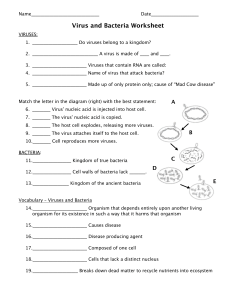
BACTERIA - Virus and Bacteria worksheet
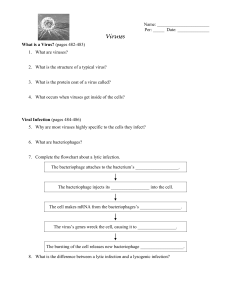
... 1. ____________________ Do viruses belong to a kingdom? 2. _____________________________ A virus is made of ____ and ____. 3. ________________________ Viruses that contain RNA are called: 4. ________________________ Name of virus that attack bacteria? 5. ________________________ Made up of only ...
... 1. ____________________ Do viruses belong to a kingdom? 2. _____________________________ A virus is made of ____ and ____. 3. ________________________ Viruses that contain RNA are called: 4. ________________________ Name of virus that attack bacteria? 5. ________________________ Made up of only ...
Our selections for Fall 2005
... – Virus tricks cell into preparing for cell division • Protein E7 binds to pRB – Leads to greater susceptibility to cancer, particularly ...
... – Virus tricks cell into preparing for cell division • Protein E7 binds to pRB – Leads to greater susceptibility to cancer, particularly ...


Intro to Virology: March 15 2009
... 1915 Twort and dHerell identify bacteriophages viruses that infect bacteria 1935 Wendell Stanley crystalised tobbacco mosaic virus learned about the form and shape of the virus. Present: geonomic analyses, virus host interactions, genetic manipulations treatment and prevention fall short. 8. Sars di ...
... 1915 Twort and dHerell identify bacteriophages viruses that infect bacteria 1935 Wendell Stanley crystalised tobbacco mosaic virus learned about the form and shape of the virus. Present: geonomic analyses, virus host interactions, genetic manipulations treatment and prevention fall short. 8. Sars di ...

Contagion Worksheet
... 2. What U.S. government agency tracks diseases here in the U.S. (and monitors world diseases as well)? ...
... 2. What U.S. government agency tracks diseases here in the U.S. (and monitors world diseases as well)? ...

viruses - Helena High School
... Infections- disease that can be transmitted from animals to people (rabies, SARS, influenza, Lyme disease) ...
... Infections- disease that can be transmitted from animals to people (rabies, SARS, influenza, Lyme disease) ...

Unit Vocabulary: Diseases
... Unit Vocabulary: Diseases For each word below, complete the Definition, Examples, and Sentence boxes of the Frayer Models. ...
... Unit Vocabulary: Diseases For each word below, complete the Definition, Examples, and Sentence boxes of the Frayer Models. ...
20.1 viruses - OG
... 2. Viruses are particles of nucleic acid, protein and some cases lipids that can reproduce only by infecting living cells. ...
... 2. Viruses are particles of nucleic acid, protein and some cases lipids that can reproduce only by infecting living cells. ...
Viruses - Mr. Enns
... reproduce ONLY inside a host cell. Viruses seem to be living because they can infect us and spread… ….but a virus has no nucleus and no organelles So its not classed as living! ...
... reproduce ONLY inside a host cell. Viruses seem to be living because they can infect us and spread… ….but a virus has no nucleus and no organelles So its not classed as living! ...
viruses - Spanish Point Biology
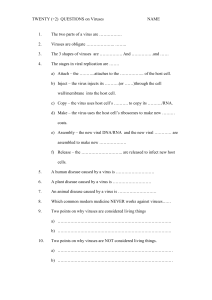
... b) Inject – the virus injects its ……….(or ……)through the cell wall/membrane into the host cell. c) Copy – the virus uses host cell’s ………. to copy its ………./RNA. d) Make – the virus uses the host cell’s ribosomes to make new ……… coats. e) Assembly – the new viral DNA/RNA and the new viral ………… are ass ...
... b) Inject – the virus injects its ……….(or ……)through the cell wall/membrane into the host cell. c) Copy – the virus uses host cell’s ………. to copy its ………./RNA. d) Make – the virus uses the host cell’s ribosomes to make new ……… coats. e) Assembly – the new viral DNA/RNA and the new viral ………… are ass ...
Social history of viruses

The social history of viruses describes the influence of viruses and viral infections on human history. Epidemics caused by viruses began when human behaviour changed during the Neolithic period, around 12,000 years ago, when humans developed more densely populated agricultural communities. This allowed viruses to spread rapidly and subsequently to become endemic. Viruses of plants and livestock also increased, and as humans became dependent on agriculture and farming, diseases such as potyviruses of potatoes and rinderpest of cattle had devastating consequences.Smallpox and measles viruses are among the oldest that infect humans. Having evolved from viruses that infected other animals, they first appeared in humans in Europe and North Africa thousands of years ago. The viruses were later carried to the New World by Europeans during the time of the Spanish Conquests, but the indigenous people had no natural resistance to the viruses and millions of them died during epidemics. Influenza pandemics have been recorded since 1580, and they have occurred with increasing frequency in subsequent centuries. The pandemic of 1918–19, in which 40–50 million died in less than a year, was one of the most devastating in history.Louis Pasteur and Edward Jenner were the first to develop vaccines to protect against viral infections. The nature of viruses remained unknown until the invention of the electron microscope in the 1930s, when the science of virology gained momentum. In the 20th century many diseases both old and new were found to be caused by viruses. There were epidemics of poliomyelitis that were only controlled following the development of a vaccine in the 1950s. HIV is one of the most pathogenic new viruses to have emerged in centuries. Although scientific interest in them arose because of the diseases they cause, most viruses are beneficial. They drive evolution by transferring genes across species, play important roles in ecosystems and are essential to life.