
Evolutionary Dynamics of Nitrogen Fixation in the Legume–Rhizobia
... in a frequency-dependent manner according to Eq. (1), change in their nitrogen fixation ability by mutation, and are released back to the soil following the death of their host plants (Eq. (4)). Proliferation of colonized rhizobia is driven by the benefit (promoting force) and cost (destabilizing fo ...
... in a frequency-dependent manner according to Eq. (1), change in their nitrogen fixation ability by mutation, and are released back to the soil following the death of their host plants (Eq. (4)). Proliferation of colonized rhizobia is driven by the benefit (promoting force) and cost (destabilizing fo ...

Final Review - Houston ISD
... Identify the main functions of the cell membrane and the cell wall Explain the processes of diffusion, osmosis, facilitated diffusion, and active transport Describe cell specialization Identify the organization levels in multicellular organisms Chapter 8: Photosynthesis Explain where plants get the ...
... Identify the main functions of the cell membrane and the cell wall Explain the processes of diffusion, osmosis, facilitated diffusion, and active transport Describe cell specialization Identify the organization levels in multicellular organisms Chapter 8: Photosynthesis Explain where plants get the ...
Bully for Brontosaurus - A Website About Stephen Jay Gould`s
... salesmen to produce the word “TYPEWRITER,” then a brand name, using only keys in the top row. These attributes suggest a degree of contingency in this particular layout; the keys are not ordered at random, but there is a certain amount of what appears to be “chance” that Gould also sees in biologica ...
... salesmen to produce the word “TYPEWRITER,” then a brand name, using only keys in the top row. These attributes suggest a degree of contingency in this particular layout; the keys are not ordered at random, but there is a certain amount of what appears to be “chance” that Gould also sees in biologica ...
The Natures of Selection
... Are drift and selection forces? It is best not to phrase the question as bluntly as this. Instead, one should simply ask in what respects drift and selection resemble Newtonian forces, and in what ways they differ, paying attention all the time to the dangers of a seductive metaphor. Christopher Ste ...
... Are drift and selection forces? It is best not to phrase the question as bluntly as this. Instead, one should simply ask in what respects drift and selection resemble Newtonian forces, and in what ways they differ, paying attention all the time to the dangers of a seductive metaphor. Christopher Ste ...

Evolution Practice
... 12. Genetic dri" is most likely to result when a single population splits in two, and (1 point) (0 pts) the two populations are large and roughly equal in size. (1 pt) one of the populations is very small. (0 pts) the two populations have the same gene frequencies in the gene pool. (0 pts) the envir ...
... 12. Genetic dri" is most likely to result when a single population splits in two, and (1 point) (0 pts) the two populations are large and roughly equal in size. (1 pt) one of the populations is very small. (0 pts) the two populations have the same gene frequencies in the gene pool. (0 pts) the envir ...
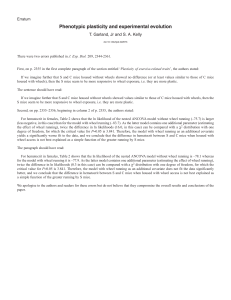
Phenotypic plasticity and experimental evolution
... difference in population mean phenotype between generations one (G1) and two (G2) indicates that evolution has occurred (assuming that the environment in which the organisms are living has not changed in a way that causes the altered phenotypes via direct environmental effects). This process continu ...
... difference in population mean phenotype between generations one (G1) and two (G2) indicates that evolution has occurred (assuming that the environment in which the organisms are living has not changed in a way that causes the altered phenotypes via direct environmental effects). This process continu ...
PDF file - Department of Biology
... difference in population mean phenotype between generations one (G1) and two (G2) indicates that evolution has occurred (assuming that the environment in which the organisms are living has not changed in a way that causes the altered phenotypes via direct environmental effects). This process continu ...
... difference in population mean phenotype between generations one (G1) and two (G2) indicates that evolution has occurred (assuming that the environment in which the organisms are living has not changed in a way that causes the altered phenotypes via direct environmental effects). This process continu ...
Richardson and Chipman 2003
... that they have evolved moveable abdominal lobes, at least twice independently, in response to sexual selection. Such lobes are rare or absent in other dipterans. He concluded that the absence of such lobes in most Diptera is due to lack of selection, not constraint. However, Wagner and Müller (2002 ...
... that they have evolved moveable abdominal lobes, at least twice independently, in response to sexual selection. Such lobes are rare or absent in other dipterans. He concluded that the absence of such lobes in most Diptera is due to lack of selection, not constraint. However, Wagner and Müller (2002 ...
Marty Ferris
... suggest that ' the design criterion can thus be invoked when the link between environmental and phenotypic change is predictable, but improbable enough that it must have been shaped by selection.' This seems like a pretty fuzzy way of determining when this criterion can be used or not. They return t ...
... suggest that ' the design criterion can thus be invoked when the link between environmental and phenotypic change is predictable, but improbable enough that it must have been shaped by selection.' This seems like a pretty fuzzy way of determining when this criterion can be used or not. They return t ...
A Comparative Genomic Study of Human and Chimpanzee
... 7.1 Distribution of Disease-Associated Mutations in p53 . . . . . . . 7.2 Characterization of Selective Constraints on p53 Codon Sites . . 7.3 Mapping Selective Pressures in the Structure of p53 . . . . . . . 7.4 Selective Pressures and Mutations Associated with Cancer in p53 7.5 Testing Association ...
... 7.1 Distribution of Disease-Associated Mutations in p53 . . . . . . . 7.2 Characterization of Selective Constraints on p53 Codon Sites . . 7.3 Mapping Selective Pressures in the Structure of p53 . . . . . . . 7.4 Selective Pressures and Mutations Associated with Cancer in p53 7.5 Testing Association ...
ENCYCLOPEDIA OF Evolution
... category of formal causes separate from the efficient causes. The idea that organisms are perfectly adapted to their environments predates evolutionary theory. This idea was central to natural theology in which the perfect fit of organism and environment was considered evidence of di ...
... category of formal causes separate from the efficient causes. The idea that organisms are perfectly adapted to their environments predates evolutionary theory. This idea was central to natural theology in which the perfect fit of organism and environment was considered evidence of di ...
Course Outline - Gavilan College
... selection and explain how it can lead to sexual dimorphism. Assignments: read text, answer homework questions. Lab Topic: Agents of Evolution; Objectives: 1. Use the Hardy-Weinberg Equilibrium to demonstrate the effects of natural selection, gene flow and genetic drift on a population. 2. Explain h ...
... selection and explain how it can lead to sexual dimorphism. Assignments: read text, answer homework questions. Lab Topic: Agents of Evolution; Objectives: 1. Use the Hardy-Weinberg Equilibrium to demonstrate the effects of natural selection, gene flow and genetic drift on a population. 2. Explain h ...

3 pts - Ionia Public Schools
... Name two reasons the publication of Origin of the Species succeeded in changing the direction of scientific thought when other proposals by other men had failed? (1. It gave a logical stepwise presentation of ideas 2. the examples involved domesticated animals and plants, which were familiar and rea ...
... Name two reasons the publication of Origin of the Species succeeded in changing the direction of scientific thought when other proposals by other men had failed? (1. It gave a logical stepwise presentation of ideas 2. the examples involved domesticated animals and plants, which were familiar and rea ...

Final Review - Houston ISD
... Identify the main functions of the cell membrane and the cell wall Explain the processes of diffusion, osmosis, facilitated diffusion, and active transport Describe cell specialization Identify the organization levels in multicellular organisms Chapter 8: Photosynthesis Explain where plants get the ...
... Identify the main functions of the cell membrane and the cell wall Explain the processes of diffusion, osmosis, facilitated diffusion, and active transport Describe cell specialization Identify the organization levels in multicellular organisms Chapter 8: Photosynthesis Explain where plants get the ...
- CUNY Academic Works
... Since the cause of variation is unknown we can not be certain that it is random; Darwinism supposes that there is neither mutation pressure to expand into ecological niches, nor mutations which arise directly in response to environmental stimuli; natural selection supposedly acts on existing variati ...
... Since the cause of variation is unknown we can not be certain that it is random; Darwinism supposes that there is neither mutation pressure to expand into ecological niches, nor mutations which arise directly in response to environmental stimuli; natural selection supposedly acts on existing variati ...
Chapter 6
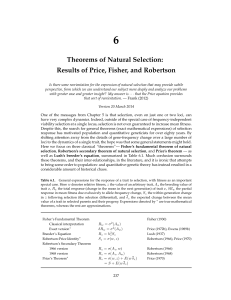
... generally induces complications and makes the theoretician’s job challenging. This can be seen in Table 6.1 by simply comparing the exact Robertson-Price result for within-generation change with results for cross-generational change. The surprising result is not that Fisher’s and Robertson’s theorem ...
... generally induces complications and makes the theoretician’s job challenging. This can be seen in Table 6.1 by simply comparing the exact Robertson-Price result for within-generation change with results for cross-generational change. The surprising result is not that Fisher’s and Robertson’s theorem ...
Phenotypic plasticity of phages with diverse genome sizes
... set of interactions between what appears to be regulatory and structural genes. With empirical data only recently becoming more readily available, the modelling of plastic responses are often still founded on the theoretical predictions and assumptions for which there is little proof. To bridge the ...
... set of interactions between what appears to be regulatory and structural genes. With empirical data only recently becoming more readily available, the modelling of plastic responses are often still founded on the theoretical predictions and assumptions for which there is little proof. To bridge the ...
Rapid evolution of adaptive niche construction
... subjected to frequent resetting of environmental conditions and severe reduction of spatial habitat structure, both of which are thought to make adaptive niche construction difficult to evolve. Our finding that adaptive niche construction nevertheless evolved repeatably suggests that it may play a m ...
... subjected to frequent resetting of environmental conditions and severe reduction of spatial habitat structure, both of which are thought to make adaptive niche construction difficult to evolve. Our finding that adaptive niche construction nevertheless evolved repeatably suggests that it may play a m ...

Reprint
... 2002b; Ferriere et al. 2002; Sachs and Simms 2006; Ferriere et al. 2007), the dynamics of trait evolution within mutualistic symbioses have received less attention. For example, some traits are emergent properties of interspecific interactions occurring within a symbiosis (Wade 2003, 2007; Whitham e ...
... 2002b; Ferriere et al. 2002; Sachs and Simms 2006; Ferriere et al. 2007), the dynamics of trait evolution within mutualistic symbioses have received less attention. For example, some traits are emergent properties of interspecific interactions occurring within a symbiosis (Wade 2003, 2007; Whitham e ...
Review Phenotypic plasticity and experimental evolution
... difference in population mean phenotype between generations one (G1) and two (G2) indicates that evolution has occurred (assuming that the environment in which the organisms are living has not changed in a way that causes the altered phenotypes via direct environmental effects). This process continu ...
... difference in population mean phenotype between generations one (G1) and two (G2) indicates that evolution has occurred (assuming that the environment in which the organisms are living has not changed in a way that causes the altered phenotypes via direct environmental effects). This process continu ...

Chapter 7 - New Underwood School District
... • What Is a Species? A species is a group of organisms that can mate with one another to produce fertile offspring. A characteristic that helps an organism survive and reproduce in its environment is called an adaptation. ...
... • What Is a Species? A species is a group of organisms that can mate with one another to produce fertile offspring. A characteristic that helps an organism survive and reproduce in its environment is called an adaptation. ...

Stephen E - lundslaktare
... "Long before the reader has arrived at this part of my work, a crowd of difficulties will have occurred to him. Some of them are so serious that to this day I can hardly reflect on them without being in some degree staggered; but, to the best of my judgment, the greater number are only apparent, and ...
... "Long before the reader has arrived at this part of my work, a crowd of difficulties will have occurred to him. Some of them are so serious that to this day I can hardly reflect on them without being in some degree staggered; but, to the best of my judgment, the greater number are only apparent, and ...
Divergent Evolution through Cumulative Segregation.
... districts which present essentially the same environment. As my observations extended, I became more and more impressed with the improbability that these divergences had been caused by differences in the environment. It waR not easy to prove that sexual selection had no influence; but, owing to the ...
... districts which present essentially the same environment. As my observations extended, I became more and more impressed with the improbability that these divergences had been caused by differences in the environment. It waR not easy to prove that sexual selection had no influence; but, owing to the ...

Are Random Drift and Natural Selection - Philsci
... indiscriminate parent sampling. This contrasts with alternative scenarios in which physical differences do play a causal role in the differences in reproductive success. Suppose, for example, that the predator was not colorblind, and that in this particular environment the predator was able to see t ...
... indiscriminate parent sampling. This contrasts with alternative scenarios in which physical differences do play a causal role in the differences in reproductive success. Suppose, for example, that the predator was not colorblind, and that in this particular environment the predator was able to see t ...
Parameter Control in Evolutionary Algorithms:Trends and Challenges
... even in the GA community, [196], [198], [211], but there was no unifying vision and generally adopted terminology. Some authors recognized the importance of these issues and offered a (partial) solution, see [9], [197], but these attempts did not receive the attention they deserved. The situation ch ...
... even in the GA community, [196], [198], [211], but there was no unifying vision and generally adopted terminology. Some authors recognized the importance of these issues and offered a (partial) solution, see [9], [197], but these attempts did not receive the attention they deserved. The situation ch ...