Move to the rhythm: oscillations in the subthalamic nucleus–external
... completely for STN neurons. In these neurons, voltage-gated Na+ channels that inactivate slowly are the primary source of current during the depolarizing phase of the oscillation [57–58]. The period and precision of the oscillation are controlled, at least in part, by an apamin-sensitive Ca2+-depend ...
... completely for STN neurons. In these neurons, voltage-gated Na+ channels that inactivate slowly are the primary source of current during the depolarizing phase of the oscillation [57–58]. The period and precision of the oscillation are controlled, at least in part, by an apamin-sensitive Ca2+-depend ...
Anxiolytic action on the behavioural inhibition system implies
... Eichenbaum case). This emphasis on processing as opposed to storage brings these recent theories very close to the updated version of our theory (see below). But they universally see the hippocampal formation as aiding the production of certain types of true memories; whereas, we see it as aiding th ...
... Eichenbaum case). This emphasis on processing as opposed to storage brings these recent theories very close to the updated version of our theory (see below). But they universally see the hippocampal formation as aiding the production of certain types of true memories; whereas, we see it as aiding th ...
the amygdala and reward
... That is, like normal monkeys, they show stable preferences among a set of food items. Similarly, they can acquire object preferences for items that have been associated with particular foods18. These findings, considered together, provide clear evidence that the amygdala is not important for all rew ...
... That is, like normal monkeys, they show stable preferences among a set of food items. Similarly, they can acquire object preferences for items that have been associated with particular foods18. These findings, considered together, provide clear evidence that the amygdala is not important for all rew ...
THE AMYGDALA AND REWARD
... That is, like normal monkeys, they show stable preferences among a set of food items. Similarly, they can acquire object preferences for items that have been associated with particular foods18. These findings, considered together, provide clear evidence that the amygdala is not important for all rew ...
... That is, like normal monkeys, they show stable preferences among a set of food items. Similarly, they can acquire object preferences for items that have been associated with particular foods18. These findings, considered together, provide clear evidence that the amygdala is not important for all rew ...
A Test of an Interactive Model of
... Despite the paucity of research on disordered eating symptoms in adult women, there is evidence to support their existence. For example, at least six case reports of recent-onset bulimia in women over 55 years old have been published (Hsu & Zimmer, 1988; Jonas, Pope, Hudson, & Satlin, 1984). In an A ...
... Despite the paucity of research on disordered eating symptoms in adult women, there is evidence to support their existence. For example, at least six case reports of recent-onset bulimia in women over 55 years old have been published (Hsu & Zimmer, 1988; Jonas, Pope, Hudson, & Satlin, 1984). In an A ...
Serotonin in the inferior colliculus fluctuates with behavioral state
... variability in 5-HT regulatory mechanisms means that in order to determine the conditions in which 5-HT has an elevated effect on auditory processing, extracellular 5-HT must be measured directly within the auditory system. Concentrations of extracellular 5-HT in the brain are not only region-specif ...
... variability in 5-HT regulatory mechanisms means that in order to determine the conditions in which 5-HT has an elevated effect on auditory processing, extracellular 5-HT must be measured directly within the auditory system. Concentrations of extracellular 5-HT in the brain are not only region-specif ...

A Functional Magnetic Resonance Imaging Study to
... these findings: lack of sensitivity in the scales used to record pain- and movement- related fear, undisclosed or unrecognized fears, painful movements not defined in the questionnaires, and/ or the physical capacity task chosen may not to tap into an individual’s specific fears [32]. To improve und ...
... these findings: lack of sensitivity in the scales used to record pain- and movement- related fear, undisclosed or unrecognized fears, painful movements not defined in the questionnaires, and/ or the physical capacity task chosen may not to tap into an individual’s specific fears [32]. To improve und ...
Depression of Acetylcholinesterase Synthesis Following Transient
... a number of studies yielded controversial results concerning AChE changes in ischemic bram AChE activity was significantly reduced in gerbil brain after the occlusion of the common carotid arteries (Mrsulja et al 1978), whereas increased AChE activity has been reported in the infarcted bram cortex a ...
... a number of studies yielded controversial results concerning AChE changes in ischemic bram AChE activity was significantly reduced in gerbil brain after the occlusion of the common carotid arteries (Mrsulja et al 1978), whereas increased AChE activity has been reported in the infarcted bram cortex a ...
How Do Short-Term Changes at Synapses Fine
... of ions, molecules, and membranes as part of the signaling event, as well as during recovery from a signaling event. These mechanistic constraints limit the time scale at which synaptic transmission can function and dynamically alter the amplitudes of synaptic responses in ways that depend on recent ...
... of ions, molecules, and membranes as part of the signaling event, as well as during recovery from a signaling event. These mechanistic constraints limit the time scale at which synaptic transmission can function and dynamically alter the amplitudes of synaptic responses in ways that depend on recent ...
Axonal Dopamine Receptors Activate Peripheral Spike
... Dopamine elicited tonic “extraburst” spiking in PD neurons and increased the cycle frequency of the pyloric rhythm In H. americanus, when the modulatory input from the CoGs and the OG to the STG is removed by blocking impulse activity in the stn, the AB and the two PD neurons continue to cycle at a ...
... Dopamine elicited tonic “extraburst” spiking in PD neurons and increased the cycle frequency of the pyloric rhythm In H. americanus, when the modulatory input from the CoGs and the OG to the STG is removed by blocking impulse activity in the stn, the AB and the two PD neurons continue to cycle at a ...
(15 pages pdf)
... potentiate this response. One such mutation is a hypomorphic allele of the D1 receptor ortholog, DopR. This same mutation caused decreased spontaneous activity during the night phase of the circadian cycle, due to increased rest bout duration. In both assays, cocaine influenced behavior in the oppos ...
... potentiate this response. One such mutation is a hypomorphic allele of the D1 receptor ortholog, DopR. This same mutation caused decreased spontaneous activity during the night phase of the circadian cycle, due to increased rest bout duration. In both assays, cocaine influenced behavior in the oppos ...
Csercsa Richárd
... external sensory stimuli (sounds, touch, smell) and processing of the information these stimuli carry are altered compared to the waking state. Most of these stimuli don’t reach the conscious level, they fade in the neuronal silence of the brain. Opposing this function that maintains sleep, there is ...
... external sensory stimuli (sounds, touch, smell) and processing of the information these stimuli carry are altered compared to the waking state. Most of these stimuli don’t reach the conscious level, they fade in the neuronal silence of the brain. Opposing this function that maintains sleep, there is ...
Link
... head-movements. The knowledge about the function of this structure is mainly based on single-unit recordings in animals with relatively few neuroimaging studies investigating eye-movement related brain activity in humans. Methodology/Principal Findings: The present study employed high-field (7 Tesla ...
... head-movements. The knowledge about the function of this structure is mainly based on single-unit recordings in animals with relatively few neuroimaging studies investigating eye-movement related brain activity in humans. Methodology/Principal Findings: The present study employed high-field (7 Tesla ...

diabetes and depression - World Federation for Mental Health
... Over the past decade, researchers have gained ground in their efforts to more clearly elucidate the links between diabetes and depression. Current research suggests that each disease is a risk factor for developing the other, that the two disorders may share similar patho-physiological mechanisms (A ...
... Over the past decade, researchers have gained ground in their efforts to more clearly elucidate the links between diabetes and depression. Current research suggests that each disease is a risk factor for developing the other, that the two disorders may share similar patho-physiological mechanisms (A ...
The Orbitofrontal Cortex and Reward
... in which the reward value of taste is represented. It also contains the secondary and tertiary olfactory cortical areas, in which information about the identity and also about the reward value of odors is represented. The orbitofrontal cortex also receives information about the sight of objects and ...
... in which the reward value of taste is represented. It also contains the secondary and tertiary olfactory cortical areas, in which information about the identity and also about the reward value of odors is represented. The orbitofrontal cortex also receives information about the sight of objects and ...
Sensorimotor cortical influences on cuneate nucleus
... undoubted functional importance, since if the neocortex imposes its rhythmic patterns of activity on the subcortical structures receiving direct corticofugal input, then the cortex may coherently induce oscillatory activity on these structures, thus deafferenting itself during the states of sleep an ...
... undoubted functional importance, since if the neocortex imposes its rhythmic patterns of activity on the subcortical structures receiving direct corticofugal input, then the cortex may coherently induce oscillatory activity on these structures, thus deafferenting itself during the states of sleep an ...
Non-reward neural mechanisms in the orbitofrontal cortex
... failed to switch their choice of stimulus after a large loss; and often did switch their choice even though they had just received a reward, and this has been quantified in a more recent study (Berlin et al., 2004). The importance of the failure to rapidly learn about the value of stimuli from negat ...
... failed to switch their choice of stimulus after a large loss; and often did switch their choice even though they had just received a reward, and this has been quantified in a more recent study (Berlin et al., 2004). The importance of the failure to rapidly learn about the value of stimuli from negat ...
Circadian and histaminergic regulation of the sleep
... of high θ-, and γ-waves and strengthened the phase-amplitude coupling between these frequencies. The 24-hour rhythms of production and release of histamine and its metabolite, 1-methylhistamine were detected, whereas activities of the enzymes had no detectable diurnal rhythm. In addition, histamine ...
... of high θ-, and γ-waves and strengthened the phase-amplitude coupling between these frequencies. The 24-hour rhythms of production and release of histamine and its metabolite, 1-methylhistamine were detected, whereas activities of the enzymes had no detectable diurnal rhythm. In addition, histamine ...

Atlas of Bipolar Disorders
... resembling bipolar illness. This is particularly true for depressive episodes. Stories depicting manic and depressive episodes can be found in ancient Greek, Persian, and biblical writings. Areteus in the second century AD recounted observing people who, for no known reason, danced throughout the ni ...
... resembling bipolar illness. This is particularly true for depressive episodes. Stories depicting manic and depressive episodes can be found in ancient Greek, Persian, and biblical writings. Areteus in the second century AD recounted observing people who, for no known reason, danced throughout the ni ...
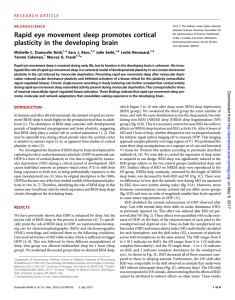
Rapid eye movement sleep promotes cortical
... times, and with the same distribution across the sleep period, but only during non-REM (NREM) sleep [NREM sleep fragmentation (NF) group] (fig. S1B). This is a necessary control because RSD has indirect effects on NREM sleep duration and EEG activity (9). After 6 hours of MD and 1 hour of sleep, whe ...
... times, and with the same distribution across the sleep period, but only during non-REM (NREM) sleep [NREM sleep fragmentation (NF) group] (fig. S1B). This is a necessary control because RSD has indirect effects on NREM sleep duration and EEG activity (9). After 6 hours of MD and 1 hour of sleep, whe ...

Inventory of Complicated Grief - EMDR Association of Australia
... take the place in my life of the person who died” and “Things and people around me still remind me of the person who died” would not be expected to be associated with maladaptation to the loss. The TRIG asks the respondent about crying in three separate statements, a procedure that seems redundant f ...
... take the place in my life of the person who died” and “Things and people around me still remind me of the person who died” would not be expected to be associated with maladaptation to the loss. The TRIG asks the respondent about crying in three separate statements, a procedure that seems redundant f ...

Unit 05
... (the subject) responds to another person’s (the hypnotist’s) suggestions that certain perceptions, feelings, thoughts, or behaviors will spontaneously occur. ...
... (the subject) responds to another person’s (the hypnotist’s) suggestions that certain perceptions, feelings, thoughts, or behaviors will spontaneously occur. ...
19 CORTICAL PROJECTIONS FROM TWO PRESTRIATE AREAS IN
... were therefore planned to fall in regions of vertical and horizontal meridian rerepresentations of areas 18 and 19 of both upper and lower prestriate cortex (see Fig. 1). The region between the anterior border of area 19 and the depth of the superior temporal sulcus was examined for degeneration, be ...
... were therefore planned to fall in regions of vertical and horizontal meridian rerepresentations of areas 18 and 19 of both upper and lower prestriate cortex (see Fig. 1). The region between the anterior border of area 19 and the depth of the superior temporal sulcus was examined for degeneration, be ...
Specialized prefrontal "auditory fields": organization of primate
... (Figure 2). While classical and modern anatomic studies have found strong auditory-related connections in the frontal pole (Pandya and Kuypers, 1969; Chavis and Pandya, 1976; Petrides and Pandya, 1988; Barbas et al., 1999, 2005; Hackett et al., 1999; Romanski et al., 1999a,b; Medalla et al., 2007), ...
... (Figure 2). While classical and modern anatomic studies have found strong auditory-related connections in the frontal pole (Pandya and Kuypers, 1969; Chavis and Pandya, 1976; Petrides and Pandya, 1988; Barbas et al., 1999, 2005; Hackett et al., 1999; Romanski et al., 1999a,b; Medalla et al., 2007), ...

Fluoxetine and hyperforin appear to act like a
... not a primary function of either SSRI, to a greater extent than hyperforin (figure 1). This questions the safety of using fluoxetine, the main active ingredient in Prozac, because of its lack of selectivity to only serotonin reuptake pumps, which could lead to undesirable side effects. There is also ...
... not a primary function of either SSRI, to a greater extent than hyperforin (figure 1). This questions the safety of using fluoxetine, the main active ingredient in Prozac, because of its lack of selectivity to only serotonin reuptake pumps, which could lead to undesirable side effects. There is also ...
Biology of depression

Scientific studies have found that numerous brain areas show altered activity in patients suffering from depression, and this has encouraged advocates of various theories that seek to identify a biochemical origin of the disease, as opposed to theories that emphasize psychological or situational causes. Several theories concerning the biologically based cause of depression have been suggested over the years, of which the most prominent and widely researched is the monoamine hypothesis.