
Mood disorders
... Mood: persistent emotional states that affect how an individual acts, acts, think and perceivel his or her environment environment The basic abnormalities of mood: mood: depression, depression, mania. mania. Both occur on a continuum from normal to clearly pathological. pathological. The minor sympt ...
... Mood: persistent emotional states that affect how an individual acts, acts, think and perceivel his or her environment environment The basic abnormalities of mood: mood: depression, depression, mania. mania. Both occur on a continuum from normal to clearly pathological. pathological. The minor sympt ...

Diagnostic Criteria
... Interpret and recall information and events with a negative bias Engage in repetitive focus on bad feelings and experiences from the past and to disengage attention from thought content (rumination) Show referential attention negative stimuli. ...
... Interpret and recall information and events with a negative bias Engage in repetitive focus on bad feelings and experiences from the past and to disengage attention from thought content (rumination) Show referential attention negative stimuli. ...

Mood Disorders and Suicide
... accompanied by a reduction in social support Suicide rates are highest in elderly groups ...
... accompanied by a reduction in social support Suicide rates are highest in elderly groups ...
H382: The Problems Kids Have
... Other Specified Depressive Disorder Unspecified Depressive Disorder ...
... Other Specified Depressive Disorder Unspecified Depressive Disorder ...

Everyone, from children to the elderly, feels sad, blue, or down
... That is a tough question since everyone feels sad sometimes. The most important things are to talk with your kids, to be educated about depression, and to notice changes in behavior. If the symptoms listed persist for more than two weeks and lead to problems in any area of life, you should seek prof ...
... That is a tough question since everyone feels sad sometimes. The most important things are to talk with your kids, to be educated about depression, and to notice changes in behavior. If the symptoms listed persist for more than two weeks and lead to problems in any area of life, you should seek prof ...
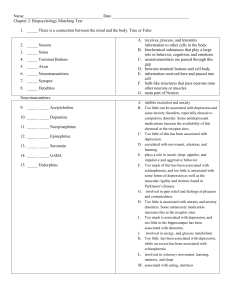
Chapter 2: Biopsychology Study Guide
... Flight" phenomenon because of its control over the necessary bodily changes needed when we are faced with a situation where we may need to defend ourselves or escape. Imagine walking down a dark street at night by yourself B. regulates primarily involuntary activity such as heart rate, breathing, bl ...
... Flight" phenomenon because of its control over the necessary bodily changes needed when we are faced with a situation where we may need to defend ourselves or escape. Imagine walking down a dark street at night by yourself B. regulates primarily involuntary activity such as heart rate, breathing, bl ...

Depression
... Unexplained memory loss, sleep problems, or withdrawal may be signs of depression. ...
... Unexplained memory loss, sleep problems, or withdrawal may be signs of depression. ...

Psychiatric Aspects of PD
... greater severity of extrapyramidal signs susceptibility to psychosis or confusion in response to levodopa, and depression. • Depression is, however, no more common in patients with dementia than in those without; whereas psychotic symptoms are more frequent in demented patients ...
... greater severity of extrapyramidal signs susceptibility to psychosis or confusion in response to levodopa, and depression. • Depression is, however, no more common in patients with dementia than in those without; whereas psychotic symptoms are more frequent in demented patients ...

The Biomedical Therapies
... 55-2. Describe the characteristics of antipsychotic, antianxiety, antidepressant, and mood-stabilizing drugs, and discuss their use in treating psychological disorders. Antipsychotic drugs, such as chlorpromazine (sold as Thorazine), provide help to people experiencing the positive symptoms of audit ...
... 55-2. Describe the characteristics of antipsychotic, antianxiety, antidepressant, and mood-stabilizing drugs, and discuss their use in treating psychological disorders. Antipsychotic drugs, such as chlorpromazine (sold as Thorazine), provide help to people experiencing the positive symptoms of audit ...

Understanding Depression
... 10. Lasting physical symptoms that do not respond to treatment … headaches, digestive problems, chronic pain ...
... 10. Lasting physical symptoms that do not respond to treatment … headaches, digestive problems, chronic pain ...

Is there good evidence for alternative therapies in depression?
... to prescribe exercise to depressed patients but one study showed 30% of depressed subjects exercised for the duration of a 26-month study period. Bright light therapy. Bright light therapy has been used since the 1980s for the treatment of seasonal mood disorders, but some RCT evidence exists for ef ...
... to prescribe exercise to depressed patients but one study showed 30% of depressed subjects exercised for the duration of a 26-month study period. Bright light therapy. Bright light therapy has been used since the 1980s for the treatment of seasonal mood disorders, but some RCT evidence exists for ef ...


THE WORKING OF THE HUMAN BRAIN
... opium, heroin and alcohol initially increase the levels of dopamine artificially Addiction occurs when the production of dopamine decreases and more of these drugs are needed Withdrawal symptoms when discontinued ...
... opium, heroin and alcohol initially increase the levels of dopamine artificially Addiction occurs when the production of dopamine decreases and more of these drugs are needed Withdrawal symptoms when discontinued ...

Folie 1 - Universitätsklinikum Ulm
... Dept. of Child and Adolescent Psychiatry and Psychotherapy, University Hospital Ulm, Ulm, Germany; 2Dept. of Psychiatry and Psychotherapy III, University Hospital Ulm, Ulm, Germany; 3 Dept. of Child and Adolescent Psychiatry, Psychosomatics and Psychotherapy, Philipps-University Marburg, Marburg, Ge ...
... Dept. of Child and Adolescent Psychiatry and Psychotherapy, University Hospital Ulm, Ulm, Germany; 2Dept. of Psychiatry and Psychotherapy III, University Hospital Ulm, Ulm, Germany; 3 Dept. of Child and Adolescent Psychiatry, Psychosomatics and Psychotherapy, Philipps-University Marburg, Marburg, Ge ...

File
... mysteriously painful and elusive in the way it becomes known to the self…as to verge close to being beyond description. It thus remains nearly incomprehensible to others who have not experienced it in its extreme mode, although the gloom, “the blues” which people go through occasionally and associat ...
... mysteriously painful and elusive in the way it becomes known to the self…as to verge close to being beyond description. It thus remains nearly incomprehensible to others who have not experienced it in its extreme mode, although the gloom, “the blues” which people go through occasionally and associat ...


Depression in Adolescents
... Depression can be caused by a combination of genetic and environmental factors, and sometimes early adverse experiences. The condition may be triggered by stressful life events such as bullying, abuse or parental separation - precipitants for depression in a person who is already predisposed to beco ...
... Depression can be caused by a combination of genetic and environmental factors, and sometimes early adverse experiences. The condition may be triggered by stressful life events such as bullying, abuse or parental separation - precipitants for depression in a person who is already predisposed to beco ...

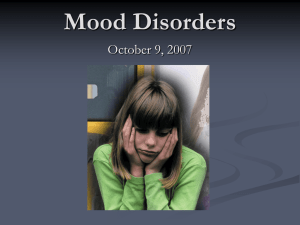
Mood Disorders
... friends, including available alternative services, and, without treatment, is likely to suffer from neglect or refuse to care for himself or herself, and such neglect or refusal poses a real and present threat of substantial harm to his or her well-being; or ...
... friends, including available alternative services, and, without treatment, is likely to suffer from neglect or refuse to care for himself or herself, and such neglect or refusal poses a real and present threat of substantial harm to his or her well-being; or ...
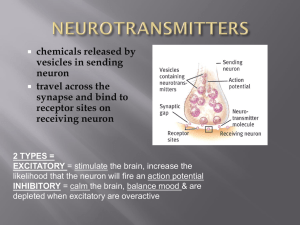
Chapter 2 - Biological Basis of Behavior
... to be pushed into the synapse so that focus is improved BUT cause a depletion over time Acetylcholine triggers muscle contraction important role in arousal and attention Loss = linked to Alzheimer’s Disease ...
... to be pushed into the synapse so that focus is improved BUT cause a depletion over time Acetylcholine triggers muscle contraction important role in arousal and attention Loss = linked to Alzheimer’s Disease ...

depression - Swindon General Practice Education
... intervention subthreshold symptoms who request an intervention who may recover with no formal intervention ...
... intervention subthreshold symptoms who request an intervention who may recover with no formal intervention ...

Module 55 The Biomedical Therapies Module Preview
... 55-3. Describe the use of brain stimulation techniques and psychosurgery in treating specific disorders. Electroconvulsive therapy (ECT), or shock treatment, is used for severely depressed patients. A brief electric current is sent through the brain of an anesthetized patient. Although ECT is credit ...
... 55-3. Describe the use of brain stimulation techniques and psychosurgery in treating specific disorders. Electroconvulsive therapy (ECT), or shock treatment, is used for severely depressed patients. A brief electric current is sent through the brain of an anesthetized patient. Although ECT is credit ...

The Practical Management of Depression
... signals from one component of the nervous system to another ...
... signals from one component of the nervous system to another ...
right click here
... How is Bipolar Disorder DIFFERENT from Major Depressive Disorder? Manic episodes Earlier age at onset Reversed vegetative symptoms Oversleeping, overeating ...
... How is Bipolar Disorder DIFFERENT from Major Depressive Disorder? Manic episodes Earlier age at onset Reversed vegetative symptoms Oversleeping, overeating ...
Biology of depression

Scientific studies have found that numerous brain areas show altered activity in patients suffering from depression, and this has encouraged advocates of various theories that seek to identify a biochemical origin of the disease, as opposed to theories that emphasize psychological or situational causes. Several theories concerning the biologically based cause of depression have been suggested over the years, of which the most prominent and widely researched is the monoamine hypothesis.