
Chapter 1
... – Most people who meet criteria for bipolar disorder experience a average of 0.4 to 0.7 cycles per year, lasting three to six months – defined as having four or more episodes per year – found in a significant fraction of individuals with bipolar disorder. ...
... – Most people who meet criteria for bipolar disorder experience a average of 0.4 to 0.7 cycles per year, lasting three to six months – defined as having four or more episodes per year – found in a significant fraction of individuals with bipolar disorder. ...

Psychiatric Disorders in Seniors
... conjugal partner when compared to married persons of the same age Highest relative risk of mortality occurred 7 – 12 months after spousal loss ...
... conjugal partner when compared to married persons of the same age Highest relative risk of mortality occurred 7 – 12 months after spousal loss ...

Depression - St. Patrick`s Mental Health Services
... Everyone feels sad from time to time. However these feelings are short-lived and last only a few days. Depression is where these feelings are severe, or long lasting. Depression is a serious illness that leaves you feeling “down” most of the time and finding it hard to “cope” from day to day. Depres ...
... Everyone feels sad from time to time. However these feelings are short-lived and last only a few days. Depression is where these feelings are severe, or long lasting. Depression is a serious illness that leaves you feeling “down” most of the time and finding it hard to “cope” from day to day. Depres ...
Biological treatments carousel
... patient’s temples. In the past, electrodes were put on each side of the forehead. Nowadays it is more common to use ECT on one side of the brain as this reduces side effects. The current induces convulsions that last for approximately one minute. Once the patient comes round from the anaesthetic the ...
... patient’s temples. In the past, electrodes were put on each side of the forehead. Nowadays it is more common to use ECT on one side of the brain as this reduces side effects. The current induces convulsions that last for approximately one minute. Once the patient comes round from the anaesthetic the ...
Diagnosis and Treatment of Mood Disorders in Epilepsy
... • ECT is likley the most effective treatment we have for Depression • ECT is not contraindicated in Epilepsy • In fact ECT came into use due to “forced ...
... • ECT is likley the most effective treatment we have for Depression • ECT is not contraindicated in Epilepsy • In fact ECT came into use due to “forced ...

Depression -> Suicide
... Don't confuse it with life's ups and downs. Life is stressful. Your boyfriend or girlfriend just dumped you or you got your first speeding ticket or even lost your job. You find a way to cope with the stressors in your life and then move on. The problem is when you can't cope with these stressors. T ...
... Don't confuse it with life's ups and downs. Life is stressful. Your boyfriend or girlfriend just dumped you or you got your first speeding ticket or even lost your job. You find a way to cope with the stressors in your life and then move on. The problem is when you can't cope with these stressors. T ...

Psychology Wednesday, 9/23
... • Attribution theory: people assign different types of explanations to events, which affect self-esteem and self-efficacy. • Beck suggests that people who are depressed have a negative view of themselves, their experiences, and their future. ...
... • Attribution theory: people assign different types of explanations to events, which affect self-esteem and self-efficacy. • Beck suggests that people who are depressed have a negative view of themselves, their experiences, and their future. ...
A REVIEW: HYPOTHESIS OF DEPRESSION AND ROLE OF ANTIDEPRESSANT DRUGS. Review Article S. M. KHARADE
... patients does not consistently produce depressive symptoms. Tryptophan (precursor of 5‐HT depletion does not affect mood in healthy subjects, but does change mood in subjects with a history of psychiatric illness 13, 14. In addition, tryptophan depletion produces alterations i ...
... patients does not consistently produce depressive symptoms. Tryptophan (precursor of 5‐HT depletion does not affect mood in healthy subjects, but does change mood in subjects with a history of psychiatric illness 13, 14. In addition, tryptophan depletion produces alterations i ...

Ask the Expert: Depression Presenter: Kenneth J. Herrmann, MD
... underlies mood disorders and increases in these neurotrophic factors to normal levels brings about mood recovery, may not sufficiently explain the complex process of recovery from depression. This review discusses recent data on the role of BDNF and its receptors in depression and the antidepressant ...
... underlies mood disorders and increases in these neurotrophic factors to normal levels brings about mood recovery, may not sufficiently explain the complex process of recovery from depression. This review discusses recent data on the role of BDNF and its receptors in depression and the antidepressant ...
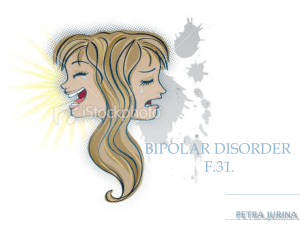
Petra Jurina
... no single cause - heredity - 2/3 of bipolar patients have family history of mental disorders - biological differences - abnormal levels of certain chemicals (dopamine) - enviromental factors - stress, abuse, significant loss or other traumatic experiences ...
... no single cause - heredity - 2/3 of bipolar patients have family history of mental disorders - biological differences - abnormal levels of certain chemicals (dopamine) - enviromental factors - stress, abuse, significant loss or other traumatic experiences ...

Mood Disorders - Davaar Consultancy
... and includes moderate amounts of alcohol. The Mediterranean diet is thought to reduce inflammatory and metabolic processes that may be involved in depression ...
... and includes moderate amounts of alcohol. The Mediterranean diet is thought to reduce inflammatory and metabolic processes that may be involved in depression ...

Signs of Depression - Vestibular Disorders Association
... parents, and others may become caregivers. A caregiver is a person who provides help and protection to someone with a problem. At some stages of an illness or disability, we may take on a more protective role, and later be called to play an increasing role in the health and wellbeing of the patient. ...
... parents, and others may become caregivers. A caregiver is a person who provides help and protection to someone with a problem. At some stages of an illness or disability, we may take on a more protective role, and later be called to play an increasing role in the health and wellbeing of the patient. ...

Problems with Imbalance
... This multimedia product and its contents are protected under copyright law. The following are prohibited by law: any public performance or display, including transmission of any image over a network; preparation of any derivative work, including the extraction, in whole or part, of any images; any r ...
... This multimedia product and its contents are protected under copyright law. The following are prohibited by law: any public performance or display, including transmission of any image over a network; preparation of any derivative work, including the extraction, in whole or part, of any images; any r ...
Neurotransmitters
... transmission at these synapses. Acetylcholine also operates in many regions of the brain, but using different types of receptors. Dopamine has a number of important functions in the brain. It plays a critical role in the reward system, but dysfunction of the dopamine system is also implicated in Par ...
... transmission at these synapses. Acetylcholine also operates in many regions of the brain, but using different types of receptors. Dopamine has a number of important functions in the brain. It plays a critical role in the reward system, but dysfunction of the dopamine system is also implicated in Par ...


Antidepressants and neuroleptic
... Correct answer = A. Because of its potent antimuscarinic activity, amitriptyline should not be given to patients with glaucoma because of the risk of acute increases in ocular pressure. The other antidepressants all lack antagonist activity at the muscarinic receptor. ...
... Correct answer = A. Because of its potent antimuscarinic activity, amitriptyline should not be given to patients with glaucoma because of the risk of acute increases in ocular pressure. The other antidepressants all lack antagonist activity at the muscarinic receptor. ...

Management of treatment- resistant depression
... then stop the initial antidepressant and start the new medication. There are many choices available when switching antidepressant class. The most commonly prescribed would be the serotonin-norepinephrine reuptake inhibitor (SNRI), venlafaxine, followed by atypical antidepressants such as mirtazapine ...
... then stop the initial antidepressant and start the new medication. There are many choices available when switching antidepressant class. The most commonly prescribed would be the serotonin-norepinephrine reuptake inhibitor (SNRI), venlafaxine, followed by atypical antidepressants such as mirtazapine ...

Monoamine Hypothesis of Depression
... Amine Depression Hypotheses • Biogenic amine hypothesis suggests that depression reflects a suboptimal level of NE, DA, EPI, or 5-HT in brain • Evidence from – Reserpine depletes CNS catecholamines (leads to depression) – Depressed patients have low levels of 5-HIAA (metabolite) – Drugs used to tre ...
... Amine Depression Hypotheses • Biogenic amine hypothesis suggests that depression reflects a suboptimal level of NE, DA, EPI, or 5-HT in brain • Evidence from – Reserpine depletes CNS catecholamines (leads to depression) – Depressed patients have low levels of 5-HIAA (metabolite) – Drugs used to tre ...


Affective Disorders
... Not taking antimanic medication – Patients who are prescribed an antidepressant should also be prescribed an antimanic drug. ...
... Not taking antimanic medication – Patients who are prescribed an antidepressant should also be prescribed an antimanic drug. ...

Mood disorders
... Linkage analysis and associations studies link possible genes and dispositions for depression. ...
... Linkage analysis and associations studies link possible genes and dispositions for depression. ...
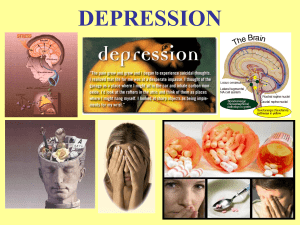
Depression
... ECT has been reported to result in a prompt improvement in symptoms of depression in the majority of patients treated. The Consortium for Research in ECT (CORE) reported a 75% remission rate among 217 patients who completed a short course of ECT during an acute episode of depression, with 65% of pat ...
... ECT has been reported to result in a prompt improvement in symptoms of depression in the majority of patients treated. The Consortium for Research in ECT (CORE) reported a 75% remission rate among 217 patients who completed a short course of ECT during an acute episode of depression, with 65% of pat ...

Psychopathology Today Mental Disorder Issues Causes of Illness
... Circuit disturbance rather than specific cerebral localized dysfunction is involved in schizophrenia. Symptoms of schizophrenia arise from impaired connectivity between different brain regions as a consequence of some neurodevelopmental defects (fig. on next slide) ...
... Circuit disturbance rather than specific cerebral localized dysfunction is involved in schizophrenia. Symptoms of schizophrenia arise from impaired connectivity between different brain regions as a consequence of some neurodevelopmental defects (fig. on next slide) ...
Biology of depression

Scientific studies have found that numerous brain areas show altered activity in patients suffering from depression, and this has encouraged advocates of various theories that seek to identify a biochemical origin of the disease, as opposed to theories that emphasize psychological or situational causes. Several theories concerning the biologically based cause of depression have been suggested over the years, of which the most prominent and widely researched is the monoamine hypothesis.