
ExamView - ch 5 practice.tst
... D. a diagram that shows the evolutionary history of groups of species Charles Darwin was unable to explain the source of the variations he claimed were necessary for evolution. This was because A. such variations did not exist. B. variations occur in nature and have no explanation. C. variations res ...
... D. a diagram that shows the evolutionary history of groups of species Charles Darwin was unable to explain the source of the variations he claimed were necessary for evolution. This was because A. such variations did not exist. B. variations occur in nature and have no explanation. C. variations res ...

LabReviewS13 Labs1-6-2
... Lab 2: Mathematical Modeling: Hardy-Weinberg Analysis & Results: Null model: in the absence of random events that affect populations, allele frequencies (p,q) should be the same from generation to generation (H-W equilibrium) Analyze genetic drift and the effect of selection on a given populati ...
... Lab 2: Mathematical Modeling: Hardy-Weinberg Analysis & Results: Null model: in the absence of random events that affect populations, allele frequencies (p,q) should be the same from generation to generation (H-W equilibrium) Analyze genetic drift and the effect of selection on a given populati ...
Population divergence and candidate signatures of natural selection
... Phenotypically, natural selection increases the prevalence of traits in a population or species that confer some form of adaptation to a particular environment. Individuals with adaptive phenotypes have higher fitness, surviving to produce viable offspring with traits that are advantageous in a part ...
... Phenotypically, natural selection increases the prevalence of traits in a population or species that confer some form of adaptation to a particular environment. Individuals with adaptive phenotypes have higher fitness, surviving to produce viable offspring with traits that are advantageous in a part ...

Lab review 1-6
... Lab 2: Mathematical Modeling: Hardy-Weinberg Analysis & Results: Null model: in the absence of random events that affect populations, allele frequencies (p,q) should be the same from generation to generation (H-W equilibrium) Analyze genetic drift and the effect of selection on a given populati ...
... Lab 2: Mathematical Modeling: Hardy-Weinberg Analysis & Results: Null model: in the absence of random events that affect populations, allele frequencies (p,q) should be the same from generation to generation (H-W equilibrium) Analyze genetic drift and the effect of selection on a given populati ...

PDF (includes journal cover)
... and mane pigeons, breeds with unusual feather manes or hoods about the head (Figure 1). The second ancestral cluster consisted mainly of the tumblers (including rollers and highflyers), the most breedrich of the major groups (at least 80 breeds recognized in the USA) [4, 8]. Tumblers are generally s ...
... and mane pigeons, breeds with unusual feather manes or hoods about the head (Figure 1). The second ancestral cluster consisted mainly of the tumblers (including rollers and highflyers), the most breedrich of the major groups (at least 80 breeds recognized in the USA) [4, 8]. Tumblers are generally s ...
Domains, Brains and Evolution
... as an adaptive problem, or a set of suitably related adaptive problems. Adopting this definition, we proceed to introduce the distinction between data and algorithms, and to differentiate four conceptions of our cognitive architecture, only two of which, we argue, are viable: (a) generalpurpose mech ...
... as an adaptive problem, or a set of suitably related adaptive problems. Adopting this definition, we proceed to introduce the distinction between data and algorithms, and to differentiate four conceptions of our cognitive architecture, only two of which, we argue, are viable: (a) generalpurpose mech ...
The Evolution of Aging Theories: Why Modern
... following the age at which a species can complete an initial reproduction. We can summarize this idea by saying that there is clearly no evolutionary benefit from an organism possessing the internal capability for living and reproducing beyond the species-specific age at which essentially all the me ...
... following the age at which a species can complete an initial reproduction. We can summarize this idea by saying that there is clearly no evolutionary benefit from an organism possessing the internal capability for living and reproducing beyond the species-specific age at which essentially all the me ...

Psychological Science
... and undergraduates (Bishop & Anderson, 1990; Brumby, 1984; Nehm & Reilly, 2007; for a review, see Gregory, 2009), who are often targets of instruction on the topic, but also, disturbingly, among many of the teachers expected to teach natural selection (Nehm, Kim, & Sheppard, 2009; Nehm & Schonfeld, ...
... and undergraduates (Bishop & Anderson, 1990; Brumby, 1984; Nehm & Reilly, 2007; for a review, see Gregory, 2009), who are often targets of instruction on the topic, but also, disturbingly, among many of the teachers expected to teach natural selection (Nehm, Kim, & Sheppard, 2009; Nehm & Schonfeld, ...
Ecological explanations for (incomplete) speciation
... Much theoretical and empirical work on the completeness of speciation has focused on time-based, geographic or genetic factors (Figure 2). Speciation can be promoted by increased time since beginning of divergence [4,16] and by geographic barriers to gene flow [4,5]. Speciation can also be promoted ...
... Much theoretical and empirical work on the completeness of speciation has focused on time-based, geographic or genetic factors (Figure 2). Speciation can be promoted by increased time since beginning of divergence [4,16] and by geographic barriers to gene flow [4,5]. Speciation can also be promoted ...
A general model of the relation between phenotypic selection and
... all relevant (especially internal) traits may not be possible at all. Simplifying assumptions have to be made. One possible simplification is that the relationship between the external phenotype and fitness is independent of the factors causing phenotypic variation. However, this is not a fortunate ...
... all relevant (especially internal) traits may not be possible at all. Simplifying assumptions have to be made. One possible simplification is that the relationship between the external phenotype and fitness is independent of the factors causing phenotypic variation. However, this is not a fortunate ...
The Darwinian Revelation: Tracing the Origin and Evolution of an Idea
... long argument” in the opening line of the book’s final chapter has long served as a general guide to the way in which Darwin conceptualized his theory, but the fuller picture of Darwin’s creative process was possible only as his correspondence, notebooks, and other private writings became available ...
... long argument” in the opening line of the book’s final chapter has long served as a general guide to the way in which Darwin conceptualized his theory, but the fuller picture of Darwin’s creative process was possible only as his correspondence, notebooks, and other private writings became available ...
BIOLOGY SPRING FINALEXAMOBJECTIVES11
... 6. Identify and define the lobes of the brain. 7. Diagram a reflex arc and explain what a stimulus is. 8. Identify the main glands of the endocrine system and the hormones they secrete. 9. Explain how body systems must work together to provide the body with oxygen and remove carbon dioxide from the ...
... 6. Identify and define the lobes of the brain. 7. Diagram a reflex arc and explain what a stimulus is. 8. Identify the main glands of the endocrine system and the hormones they secrete. 9. Explain how body systems must work together to provide the body with oxygen and remove carbon dioxide from the ...
Mallet (2012) "The struggle..."
... focused only on population densities of competing individuals and species. Meanwhile, the originators of population genetics, Ronald A. Fisher, J.B.S. Haldane, and Sewall Wright, based theories of natural selection on demography, but generalized their evolutionary models almost exclusively in terms ...
... focused only on population densities of competing individuals and species. Meanwhile, the originators of population genetics, Ronald A. Fisher, J.B.S. Haldane, and Sewall Wright, based theories of natural selection on demography, but generalized their evolutionary models almost exclusively in terms ...
Explaining stasis: microevolutionary studies in natural populations
... these explanations, and describe methodological advances which can be used to distinguish among them. We illustrate these approaches using examples from our own recent work on wild populations of collared flycatchers Ficedula albicollis and red deer Cervus elaphus. It is our belief that it is as imp ...
... these explanations, and describe methodological advances which can be used to distinguish among them. We illustrate these approaches using examples from our own recent work on wild populations of collared flycatchers Ficedula albicollis and red deer Cervus elaphus. It is our belief that it is as imp ...
The Evolutionary Origin of the Vertebrate Body Plan: The Problem of
... vertebrae, such that the scheme could derive all vertebrate skulls. However, this scheme resulted in the construction of a monster-like figure not found in nature, because it was an assemblage of characteristics that represented both derived and ancestral traits. Thus, the arguments on the head segme ...
... vertebrae, such that the scheme could derive all vertebrate skulls. However, this scheme resulted in the construction of a monster-like figure not found in nature, because it was an assemblage of characteristics that represented both derived and ancestral traits. Thus, the arguments on the head segme ...
Robustness and Evolvability
... recombination rates as distinct cases. At first, robustness and evolvability appear to be opposites; if most mutations have no effect, then there will be less variation for selection to act on. Indeed, ‘robustness’ mechanisms that prevent genetic change from occurring in the first place, such as pro ...
... recombination rates as distinct cases. At first, robustness and evolvability appear to be opposites; if most mutations have no effect, then there will be less variation for selection to act on. Indeed, ‘robustness’ mechanisms that prevent genetic change from occurring in the first place, such as pro ...

Life Science HS - Standards Aligned System
... Use a model to describe the role of cellular division and differentiation to produce and maintain complex organisms composed of organ systems and tissue subsystems that work together to meet the needs of the entire organism. Use a model to explain the role of cellular division and the mechanisms in ...
... Use a model to describe the role of cellular division and differentiation to produce and maintain complex organisms composed of organ systems and tissue subsystems that work together to meet the needs of the entire organism. Use a model to explain the role of cellular division and the mechanisms in ...
long program - Pan
... and Bem-vindo” to all participants of the Inaugural meeting of the Pan-American Society for Evolutionary Developmental Biology! For the first time, over 300 members of our new Society will sit in a single room for 3 days to discuss the past accomplishments and future challenges of our field. To spar ...
... and Bem-vindo” to all participants of the Inaugural meeting of the Pan-American Society for Evolutionary Developmental Biology! For the first time, over 300 members of our new Society will sit in a single room for 3 days to discuss the past accomplishments and future challenges of our field. To spar ...

- Wiley Online Library
... de Jong 1993; Worley, Houle & Barrett 2003). Applied to growth, this means that individuals that acquire resources more efficiently than others will be able to allocate more resources to both growth and competing resource demands. If there is little variation at the acquisition level, however, growt ...
... de Jong 1993; Worley, Houle & Barrett 2003). Applied to growth, this means that individuals that acquire resources more efficiently than others will be able to allocate more resources to both growth and competing resource demands. If there is little variation at the acquisition level, however, growt ...
Asexual but not clonal: evolutionary processes in
... The vast majority of animals and plants reproduce via the familiar mechanism of sex (BELL 1982): haploid gametes are produced through meiosis, and these fuse to form diploid offspring that are a genetic mix of their parents. Conversely, bacteria, many unicellular and some multicellular eukaryotes re ...
... The vast majority of animals and plants reproduce via the familiar mechanism of sex (BELL 1982): haploid gametes are produced through meiosis, and these fuse to form diploid offspring that are a genetic mix of their parents. Conversely, bacteria, many unicellular and some multicellular eukaryotes re ...
Individual pollen limitation, phylogeny and selection
... sexually reproducing organisms and in animals is often stronger among males than females (Bateman, 1948). In seed plants, however, female success can be limited by pollen receipt (Knight et al., 2005), indicating competition for mates via both female and male function. Pollen limitation of seed prod ...
... sexually reproducing organisms and in animals is often stronger among males than females (Bateman, 1948). In seed plants, however, female success can be limited by pollen receipt (Knight et al., 2005), indicating competition for mates via both female and male function. Pollen limitation of seed prod ...
Temperature- Dependent Sex Determination (TSD): benefits and
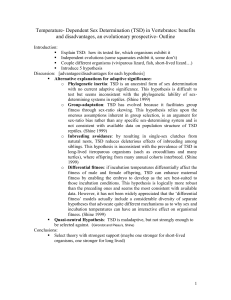
... heritability in narrow transition zones, and when combined with transition zones differing from one degree Celsius to greater than four degrees in some phyla. Due to this degree of variance across populations, it must be assumed there are high levels of genetic diversity. Thus there is strong eviden ...
... heritability in narrow transition zones, and when combined with transition zones differing from one degree Celsius to greater than four degrees in some phyla. Due to this degree of variance across populations, it must be assumed there are high levels of genetic diversity. Thus there is strong eviden ...
Pre´cis of Evolution in Four Dimensions
... Some modifications of the original Modern Synthesis had to be made. It transpired that many variations in the amino acid sequences of proteins (and many more variations in DNA sequences) make no phenotypic difference: some genetic variations seem to be selectively neutral. Moreover, there are genes ...
... Some modifications of the original Modern Synthesis had to be made. It transpired that many variations in the amino acid sequences of proteins (and many more variations in DNA sequences) make no phenotypic difference: some genetic variations seem to be selectively neutral. Moreover, there are genes ...
Niche construction in evolutionary theory: the construction
... bioRxiv preprint first posted online Feb. 19, 2017; doi: http://dx.doi.org/10.1101/109793. The copyright holder for this preprint (which was not peer-reviewed) is the author/funder. All rights reserved. No reuse allowed without permission. ...
... bioRxiv preprint first posted online Feb. 19, 2017; doi: http://dx.doi.org/10.1101/109793. The copyright holder for this preprint (which was not peer-reviewed) is the author/funder. All rights reserved. No reuse allowed without permission. ...
TWO WRONGS (James MacAllister) On April 2011, University of
... have excessive faith in their theories or ideas are not only ill prepared for making discoveries; they also make very poor observations. Of necessity, they observe with a preconceived idea, and when they devise an experiment, they can see, in its results, only a confirmation of their theory. In this ...
... have excessive faith in their theories or ideas are not only ill prepared for making discoveries; they also make very poor observations. Of necessity, they observe with a preconceived idea, and when they devise an experiment, they can see, in its results, only a confirmation of their theory. In this ...