(political) origin of “corporate governance” species
... characterised by managerial hierarchy, derives from both technological and institutional variations in the US (that did not occur in the EU); respectively, the exponential expansion of transportation and the communication industry between the end of the 19th century and the beginning of the 20th cen ...
... characterised by managerial hierarchy, derives from both technological and institutional variations in the US (that did not occur in the EU); respectively, the exponential expansion of transportation and the communication industry between the end of the 19th century and the beginning of the 20th cen ...
Why do individuals 4 and 5 have G rather than B
... can explain trait facts is not to say it always does. Second, even when selection is not all-ornothing it can explain the probability of a certain member stemming from a particular parent. For example, if due to selection 3 contributed 90 % of generation III, then selection would account for the pro ...
... can explain trait facts is not to say it always does. Second, even when selection is not all-ornothing it can explain the probability of a certain member stemming from a particular parent. For example, if due to selection 3 contributed 90 % of generation III, then selection would account for the pro ...
Adaptive Approaches Towards Better GA Performance in Dynamic
... In almost all simulations using GAs with populations of neural networks the fitness formula is fixed and decided by the researcher. Yet, the fitness formula should be let free to evolve as any other trait of the organisms without any necessary control from the researcher, since a moment of reflecti ...
... In almost all simulations using GAs with populations of neural networks the fitness formula is fixed and decided by the researcher. Yet, the fitness formula should be let free to evolve as any other trait of the organisms without any necessary control from the researcher, since a moment of reflecti ...
The Evolutionary Biology of Decision Making
... offsetting the benefits of higher food intake. Natural selection optimizes total net fitness across all domains of an organism's survival and reproduction, thereby constraining optimization in any single domain. Second, natural selection does not act as a designer, creating traits de novo. Rather, i ...
... offsetting the benefits of higher food intake. Natural selection optimizes total net fitness across all domains of an organism's survival and reproduction, thereby constraining optimization in any single domain. Second, natural selection does not act as a designer, creating traits de novo. Rather, i ...
Pfennig and Kingsolver
... added). Thus, Darwin recognized that no theory of evolution would be complete if it failed to provide a plausible mechanism that could explain how living things change over evolutionary time. Darwin’s Theory of Evolution by Natural Selection provided such a mechanism. Yet, Darwin’s theory goes beyon ...
... added). Thus, Darwin recognized that no theory of evolution would be complete if it failed to provide a plausible mechanism that could explain how living things change over evolutionary time. Darwin’s Theory of Evolution by Natural Selection provided such a mechanism. Yet, Darwin’s theory goes beyon ...

Expanded social fitness and HamiltonTs rule for kin, kith, and kind
... The first term remains the effect of the actor’s genes on its fitness, but the second term is now the effect of the moon phase and is multiplied by βGM, a sort of moony relatedness linking breeding value and phase of the moon. This model is just as correct as the first two that we considered (the ε ter ...
... The first term remains the effect of the actor’s genes on its fitness, but the second term is now the effect of the moon phase and is multiplied by βGM, a sort of moony relatedness linking breeding value and phase of the moon. This model is just as correct as the first two that we considered (the ε ter ...
The genetical theory of multilevel selection
... and/or local habitat; Grafen, 2006), then natural selection cannot be described as a simple covariance of genetic value with fitness, taken across all individuals in the population. Firstly, spurious correlations between heritable traits and nongenetic aspects of individual quality may drive genetic ...
... and/or local habitat; Grafen, 2006), then natural selection cannot be described as a simple covariance of genetic value with fitness, taken across all individuals in the population. Firstly, spurious correlations between heritable traits and nongenetic aspects of individual quality may drive genetic ...
The genetical theory of multilevel selection - synergy
... and/or local habitat; Grafen, 2006), then natural selection cannot be described as a simple covariance of genetic value with fitness, taken across all individuals in the population. Firstly, spurious correlations between heritable traits and nongenetic aspects of individual quality may drive genetic ...
... and/or local habitat; Grafen, 2006), then natural selection cannot be described as a simple covariance of genetic value with fitness, taken across all individuals in the population. Firstly, spurious correlations between heritable traits and nongenetic aspects of individual quality may drive genetic ...

What can hybrid zones tell us about speciation?
... genetic differences between forms suggests that divergence has been continuing for 3–4 million years without leading to speciation. To understand the genetics and ecology of speciation it will be valuable to study examples where hybrids are produced, but are rarer than expected under random mating. ...
... genetic differences between forms suggests that divergence has been continuing for 3–4 million years without leading to speciation. To understand the genetics and ecology of speciation it will be valuable to study examples where hybrids are produced, but are rarer than expected under random mating. ...
use of an explicit method for distinguishing exaptations from
... ABSTRACT – We applied a cladogram-based method for discerning between adaptations and exaptations. We used current definitions and recognition criteria to distinguish between the evolutionary terms adaptation and exaptation. Our cladogram identifies 14 specific exaptations for the conquest of land b ...
... ABSTRACT – We applied a cladogram-based method for discerning between adaptations and exaptations. We used current definitions and recognition criteria to distinguish between the evolutionary terms adaptation and exaptation. Our cladogram identifies 14 specific exaptations for the conquest of land b ...
Ch 22 Notes - Dublin City Schools
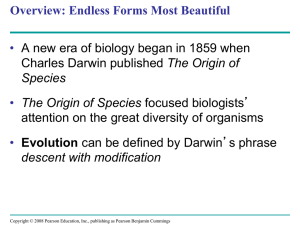
... the origin of new species as closely related processes • From studies made years after Darwin’s voyage, biologists have concluded that this is indeed what happened to the Galápagos finches ...
... the origin of new species as closely related processes • From studies made years after Darwin’s voyage, biologists have concluded that this is indeed what happened to the Galápagos finches ...

Charles Darwin and blending inheritance
... natural selection is to work against the constant blending through intercrossing. The " Essay of 1844." In his second essay Darwin had not forgotten this unresolved problem. At the very beginning it is raised again: Even in the rare instances of sports, with the hereditary tendency very strongly imp ...
... natural selection is to work against the constant blending through intercrossing. The " Essay of 1844." In his second essay Darwin had not forgotten this unresolved problem. At the very beginning it is raised again: Even in the rare instances of sports, with the hereditary tendency very strongly imp ...

Genomics of local adaptation with gene flow
... size of the loci controlling both the migration rate and the adaptive trait. We argue that the genetic architecture of locally adapted traits can also affect the strength of selection on gene flow. We distinguish ‘selection on gene flow’ from ‘selection on migration’, first, to differentiate gene fl ...
... size of the loci controlling both the migration rate and the adaptive trait. We argue that the genetic architecture of locally adapted traits can also affect the strength of selection on gene flow. We distinguish ‘selection on gene flow’ from ‘selection on migration’, first, to differentiate gene fl ...

The impact of rapid evolution on population dynamics in the
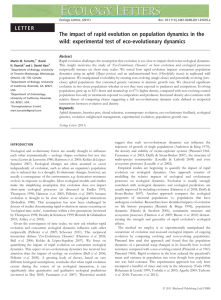
... While recognising the value of laboratory studies, field experiments are crucial because ecological context can influence both ecological and evolutionary processes. Here, we test for eco-evolutionary dynamics using methods that follow the criteria set out by Fussmann et al. (2007), but in the wild. ...
... While recognising the value of laboratory studies, field experiments are crucial because ecological context can influence both ecological and evolutionary processes. Here, we test for eco-evolutionary dynamics using methods that follow the criteria set out by Fussmann et al. (2007), but in the wild. ...
The impact of rapid evolution on population dynamics in the wild
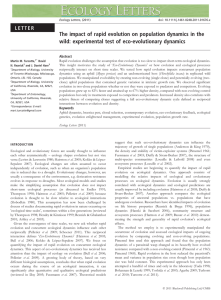
... While recognising the value of laboratory studies, field experiments are crucial because ecological context can influence both ecological and evolutionary processes. Here, we test for eco-evolutionary dynamics using methods that follow the criteria set out by Fussmann et al. (2007), but in the wild. ...
... While recognising the value of laboratory studies, field experiments are crucial because ecological context can influence both ecological and evolutionary processes. Here, we test for eco-evolutionary dynamics using methods that follow the criteria set out by Fussmann et al. (2007), but in the wild. ...
setting the stage: phenotypic plasticity as habitat selection
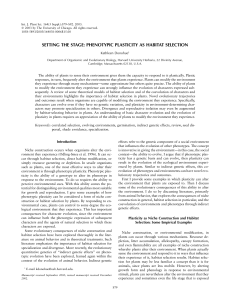
... pared with responses to resources, and thereby to identify potential habitat-selecting characters, and (b) show that habitat selection through plasticity to cues can influence the phenotypic expression of other characters, including important lifehistory characters. The shade avoidance response is a ...
... pared with responses to resources, and thereby to identify potential habitat-selecting characters, and (b) show that habitat selection through plasticity to cues can influence the phenotypic expression of other characters, including important lifehistory characters. The shade avoidance response is a ...

https://goo.gl/BUXfYV HISTORICAL BIOGEOGRAPHY
... The major clades are categorized as clades A, B and the detailed subclades are within. Numbers near nodes are the support values for the clade from the different analyses (ML/BI). The scale bar represents the phylogenetic distances expressed as units of expected nucleotide substitutions per site. Th ...
... The major clades are categorized as clades A, B and the detailed subclades are within. Numbers near nodes are the support values for the clade from the different analyses (ML/BI). The scale bar represents the phylogenetic distances expressed as units of expected nucleotide substitutions per site. Th ...

Evolution PowerPoint
... Miller, K. R., & Levine, J. S. (2005). Chapter 16: Evolution of Populations. Prentice Hall biology (North Carolina ed., pp. 392- 415). Upper Saddle River, N.J.: Prentice Hall. Miller, K. R., & Levine, J. S. (2005). Chapter 15: Darwin's Theory of Evolution. Prentice Hall biology (North Carolina ed., ...
... Miller, K. R., & Levine, J. S. (2005). Chapter 16: Evolution of Populations. Prentice Hall biology (North Carolina ed., pp. 392- 415). Upper Saddle River, N.J.: Prentice Hall. Miller, K. R., & Levine, J. S. (2005). Chapter 15: Darwin's Theory of Evolution. Prentice Hall biology (North Carolina ed., ...
Fig. 22-6 - Geneva Area City Schools
... • An adaptation is an inherited characteristic of an organism that enhances its survival and reproduction in specific environments. • From studies made years after Darwin’s voyage, biologists have concluded that this is indeed what happened to the Galápagos finches ...
... • An adaptation is an inherited characteristic of an organism that enhances its survival and reproduction in specific environments. • From studies made years after Darwin’s voyage, biologists have concluded that this is indeed what happened to the Galápagos finches ...

The role of hermaphrodites in the experimental evolution of
... interested in finding if outcrossing is adaptive and testing which fitness components could explain the increase in outcrossing rates. Approaching an answer to these two questions would explain why outcrossing can be adaptive in novel environments. Using competitive assays expected to encompass the ...
... interested in finding if outcrossing is adaptive and testing which fitness components could explain the increase in outcrossing rates. Approaching an answer to these two questions would explain why outcrossing can be adaptive in novel environments. Using competitive assays expected to encompass the ...
Adaptive divergence, genetic connectivity, and post
... and disparity in higher taxa). As such, an enhanced understanding of the mechanisms for speciation is essential to an enhanced understanding of biodiversity and how best to conserve it. ...
... and disparity in higher taxa). As such, an enhanced understanding of the mechanisms for speciation is essential to an enhanced understanding of biodiversity and how best to conserve it. ...
FairchildN0812 - ScholarWorks
... rejections by scientific organizations such as the American Association for the Advancement of Science, which rejected ID in 2002 (Pennock, 2003). Evolution is deeply accepted by the scientific community (Cavallo & McCall, 2008). All theories are tentative, but one of the strongest scientific theori ...
... rejections by scientific organizations such as the American Association for the Advancement of Science, which rejected ID in 2002 (Pennock, 2003). Evolution is deeply accepted by the scientific community (Cavallo & McCall, 2008). All theories are tentative, but one of the strongest scientific theori ...
Fig. 22-12 - Kirchner-WHS
... 1795 Hutton proposes his theory of gradualism. 1798 Malthus publishes “Essay on the Principle of Population.” 1809 Lamarck publishes his hypothesis of evolution. 1830 Lyell publishes Principles of Geology. 1831–1836 Darwin travels around the world on HMS Beagle. 1837 Darwin begins his notebooks. 184 ...
... 1795 Hutton proposes his theory of gradualism. 1798 Malthus publishes “Essay on the Principle of Population.” 1809 Lamarck publishes his hypothesis of evolution. 1830 Lyell publishes Principles of Geology. 1831–1836 Darwin travels around the world on HMS Beagle. 1837 Darwin begins his notebooks. 184 ...

File - Science Connection
... Question 29 of 37 Australia is home to several species that are not found on other continents. Why are these species only found in Australia? A. Ecological competition does not drive natural selection pressures in Australian habitats. B. Genetic mutations occur more often in Australian species than ...
... Question 29 of 37 Australia is home to several species that are not found on other continents. Why are these species only found in Australia? A. Ecological competition does not drive natural selection pressures in Australian habitats. B. Genetic mutations occur more often in Australian species than ...