
Comorbidity of Arthritis and Depression in African American
... largely due to comorbidities disproportionately experienced by this population such as diabetes, obesity, heart disease and depression.7 ...
... largely due to comorbidities disproportionately experienced by this population such as diabetes, obesity, heart disease and depression.7 ...

28/03 - Instituto de Psicologia da USP
... hippocampal neurochemistry in smokers: evidence from proton magnetic resonance spectroscopy at 3 T. J Clin Psychopharmacol, 27, 80-84. RESUMO: OBJECTIVE: In animals, nicotine, the primary psychoactive constituent of tobacco smoke, reduces neurogenesis and increases cell loss in both hippocampus and ...
... hippocampal neurochemistry in smokers: evidence from proton magnetic resonance spectroscopy at 3 T. J Clin Psychopharmacol, 27, 80-84. RESUMO: OBJECTIVE: In animals, nicotine, the primary psychoactive constituent of tobacco smoke, reduces neurogenesis and increases cell loss in both hippocampus and ...
Introduction to Psychology
... and apprehension. 2. Autonomic arousal. 3. Inability to identify or avoid the cause of certain feelings. ...
... and apprehension. 2. Autonomic arousal. 3. Inability to identify or avoid the cause of certain feelings. ...

Differential Mental Health Assessment in Older Adults
... Complicated by Presence or Sensitivity to: Overlapping and interacting symptoms of mental health and physical problems. ...
... Complicated by Presence or Sensitivity to: Overlapping and interacting symptoms of mental health and physical problems. ...

Introducing a New Product - V
... which turns the brain and body on in anticipation of that experience, and we feel excited. If we have thoughts of hate, anger, or insecurity, the brain produces chemicals that the body responds to in a comparable way and we feel hateful, angry, or unworthy. Another chemical that our brain makes, cal ...
... which turns the brain and body on in anticipation of that experience, and we feel excited. If we have thoughts of hate, anger, or insecurity, the brain produces chemicals that the body responds to in a comparable way and we feel hateful, angry, or unworthy. Another chemical that our brain makes, cal ...
Summary Ch - Dr. Allan N. Schore
... releasing factor (CRF) in the infant’s paraventricular hypothalamus it, in turn, raises plasma concentrations of noradrenalin, activates the sympathetic nervous system, increases oxygen consumption and generates a state of emotional excitement. CRF controls endorphin and ACTH production in the pitui ...
... releasing factor (CRF) in the infant’s paraventricular hypothalamus it, in turn, raises plasma concentrations of noradrenalin, activates the sympathetic nervous system, increases oxygen consumption and generates a state of emotional excitement. CRF controls endorphin and ACTH production in the pitui ...

kainic acid oxidative stress J Appl Toxicol 2001
... seems that hypothalamus, striatum and cerebral cortex are resistant to KA-induced oxidative injury. The mechanisms underlying this highly region-specific pattern of oxidative damage are far from being well understood. In an attempt to explain, at least partially, this selective pattern of oxidative ...
... seems that hypothalamus, striatum and cerebral cortex are resistant to KA-induced oxidative injury. The mechanisms underlying this highly region-specific pattern of oxidative damage are far from being well understood. In an attempt to explain, at least partially, this selective pattern of oxidative ...

Chapter 6: States of Consciousness
... 2. A listener may or may not be able to understand what you are saying. 3. Sleep talking can occur by itself. It may also be a feature of another sleep disorder, such as one of the following: a) REM sleep behavior disorder (RBD) b) Sleepwalking c) Sleep terrors d) Sleep related eating disorder (SRED ...
... 2. A listener may or may not be able to understand what you are saying. 3. Sleep talking can occur by itself. It may also be a feature of another sleep disorder, such as one of the following: a) REM sleep behavior disorder (RBD) b) Sleepwalking c) Sleep terrors d) Sleep related eating disorder (SRED ...

Economic Games Quantify Diminished Sense of Guilt in Patients
... behavior across all of the tasks. Compared with control subjects, the patients donated significantly less and were less trustworthy, and overall our model found a significant insensitivity to guilt. Despite these abnormalities, the patients had normal expectations about what other people would do, a ...
... behavior across all of the tasks. Compared with control subjects, the patients donated significantly less and were less trustworthy, and overall our model found a significant insensitivity to guilt. Despite these abnormalities, the patients had normal expectations about what other people would do, a ...

Healthy Brain SPECT Scans
... Stimulating supplements or medications that boost the brain and enhance mood ...
... Stimulating supplements or medications that boost the brain and enhance mood ...
A nested qualitative study from Karachi, Pakistan
... Childbirth has been recognized as an important life event that alters responsibilities of a woman permanently[1]. The transition to motherhood is characterized by rituals, prohibitions, and guidelines that facilitate mothers’ adaptation to their new roles[2]. However, lack of social support and stre ...
... Childbirth has been recognized as an important life event that alters responsibilities of a woman permanently[1]. The transition to motherhood is characterized by rituals, prohibitions, and guidelines that facilitate mothers’ adaptation to their new roles[2]. However, lack of social support and stre ...

A Volumetric MRI Analysis of Hypochondriac Patients
... reports of increases (8), decreases (9,10) or no differences (11-13) in the volumes of these key brain regions. Recently, Pujol et al. (14) found reduced gray matter volume in the medial frontal gyrus, the medial OFC, and the left insulo-opercular region. In a very recent metaanalysis, Whiteside et ...
... reports of increases (8), decreases (9,10) or no differences (11-13) in the volumes of these key brain regions. Recently, Pujol et al. (14) found reduced gray matter volume in the medial frontal gyrus, the medial OFC, and the left insulo-opercular region. In a very recent metaanalysis, Whiteside et ...
personality and depression p
... depression (Hollon and Ponniah 2010, Arroll et al. 2009). It has shown to be difficult to find significant and reliable differences in average effectiveness between the treatments (Simon and Perlis 2010). Length, recurrence and severity of the depressive state, comorbidity and socioeconomic state, i ...
... depression (Hollon and Ponniah 2010, Arroll et al. 2009). It has shown to be difficult to find significant and reliable differences in average effectiveness between the treatments (Simon and Perlis 2010). Length, recurrence and severity of the depressive state, comorbidity and socioeconomic state, i ...

Health beliefs and perceived need for mental health care
... (Srinivasan et al., 2003; Addis et al., 1995), a finding that is supported by all the studies mentioned above. Time-line With reference to the beliefs people have about how long their experiences were likely to last, it seems that depressed patients have more negative beliefs about the prospects of ...
... (Srinivasan et al., 2003; Addis et al., 1995), a finding that is supported by all the studies mentioned above. Time-line With reference to the beliefs people have about how long their experiences were likely to last, it seems that depressed patients have more negative beliefs about the prospects of ...
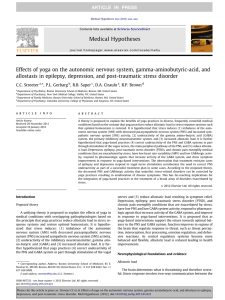
Effects of yoga on the autonomic nervous system
... term and damage the body in the long term [1], especially when stress becomes chronic and an allostatic load is incurred. For example, increased SNS activity with elevated blood pressure and heart rate in response to real or perceived threat is beneficial in the short term for survival, but sustained ...
... term and damage the body in the long term [1], especially when stress becomes chronic and an allostatic load is incurred. For example, increased SNS activity with elevated blood pressure and heart rate in response to real or perceived threat is beneficial in the short term for survival, but sustained ...

Application of EMDR in the Treatment of Major Depressive Disorder
... Recovery from individual episodes of depression is readily stimulated by appropriate treatment, but relapse is common and care over the long-term is essential. Depression runs in families, reflecting an inherited vulnerability. There is equally strong evidence, however, that childhood experiences, s ...
... Recovery from individual episodes of depression is readily stimulated by appropriate treatment, but relapse is common and care over the long-term is essential. Depression runs in families, reflecting an inherited vulnerability. There is equally strong evidence, however, that childhood experiences, s ...

Adolescent subthreshold-depression and anxiety
... DSM-IV-TR or ICD-10 due to an insufficient number or duration of symptoms (Johnson, Weissman, & Klerman, 1992). Patients with substantial functional impairment who do not meet diagnostic criteria are regarded as having subthreshold disorders (Judd, Rapaport, Paulus, & Brown, 1994). Helmchen and Lind ...
... DSM-IV-TR or ICD-10 due to an insufficient number or duration of symptoms (Johnson, Weissman, & Klerman, 1992). Patients with substantial functional impairment who do not meet diagnostic criteria are regarded as having subthreshold disorders (Judd, Rapaport, Paulus, & Brown, 1994). Helmchen and Lind ...

Mood Disorders
... because treatment of their major depressive episodes with antidepressant monotherapy may actually cause increased mood cycling or even induce a full manic episode, just as can happen in patients with bipolar I or II depressive episodes. In fact, patients who develop a manic or hypomanic episode on a ...
... because treatment of their major depressive episodes with antidepressant monotherapy may actually cause increased mood cycling or even induce a full manic episode, just as can happen in patients with bipolar I or II depressive episodes. In fact, patients who develop a manic or hypomanic episode on a ...

Depression
... • The family constellation and relationships • A developmental, medical and academic history • The status of interpersonal relationships • Verbal and behavioral warning cues • Any current stressors that may trigger a suicide attempt ...
... • The family constellation and relationships • A developmental, medical and academic history • The status of interpersonal relationships • Verbal and behavioral warning cues • Any current stressors that may trigger a suicide attempt ...
the ChemiCal imbalanCe explanation of Depression
... health problems, and whether participants believed that depression is primarily caused by “biological factors like brain chemistry” or “psychological or environmental factors like negative thoughts and behaviors or stressful life events.” The remaining two sections ...
... health problems, and whether participants believed that depression is primarily caused by “biological factors like brain chemistry” or “psychological or environmental factors like negative thoughts and behaviors or stressful life events.” The remaining two sections ...

Neural correlates of action attribution in schizophrenia
... The fraction of mean signal over the whole brain was specified for thresholding signal intensities above the grey matter value. Since the subjects were requested to move the joystick freely, there were some differences in the amount of movement between subjects and between conditions. To eliminate t ...
... The fraction of mean signal over the whole brain was specified for thresholding signal intensities above the grey matter value. Since the subjects were requested to move the joystick freely, there were some differences in the amount of movement between subjects and between conditions. To eliminate t ...

Emo7onal decision‐making systems and their role in addic7on
... these two cognitive systems, Kahneman summarized that: “…the operations of System 1 are typically fast, automatic, effortless, associative, implicit (not available to introspection), and often emotionally charged; they are also governed by habit and are therefore difBicult to control or modify…” ...
... these two cognitive systems, Kahneman summarized that: “…the operations of System 1 are typically fast, automatic, effortless, associative, implicit (not available to introspection), and often emotionally charged; they are also governed by habit and are therefore difBicult to control or modify…” ...

PDF file
... A simplest version of a Developmental Network (DN) has three areas, the sensory area X, the internal area Y and the motor area Z, with an example in Fig. 1(b). The internal neurons in Y have connection with both the sensory end X and the motor end Z. The largest scale account of neural anatomy so fa ...
... A simplest version of a Developmental Network (DN) has three areas, the sensory area X, the internal area Y and the motor area Z, with an example in Fig. 1(b). The internal neurons in Y have connection with both the sensory end X and the motor end Z. The largest scale account of neural anatomy so fa ...
Applying the Biopsychosocial Model: Factors Associated with
... medicine" are employed by educated individuals within the very country and culture from which he operates. Thus, while cultural generalities are discussed, the purpose of this research was not to claim that these cultural values and their applied implementations might in any way paint a complete pic ...
... medicine" are employed by educated individuals within the very country and culture from which he operates. Thus, while cultural generalities are discussed, the purpose of this research was not to claim that these cultural values and their applied implementations might in any way paint a complete pic ...
Biology of depression

Scientific studies have found that numerous brain areas show altered activity in patients suffering from depression, and this has encouraged advocates of various theories that seek to identify a biochemical origin of the disease, as opposed to theories that emphasize psychological or situational causes. Several theories concerning the biologically based cause of depression have been suggested over the years, of which the most prominent and widely researched is the monoamine hypothesis.