Applying the Biopsychosocial Model: Factors Associated with
... medicine" are employed by educated individuals within the very country and culture from which he operates. Thus, while cultural generalities are discussed, the purpose of this research was not to claim that these cultural values and their applied implementations might in any way paint a complete pic ...
... medicine" are employed by educated individuals within the very country and culture from which he operates. Thus, while cultural generalities are discussed, the purpose of this research was not to claim that these cultural values and their applied implementations might in any way paint a complete pic ...
Depressive Disorders An Integral Psychiatric Approach Marko van
... Experiencing a depression has a huge impact on the quality of life: 1. Depressive disorders involve a great deal of suffering for patients and their families, including the risk of premature death (through illness and/or suicide). 2. Depression has an adverse effect on the course of physical illne ...
... Experiencing a depression has a huge impact on the quality of life: 1. Depressive disorders involve a great deal of suffering for patients and their families, including the risk of premature death (through illness and/or suicide). 2. Depression has an adverse effect on the course of physical illne ...
File - McMurray VMC
... 1. Sleep Protects: Sleeping in the darkness when predators loomed about kept our ancestors out of harm’s way. 2. Sleep Helps us Recover: Sleep helps restore and repair brain tissue. 3. Sleep Helps us Remember: Sleep restores and rebuilds our fading memories. 4. Sleep may play a role in the growth pr ...
... 1. Sleep Protects: Sleeping in the darkness when predators loomed about kept our ancestors out of harm’s way. 2. Sleep Helps us Recover: Sleep helps restore and repair brain tissue. 3. Sleep Helps us Remember: Sleep restores and rebuilds our fading memories. 4. Sleep may play a role in the growth pr ...

Chapter: 10 Depressive and Bipolar Disorders.
... 31. Which symptom interferes with normal youth development of interpersonal relationships? a. sleeplessness b. agitation c. social withdrawal d. somatic complaints ANSWER: c DIFFICULTY: Easy REFERENCES: Associated Characteristics of Depressive Disorders KEYWORDS: Bloom’s: Understand 32. Which of the ...
... 31. Which symptom interferes with normal youth development of interpersonal relationships? a. sleeplessness b. agitation c. social withdrawal d. somatic complaints ANSWER: c DIFFICULTY: Easy REFERENCES: Associated Characteristics of Depressive Disorders KEYWORDS: Bloom’s: Understand 32. Which of the ...

File - Joris Vangeneugden
... quadrants will be associated with a tone of particular frequency however only one quadrant will be paired with a mild foot shock. We will investigate the time spent in the four quadrants as a measure of spatial discrimination (see 1b. Frequency-location coupling fear conditioning test [FREQ-LOC]). I ...
... quadrants will be associated with a tone of particular frequency however only one quadrant will be paired with a mild foot shock. We will investigate the time spent in the four quadrants as a measure of spatial discrimination (see 1b. Frequency-location coupling fear conditioning test [FREQ-LOC]). I ...

Meta-cognitive model - University of Sussex
... Often ‘all or nothing’ or ‘if/then’ beliefs that are contingent on selfworth. “If I do not do as well as other people, then I am inferior” Individuals with negative core beliefs often generate compensatory strategies and rules e.g. “I must always succeed in everything I do” Activation of depressotyp ...
... Often ‘all or nothing’ or ‘if/then’ beliefs that are contingent on selfworth. “If I do not do as well as other people, then I am inferior” Individuals with negative core beliefs often generate compensatory strategies and rules e.g. “I must always succeed in everything I do” Activation of depressotyp ...
Neuropsychiatric Sequelae of Stroke 113010
... – Early-onset is more strongly related to premorbid psychiatric (including alcohol) history ...
... – Early-onset is more strongly related to premorbid psychiatric (including alcohol) history ...
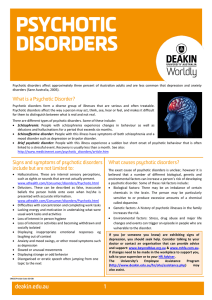
psychotic disorders
... What is a Psychotic Disorder? Psychotic disorders form a diverse group of illnesses that are serious and often treatable. Psychotic disorders affect the way a person may act, think, see, hear or feel, and makes it difficult for them to distinguish between what is real and not real. There are differe ...
... What is a Psychotic Disorder? Psychotic disorders form a diverse group of illnesses that are serious and often treatable. Psychotic disorders affect the way a person may act, think, see, hear or feel, and makes it difficult for them to distinguish between what is real and not real. There are differe ...

Evolutionary Models - Personal
... the last possibility is most fundamental and must be considered first. Does depression arise, like cancer and stroke, from a defect in the body’s machinery; or is it, like fever and pain, a protective defensive response; or is it, like chronic pain or febrile seizures, a complication or maladaptive ...
... the last possibility is most fundamental and must be considered first. Does depression arise, like cancer and stroke, from a defect in the body’s machinery; or is it, like fever and pain, a protective defensive response; or is it, like chronic pain or febrile seizures, a complication or maladaptive ...
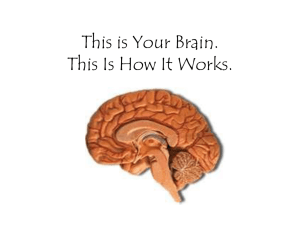
This is Your Brain. This Is How It Works.
... • The synapse is the junction between an axon terminal and an adjacent dendrite or cell body. • Neurotransmitter (NT) molecules are released from the axon terminal into the synapse when the action potential arrives at the axon terminal. © 2004 John Wiley & Sons, Inc. Huffman: PSYCHOLOGY IN ACTION, 7 ...
... • The synapse is the junction between an axon terminal and an adjacent dendrite or cell body. • Neurotransmitter (NT) molecules are released from the axon terminal into the synapse when the action potential arrives at the axon terminal. © 2004 John Wiley & Sons, Inc. Huffman: PSYCHOLOGY IN ACTION, 7 ...
Hypothalamus and Limbic System, Lecture 2 Emotion and reward
... • The sham rage experiments established the hypothalamus as playing a prominent role in coordinating emotional behavior. • Further studies by Stephen Ranson in the 1930s and by Walter Hess in the 1940s extended these findings. These investigators placed electrodes in the hypothalamus (Ranson in anae ...
... • The sham rage experiments established the hypothalamus as playing a prominent role in coordinating emotional behavior. • Further studies by Stephen Ranson in the 1930s and by Walter Hess in the 1940s extended these findings. These investigators placed electrodes in the hypothalamus (Ranson in anae ...
Hypothalamus and Limbic System, Lecture 2
... trigger specific emotional responses, presumably through the hypothalamus and other subcortical pathways. – Reward information (positive and negative) must in turn be transferred from the peripheral receptors that sense reward to cortical and sub-cortical structures that use this information to guid ...
... trigger specific emotional responses, presumably through the hypothalamus and other subcortical pathways. – Reward information (positive and negative) must in turn be transferred from the peripheral receptors that sense reward to cortical and sub-cortical structures that use this information to guid ...

1. Calabrese JR, Prescott M, Tamburrino M, Liberzon I, Slembarski
... A cohort of Ohio National Guard soldiers was interviewed three times over 3 years. The analytic sample included Ohio National Guard soldiers who had been deployed by 2008– 2009, had participated in at least one follow-up wave, had reported consuming at least one alcoholic drink in their lifetime, an ...
... A cohort of Ohio National Guard soldiers was interviewed three times over 3 years. The analytic sample included Ohio National Guard soldiers who had been deployed by 2008– 2009, had participated in at least one follow-up wave, had reported consuming at least one alcoholic drink in their lifetime, an ...

Dawn Simulation and Bright Light in the Treatment of SAD
... sleep-wake depends on the proper functioning of an internal circadian clock, which lies deep in the brain. This circadian clock works with photosensors in the eyes to sense darkness. When darkness falls, the body begins to secrete melatonin, which is one of the factors that cause sleep. Melatonin co ...
... sleep-wake depends on the proper functioning of an internal circadian clock, which lies deep in the brain. This circadian clock works with photosensors in the eyes to sense darkness. When darkness falls, the body begins to secrete melatonin, which is one of the factors that cause sleep. Melatonin co ...

1 - U-System
... fields, and more complex properties - destruction of primary somatosensory cortex causes a somatosensory deficit, but not a total loss; this is true because there is parallel processing occurring (thalamic info goes to both primary and association areas, which can function by themselves) - there are ...
... fields, and more complex properties - destruction of primary somatosensory cortex causes a somatosensory deficit, but not a total loss; this is true because there is parallel processing occurring (thalamic info goes to both primary and association areas, which can function by themselves) - there are ...

Mood Disorders
... profile that defines distinct, separate episodes may not be present (EX: the person may not have a decreased need for sleep), making such "ultra-rapid" cycling a more controversial phenomenon. Rapid cycling can occur at any time in the course of illness, although some researchers believe that it may ...
... profile that defines distinct, separate episodes may not be present (EX: the person may not have a decreased need for sleep), making such "ultra-rapid" cycling a more controversial phenomenon. Rapid cycling can occur at any time in the course of illness, although some researchers believe that it may ...

Duration
... Lowered pain sensitivity. Possibly due to changes in activity of the 5HT fibers that descend into the spinal cord. Withdrawal. No serious withdrawal symptoms. ...
... Lowered pain sensitivity. Possibly due to changes in activity of the 5HT fibers that descend into the spinal cord. Withdrawal. No serious withdrawal symptoms. ...

Chapter 8 Nervous System
... • Compares motor commands with sensory info from muscles and joints and performs adjustments to make the movement ...
... • Compares motor commands with sensory info from muscles and joints and performs adjustments to make the movement ...

The Depressed Patient And Suicidal Patient In The Emergency
... Practice is to examine the broad literature base on depression and depression with suicidal ideation as it pertains to the practice of emergency medicine. Risk factors associated with depression and suicide are ...
... Practice is to examine the broad literature base on depression and depression with suicidal ideation as it pertains to the practice of emergency medicine. Risk factors associated with depression and suicide are ...

Affective (mood) disorders
... increased risk of depressive disorders they are not at increased risk of bipolar affective disorder or schizoaffecive disorder. The concordance rate for major depression in monozygotic twins is 46%, compared to 20% in dizygotic twins. There is thus an important genetic component to the aetiology of ...
... increased risk of depressive disorders they are not at increased risk of bipolar affective disorder or schizoaffecive disorder. The concordance rate for major depression in monozygotic twins is 46%, compared to 20% in dizygotic twins. There is thus an important genetic component to the aetiology of ...
Depression - National Medical Research Council
... Take a detailed history of the presenting symptoms and determine the severity and duration of the depressive episode. Establish history of prior episodes, prior manic or hypomanic episodes, substance abuse and other psychiatric illnesses. Look out for coexisting medical conditions. Check for family ...
... Take a detailed history of the presenting symptoms and determine the severity and duration of the depressive episode. Establish history of prior episodes, prior manic or hypomanic episodes, substance abuse and other psychiatric illnesses. Look out for coexisting medical conditions. Check for family ...

Bringing the Brain of the Child with Autism Back on Track
... causes of autism, as well as the range of living subjects at such a fine level behavioral effects. Although these studies of detail allows greater understand- have been invaluable in understanding more about the disorder, it is research at a more ing of the processes that underlie basic level that m ...
... causes of autism, as well as the range of living subjects at such a fine level behavioral effects. Although these studies of detail allows greater understand- have been invaluable in understanding more about the disorder, it is research at a more ing of the processes that underlie basic level that m ...

myersand fun Chapter 16 (2)
... I felt the need to clean my room … spent four to five hour at it … At the time I loved it but then didn't want to do it any more, but could not stop … The clothes hung … two fingers apart …I touched my bedroom wall before leaving the house … I had constant anxiety … I thought I might be nuts. Marc, ...
... I felt the need to clean my room … spent four to five hour at it … At the time I loved it but then didn't want to do it any more, but could not stop … The clothes hung … two fingers apart …I touched my bedroom wall before leaving the house … I had constant anxiety … I thought I might be nuts. Marc, ...
Biology of depression

Scientific studies have found that numerous brain areas show altered activity in patients suffering from depression, and this has encouraged advocates of various theories that seek to identify a biochemical origin of the disease, as opposed to theories that emphasize psychological or situational causes. Several theories concerning the biologically based cause of depression have been suggested over the years, of which the most prominent and widely researched is the monoamine hypothesis.