
PPT File - Regional Climate Modeling Laboratory
... • Increase in night-time temperatures – Higher night-time respiration by plants – Higher soil respiration and loss of soil carbon ...
... • Increase in night-time temperatures – Higher night-time respiration by plants – Higher soil respiration and loss of soil carbon ...

Concept Note - the United Nations
... generations of humankind on the basis of equity and in accordance with their common but differentiated responsibilities and respective capabilities. 6. There is an urgent need to close the gap between the aggregate effect of mitigation pledges by parties in terms of global annual emissions of green ...
... generations of humankind on the basis of equity and in accordance with their common but differentiated responsibilities and respective capabilities. 6. There is an urgent need to close the gap between the aggregate effect of mitigation pledges by parties in terms of global annual emissions of green ...
Houghton CDFS 1 - University of California, Irvine
... The ultimate objective of this Convention .... is to achieve, .… stabilization of greenhouse gas concentrations in the atmosphere at a level that would prevent dangerous anthropogenic interference with the climate system. •Such a level should be achieved within a time-frame sufficient : • to allow e ...
... The ultimate objective of this Convention .... is to achieve, .… stabilization of greenhouse gas concentrations in the atmosphere at a level that would prevent dangerous anthropogenic interference with the climate system. •Such a level should be achieved within a time-frame sufficient : • to allow e ...

Global Environmental Change
... Climate change is intensifying the circulation of water on, above and below the surface of the Earth — causing drought and floods to be more frequent, severe and widespread. Higher temperatures increase the amount of moisture that evaporates from land and water, leading to drought in many areas. Lan ...
... Climate change is intensifying the circulation of water on, above and below the surface of the Earth — causing drought and floods to be more frequent, severe and widespread. Higher temperatures increase the amount of moisture that evaporates from land and water, leading to drought in many areas. Lan ...
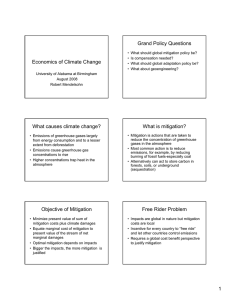
Grand Policy Questions Economics of Climate Change
... emissions, for example, by reducing burning of fossil fuels-especially coal • Alternatively can act to store carbon in ...
... emissions, for example, by reducing burning of fossil fuels-especially coal • Alternatively can act to store carbon in ...

energy & environment - Kilkenny County Council
... More specifically, eleven of the last twelve years (1995-2006) rank among the 12 warmest years ever recorded since global surface temperatures are measured (1850). Over the last 100 years (1906–2005), global temperature has increased by 0.74°C. Global sea level has risen by 17 cm during the 20th ...
... More specifically, eleven of the last twelve years (1995-2006) rank among the 12 warmest years ever recorded since global surface temperatures are measured (1850). Over the last 100 years (1906–2005), global temperature has increased by 0.74°C. Global sea level has risen by 17 cm during the 20th ...

Slide 1 - climateknowledge.org
... • Climate Monitoring at National Climatic Data Center. – http://www.ncdc.noaa.gov/oa/ncdc.html ...
... • Climate Monitoring at National Climatic Data Center. – http://www.ncdc.noaa.gov/oa/ncdc.html ...

The Earth`s Changing Climate
... IPCC 4th Assessment Report • Warming of the climate system is unequivocal • Most of global temperature is very likely (>90%) anthropogenic (human) • Anthropogenic warming and sea level rise would continue for centuries • Probability warming is only natural variation is less than 5% • World temperat ...
... IPCC 4th Assessment Report • Warming of the climate system is unequivocal • Most of global temperature is very likely (>90%) anthropogenic (human) • Anthropogenic warming and sea level rise would continue for centuries • Probability warming is only natural variation is less than 5% • World temperat ...

Chapter 16 - Global Climate
... • Humans release, fossil fuels,CFCs and other greenhouse gases into the environment. – Concentrations of these gases has increased in the recent past – The atmosphere has warmed 0.8oC during the last century ...
... • Humans release, fossil fuels,CFCs and other greenhouse gases into the environment. – Concentrations of these gases has increased in the recent past – The atmosphere has warmed 0.8oC during the last century ...

multi-dimensional security
... cause the problem • Military, law and order, economic, technological, and human dimensions of security can suffer as a result ...
... cause the problem • Military, law and order, economic, technological, and human dimensions of security can suffer as a result ...

Document
... “I say canary in the coal mine because the Arctic is one part of the world that is experiencing faster impact from global warming.” Al Gore (2006) ...
... “I say canary in the coal mine because the Arctic is one part of the world that is experiencing faster impact from global warming.” Al Gore (2006) ...

Benthic ecology - The Quality Status Report 2010
... gross productivity, which is likely to remain the case in the short to medium term. As benthic communities are broadly similar around the world, the system is not likely to become vastly different i.e. polychaetes, molluscs and echinoderms will still dominate the macrofauna, but there remains the po ...
... gross productivity, which is likely to remain the case in the short to medium term. As benthic communities are broadly similar around the world, the system is not likely to become vastly different i.e. polychaetes, molluscs and echinoderms will still dominate the macrofauna, but there remains the po ...

traditional funding Establish Climate Change (and DRR) Fund
... 17 years 10 years 10 years 3 years ...
... 17 years 10 years 10 years 3 years ...

greenhouse gases - UW Program on Climate Change
... • Human activities are increasing greenhouse gases (like CO2) all over the world. • As a result, the average temperature of the world is increasing. • Future warming of at least 1C by 2050 • Future climate depends on our choices ...
... • Human activities are increasing greenhouse gases (like CO2) all over the world. • As a result, the average temperature of the world is increasing. • Future warming of at least 1C by 2050 • Future climate depends on our choices ...

Ice cap meltdown to cause 22ft floods
... committed to a collapse of the Greenland ice sheet. But we don't think we have passed the tipping point yet." A remnant of the last Ice Age, Greenland's ice cap is nearly two miles high. But if the climate change crisis reached the point of no return and it were to melt then global sea levels would ...
... committed to a collapse of the Greenland ice sheet. But we don't think we have passed the tipping point yet." A remnant of the last Ice Age, Greenland's ice cap is nearly two miles high. But if the climate change crisis reached the point of no return and it were to melt then global sea levels would ...

Mountains, Climate Adaptation and Sustainable Development
... support more sustainable agriculture,.. forestry, fisheries,…’ to improve food security, eradicate hunger, and to conserve land, water, plant and .., biodiversity and ecosystems, for enhancing resilience to climate change and natural disasters (Agri. & FS). 119. `…We also recognize the need to maint ...
... support more sustainable agriculture,.. forestry, fisheries,…’ to improve food security, eradicate hunger, and to conserve land, water, plant and .., biodiversity and ecosystems, for enhancing resilience to climate change and natural disasters (Agri. & FS). 119. `…We also recognize the need to maint ...

Data in developing countries
... A Variety of Forecasts Weather • mostly regional, short-lived events • Deterministic forecasts • protection of life Seasonal climate • Global, seasons in advance • Probabilistic forecasts – deviations from normal seasons • Mitigation – energy; food; water; health, etc sectors Climate change scenari ...
... A Variety of Forecasts Weather • mostly regional, short-lived events • Deterministic forecasts • protection of life Seasonal climate • Global, seasons in advance • Probabilistic forecasts – deviations from normal seasons • Mitigation – energy; food; water; health, etc sectors Climate change scenari ...

PDF
... stratospheric ozone layer. As a result of this agreement, consumption of various CFCs has decreased worldwide by as much as 40 percent from 1986 levels. V nfortunately, many of the proposed substitutes for these chemicals, while ozone friendly, are also very strong greenhouse gases, 1,000s of times ...
... stratospheric ozone layer. As a result of this agreement, consumption of various CFCs has decreased worldwide by as much as 40 percent from 1986 levels. V nfortunately, many of the proposed substitutes for these chemicals, while ozone friendly, are also very strong greenhouse gases, 1,000s of times ...

Steven McNulty - NSTA Learning Center
... Insect Caused Forest Loss Mountain pine beetle Pine beetle damage ...
... Insect Caused Forest Loss Mountain pine beetle Pine beetle damage ...

Climate Change and Natural Disasters in Switzerland
... Whether Switzerland will be affected more frequently by natural disasters in the future will depend on the interplay between the different climatic factors and on local sensitivities. In order to make quantitative estimates, detailed model analyses will be generally necessary. On the whole, it can b ...
... Whether Switzerland will be affected more frequently by natural disasters in the future will depend on the interplay between the different climatic factors and on local sensitivities. In order to make quantitative estimates, detailed model analyses will be generally necessary. On the whole, it can b ...

Initiatives in Bangladesh - Workspace
... More than 80% of the 2,300 mm of annual precipitation in Bangladesh occurs during the monsoon period A quarter of the country is currently flood-prone in a normal hydrological year, which may increase up to 39% under climate change scenarios in the next century. Predictions: – episodes of heavy rain ...
... More than 80% of the 2,300 mm of annual precipitation in Bangladesh occurs during the monsoon period A quarter of the country is currently flood-prone in a normal hydrological year, which may increase up to 39% under climate change scenarios in the next century. Predictions: – episodes of heavy rain ...

Brief Overview of Climate Change
... Greenhouse gases are necessary to live as we know it, because they keep the planet's surface warmer than it otherwise would be. But, as the concentrations of these gases continue to increase in the atmosphere, the Earth's temperature is climbing above past levels. According to NOAA and NASA data, th ...
... Greenhouse gases are necessary to live as we know it, because they keep the planet's surface warmer than it otherwise would be. But, as the concentrations of these gases continue to increase in the atmosphere, the Earth's temperature is climbing above past levels. According to NOAA and NASA data, th ...
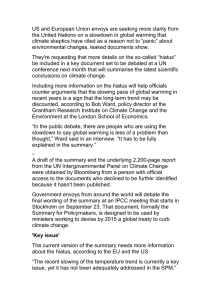
IPCC critique of Draft seeking more clarity slowdown in global
... Environment at the London School of Economics. “In the public debate, there are people who are using the slowdown to say global warming is less of a problem than thought,” Ward said in an interview. “It has to be fully explained in the summary.” ...
... Environment at the London School of Economics. “In the public debate, there are people who are using the slowdown to say global warming is less of a problem than thought,” Ward said in an interview. “It has to be fully explained in the summary.” ...

100530_ShanhaiForumPresSubmitted1_Husar
... Some heating other cooling the Earth If human-induced heating exceeds the cooling, the atmosphere will be warming. ...
... Some heating other cooling the Earth If human-induced heating exceeds the cooling, the atmosphere will be warming. ...

Presentation
... - Increased humanitarian assistance and disaster relief operations due to extreme weather events. - Increased access to the Arctic region, driving competition. - Increased potential conflict due to water scarcity. - Developing countries are already experiencing this. - Competition for access and con ...
... - Increased humanitarian assistance and disaster relief operations due to extreme weather events. - Increased access to the Arctic region, driving competition. - Increased potential conflict due to water scarcity. - Developing countries are already experiencing this. - Competition for access and con ...
Effects of global warming on humans

Climate change has brought about possibly permanent alterations to our planet’s geological, biological and ecological systems. The Intergovernmental Panel on Climate Change (IPCC) contended in 2003 that “there is new and stronger evidence that most of the warming observed over the last 50 years is attributable to human activities”. These changes have led to the emergence of large-scale environmental hazards to human health, such as extreme weather, ozone depletion, increased danger of wildland fires, loss of biodiversity, stresses to food-producing systems and the global spread of infectious diseases. The World Health Organization (WHO) estimates that 160,000 deaths, since 1950, are directly attributable to climate change. Many believe this to be a conservative estimate.To date, a neglected aspect of the climate change debate, much less research has been conducted on the impacts of climate change on health, food supply, economic growth, migration, security, societal change, and public goods, such as drinking water, than on the geophysical changes related to global warming. Human impacts can be both negative and positive. Climatic changes in Siberia, for instance, are expected to improve food production and local economic activity, at least in the short to medium term. Numerous studies suggest, however, that the current and future impacts of climate change on human society are and will continue to be overwhelmingly negative.The majority of the adverse effects of climate change are experienced by poor and low-income communities around the world, who have much higher levels of vulnerability to environmental determinants of health, wealth and other factors, and much lower levels of capacity available for coping with environmental change. A report on the global human impact of climate change published by the Global Humanitarian Forum in 2009, estimated more than 300,000 deaths and about $125 billion in economic losses each year, and indicating that most climate change induced mortality is due to worsening floods and droughts in developing countries. This also raises questions of climate justice, since the 50 least developed countries of the world account for not more than 1% of worldwide emissions of greenhouse gases.