
Geology of Base-Metal Deposits
... Thus, in a Cu–Zn deposit the copper may be contained in chalcopyrite and/or bornite, and the zinc in sphalerite. Other sulfide minerals usually found in association with these ore minerals are pyrite and/or pyrrhotite; common accessory oxide minerals are magnetite and hematite. Geologists recognize ...
... Thus, in a Cu–Zn deposit the copper may be contained in chalcopyrite and/or bornite, and the zinc in sphalerite. Other sulfide minerals usually found in association with these ore minerals are pyrite and/or pyrrhotite; common accessory oxide minerals are magnetite and hematite. Geologists recognize ...

8.7 NOTES How do glaciers cause erosion? Objective: Explain how
... Frozen sediments moves with the glacier and is carried to new places. If it moves to warmer places, the ice around the edges begins to melt. Rocks and sediment that were frozen in the glacier are left behind. This loose material is called till. ...
... Frozen sediments moves with the glacier and is carried to new places. If it moves to warmer places, the ice around the edges begins to melt. Rocks and sediment that were frozen in the glacier are left behind. This loose material is called till. ...

Adamstown
... Ll: Locally important aquifer which is moderately productive only in local zones Pl: Poor aquifer which is generally unproductive except for local zones Mostly: Ordovician Volcanics With Smaller areas of: Devonian Old Red Sandstones Granites & other Igneous Intrusive rocks Ordovician Metasediments T ...
... Ll: Locally important aquifer which is moderately productive only in local zones Pl: Poor aquifer which is generally unproductive except for local zones Mostly: Ordovician Volcanics With Smaller areas of: Devonian Old Red Sandstones Granites & other Igneous Intrusive rocks Ordovician Metasediments T ...
KS4-Earth-and-Atmosphere
... All of these are involved in a continuous flow of rock from the surface underground only to emerge again later as part of the on-going rock ...
... All of these are involved in a continuous flow of rock from the surface underground only to emerge again later as part of the on-going rock ...

igneous rocks
... lithospheric plates pull apart at mid-ocean ridges, where plates come together at subduction zones and where continental crust is pushed together, making it thicker and allowing it to heat to melting. ...
... lithospheric plates pull apart at mid-ocean ridges, where plates come together at subduction zones and where continental crust is pushed together, making it thicker and allowing it to heat to melting. ...

from continental drift to plate tectonics
... that for several hundred million years during the late Paleozoic and Mesozoic eras (200 million to 300 million years ago), the continents were united into a supercontinent that he labeled Pangea—all Earth. Continental drift would also explain paleoclimate change, as continents drifted through differ ...
... that for several hundred million years during the late Paleozoic and Mesozoic eras (200 million to 300 million years ago), the continents were united into a supercontinent that he labeled Pangea—all Earth. Continental drift would also explain paleoclimate change, as continents drifted through differ ...

pdf of 6 units below
... stored in the ground below us, where different types of rocks can act as reservoirs. Sand or sandstone is the best material for a reservoir and forms extensive aquifers underground, but not all sands are created equal, as students will find out in lab. Filtering water through different porous substa ...
... stored in the ground below us, where different types of rocks can act as reservoirs. Sand or sandstone is the best material for a reservoir and forms extensive aquifers underground, but not all sands are created equal, as students will find out in lab. Filtering water through different porous substa ...

Earth History
... Greenhouse conditions. Sea levels the highest they have been for 200 m.y. Chalk deposits in Europe, limestone + sandstone in North America. Shallow seas flooded many continents. Break up of Pangaea continued - South Atlantic opened, India, Antarctica, and Australia all broke apart. In the western US ...
... Greenhouse conditions. Sea levels the highest they have been for 200 m.y. Chalk deposits in Europe, limestone + sandstone in North America. Shallow seas flooded many continents. Break up of Pangaea continued - South Atlantic opened, India, Antarctica, and Australia all broke apart. In the western US ...

Pangea - Mrs. LeFevre`s Class
... Australia, and Antarctica) were one gigantic continent which scientists call Pangaea (pan-gee-uh). The name Pangaea is derived from the Ancient Greek words “pan” meaning "entire," and “Gaia” meaning "Earth." Continental drift, the process by which the continents broke apart and spread out across t ...
... Australia, and Antarctica) were one gigantic continent which scientists call Pangaea (pan-gee-uh). The name Pangaea is derived from the Ancient Greek words “pan” meaning "entire," and “Gaia” meaning "Earth." Continental drift, the process by which the continents broke apart and spread out across t ...

Mineral Resources - Illinois State University
... Source Rock – Igneous U is leached (dissolved) into groundwater Deposit Types – Sandstones that have been enriched with U minerals (groundwater enrichment) – U-bearing minerals in rock fractures – Placer Deposits ...
... Source Rock – Igneous U is leached (dissolved) into groundwater Deposit Types – Sandstones that have been enriched with U minerals (groundwater enrichment) – U-bearing minerals in rock fractures – Placer Deposits ...

Full-Text - Journal of Tethys
... located in southeast of Tabriz and south of Tabriz Fault in northwest Iran (Fig. 2). Sahand Dome is one of several (about 30) sub-volcanic domes of the south of Tabriz Fault trending northwest–southeast. The dome mainly is composed of dacite and minor component is rhyodacite, with porphyritic textur ...
... located in southeast of Tabriz and south of Tabriz Fault in northwest Iran (Fig. 2). Sahand Dome is one of several (about 30) sub-volcanic domes of the south of Tabriz Fault trending northwest–southeast. The dome mainly is composed of dacite and minor component is rhyodacite, with porphyritic textur ...

Observations explained by “Snowball Earth”
... Snow-free glacier ice exposed in the subtropics. This ice will resemble the snowfree “blue ice” surfaces found near Antarctic mountains. This ice has a high albedo (about 0.6) because it contains numerous bubbles, since its origin was compression of snow. Frozen seawater exposed at the equator. If t ...
... Snow-free glacier ice exposed in the subtropics. This ice will resemble the snowfree “blue ice” surfaces found near Antarctic mountains. This ice has a high albedo (about 0.6) because it contains numerous bubbles, since its origin was compression of snow. Frozen seawater exposed at the equator. If t ...

Soil, Rocks, and Minerals Notes
... rock- Hardened, non-living material that makes up the crust of the earth, made up of two or more minerals sedimentary rock- Rock formed from bits or layers of rocks cemented together igneous rock- “Fire-made” rock formed from melted rock material from the mantle that has cooled. metamorphic rock- Ro ...
... rock- Hardened, non-living material that makes up the crust of the earth, made up of two or more minerals sedimentary rock- Rock formed from bits or layers of rocks cemented together igneous rock- “Fire-made” rock formed from melted rock material from the mantle that has cooled. metamorphic rock- Ro ...

Sediment and Sedimentary Rocks
... eroding rocks. Such material, called detritus, consists of fragments of rocks and minerals. When the energy of the transporting current is not strong enough to carry these particles, the particles drop out in the process of sedimentation. This type of sedimentary deposition is referred to as clastic ...
... eroding rocks. Such material, called detritus, consists of fragments of rocks and minerals. When the energy of the transporting current is not strong enough to carry these particles, the particles drop out in the process of sedimentation. This type of sedimentary deposition is referred to as clastic ...

THE GEOLOGICAL STORY OF PENNSYLVANIA Educational Series 4
... 4.6 to 4 billion years ago, the earth became zoned into contrasting concentric layers. A thin, silica-rich outer layer, the crust, floats on a thick, dense, silica-deficient partly molten layer called the mantle. Beneath that is a heavy-metal core. The outer part of the core is a very hot liquid. Th ...
... 4.6 to 4 billion years ago, the earth became zoned into contrasting concentric layers. A thin, silica-rich outer layer, the crust, floats on a thick, dense, silica-deficient partly molten layer called the mantle. Beneath that is a heavy-metal core. The outer part of the core is a very hot liquid. Th ...

Properties of aquifers
... Hydraulic conductivity - also known as permeability - is the ability of the rock or unconsolidated material to transmit water. Although hydraulic conductivity is partly controlled by intergranular porosity, it is important to remember that very fine grained rocks and materials or rocks with disconne ...
... Hydraulic conductivity - also known as permeability - is the ability of the rock or unconsolidated material to transmit water. Although hydraulic conductivity is partly controlled by intergranular porosity, it is important to remember that very fine grained rocks and materials or rocks with disconne ...
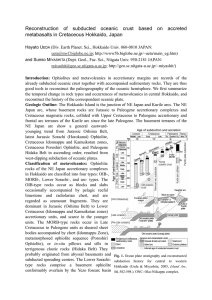
Reconstruction of subducted oceanic crust based on accreted
... complex) of the Idonnappu Zone as a dismembered ophiolite. The partly preserved volcano-sedimentary sequence, in which andesitic volcanics are overlain by radiolarian chert, suggests that they originated from intraoceanic remnant arc such as the present-day Kyushu-Palau Ridge. History of subducted o ...
... complex) of the Idonnappu Zone as a dismembered ophiolite. The partly preserved volcano-sedimentary sequence, in which andesitic volcanics are overlain by radiolarian chert, suggests that they originated from intraoceanic remnant arc such as the present-day Kyushu-Palau Ridge. History of subducted o ...

arehart-draft - The Nevada Seismological Laboratory
... Proterozoic sedimentary rocks (terrigenous detrital sequence [TDS] of Stewart, 1980). During early- to mid-Paleozoic time, much of the western margin of North America was a passive margin, with continued accumulation of a thick section of dominantly fine-grained clastic and carbonate “eastern assemb ...
... Proterozoic sedimentary rocks (terrigenous detrital sequence [TDS] of Stewart, 1980). During early- to mid-Paleozoic time, much of the western margin of North America was a passive margin, with continued accumulation of a thick section of dominantly fine-grained clastic and carbonate “eastern assemb ...

Formation of limestone pavement in Karst region| sample
... As more weight is added the air and water pockets between each sediment are squeezed out and is stuck together with a calcium or silica sticking agent. Limestone is formed when lithification occurs with dead marine organisms on the sea bed. In Ireland, limestone was formed in the carboniferous perio ...
... As more weight is added the air and water pockets between each sediment are squeezed out and is stuck together with a calcium or silica sticking agent. Limestone is formed when lithification occurs with dead marine organisms on the sea bed. In Ireland, limestone was formed in the carboniferous perio ...

Rocks provide a timeline for Earth.
... The geologic time scale divides Earth’s history into eons, eras, periods, and epochs. The divisions are based on major changes or events that occurred in Earth’s history. ...
... The geologic time scale divides Earth’s history into eons, eras, periods, and epochs. The divisions are based on major changes or events that occurred in Earth’s history. ...

DOGAMI Open-File Report O-09-05, Preliminary geologic map of the
... (intrusive), black = coal, tan = alluvium, blue = blue clay. Add the appropriate four-letter county abbreviation (BENT, LINN, POLK, or MARI) to construct the Oregon Water Resources Department (OWRD) well log identification number. ...
... (intrusive), black = coal, tan = alluvium, blue = blue clay. Add the appropriate four-letter county abbreviation (BENT, LINN, POLK, or MARI) to construct the Oregon Water Resources Department (OWRD) well log identification number. ...

Review of the Earth Science Curriculum FROM McGUIRE Equations
... but doesn’t due to refraction *Sun is higher in the summer than in the winter in NY, but never overhead- can only be overhead between 23.5 degrees south and 23.5 degrees north latitude *Seasons are caused by a combination of the 23.5 degree tilt of the axis and Earth’s revolution around the sun *12 ...
... but doesn’t due to refraction *Sun is higher in the summer than in the winter in NY, but never overhead- can only be overhead between 23.5 degrees south and 23.5 degrees north latitude *Seasons are caused by a combination of the 23.5 degree tilt of the axis and Earth’s revolution around the sun *12 ...

geo-4840 tectonics-s04
... Schematic view of stages in a classical Wilson cycle 5) Remnant stage Continental collision, suture zones, deformation and metamorphism, mountain building Extensional collapse, faulting and collapse basins 4) Terminal stage Near closure of ocean, mature arcs and back-arc, accreationary wedges, HP-L ...
... Schematic view of stages in a classical Wilson cycle 5) Remnant stage Continental collision, suture zones, deformation and metamorphism, mountain building Extensional collapse, faulting and collapse basins 4) Terminal stage Near closure of ocean, mature arcs and back-arc, accreationary wedges, HP-L ...

kittitas valley field trip
... mélange rocks arrived at the subduction zone, they were obducted (thrust over) across the top of the continent along low-angle thrust faults. Some of these great “thrust sheets” may have been thrust for hundreds of kilometers. We suspect that this happened about 90 million years ago. These rocks ove ...
... mélange rocks arrived at the subduction zone, they were obducted (thrust over) across the top of the continent along low-angle thrust faults. Some of these great “thrust sheets” may have been thrust for hundreds of kilometers. We suspect that this happened about 90 million years ago. These rocks ove ...

PETLAB3-14
... known as ’spinifex’ that has a platy habit. Spinifex texture is best developed in the upper chilled margin of komatiite lava flows. Komatiites are typically somewhat lighter green in colour than associated mafic volcanic rocks such as basalts because of the formers high Mg content, and they were oft ...
... known as ’spinifex’ that has a platy habit. Spinifex texture is best developed in the upper chilled margin of komatiite lava flows. Komatiites are typically somewhat lighter green in colour than associated mafic volcanic rocks such as basalts because of the formers high Mg content, and they were oft ...
Geology of Great Britain

The geology of Great Britain is renowned for its diversity. As a result of its eventful geological history, Great Britain shows a rich variety of landscapes across the constituent countries of England, Wales and Scotland. Rocks of almost all geological ages are represented at outcrop, from the Archaean onwards.