
ROCKS - My CCSD
... When sediments are dropped, they eventually become compacted and cemented to form sedimentary rocks. Formation of Sedimentary Rocks • The word sedimentary comes from the Latin word sedimentum, which means “settling.” • Sedimentary rocks form when solids settle out of a fluid such as a water or air. ...
... When sediments are dropped, they eventually become compacted and cemented to form sedimentary rocks. Formation of Sedimentary Rocks • The word sedimentary comes from the Latin word sedimentum, which means “settling.” • Sedimentary rocks form when solids settle out of a fluid such as a water or air. ...

Facies and Time
... Primitive – crystalline rocks, both igneous and metamorphic. Thought to represent first chemical precipitates from a worldwide ocean. Transition – stony, indurated stratified rocks such as graywacke, limestones, sills. Stratified – obviously stratified fossiliferous rocks, thought to represent the f ...
... Primitive – crystalline rocks, both igneous and metamorphic. Thought to represent first chemical precipitates from a worldwide ocean. Transition – stony, indurated stratified rocks such as graywacke, limestones, sills. Stratified – obviously stratified fossiliferous rocks, thought to represent the f ...
Geology Field Notes: Big Bend National Park, Texas Big Bend is a
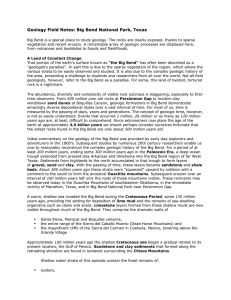
... years ago are, at best, difficult to comprehend. Since astronomers now place the age of the earth at approximately 4.6 billion years we should perhaps consider ourselves fortunate that the oldest rocks found in the Big Bend are only about 500 million years old. Initial commentary on the geology of t ...
... years ago are, at best, difficult to comprehend. Since astronomers now place the age of the earth at approximately 4.6 billion years we should perhaps consider ourselves fortunate that the oldest rocks found in the Big Bend are only about 500 million years old. Initial commentary on the geology of t ...

In-class Video Summaries - CSU
... methane, etc.) absorbing the infrared radiation as it tries to escape back to space. In contrast, the Moon with its minimal atmosphere has extremely cold nights and hot days. The ground heats the air right at the surface via conduction, but the hot air rises as convection. Evaporation carries heat e ...
... methane, etc.) absorbing the infrared radiation as it tries to escape back to space. In contrast, the Moon with its minimal atmosphere has extremely cold nights and hot days. The ground heats the air right at the surface via conduction, but the hot air rises as convection. Evaporation carries heat e ...

A PROFILE OF SOUTHERN CALIFORNIA GEOLOGY Richard H
... wise disturbed, and so much of this diastrophic activity has persisted into recent geologic times that most of the present physiographic the region are intimately related to faulting. ...
... wise disturbed, and so much of this diastrophic activity has persisted into recent geologic times that most of the present physiographic the region are intimately related to faulting. ...

The Earth`s Interior
... Continental flood basalts (CFBs) Large Igneous Provinces (LIPs) Oceanic plateaus Some rifts Continental flood basalts (CFBs) ...
... Continental flood basalts (CFBs) Large Igneous Provinces (LIPs) Oceanic plateaus Some rifts Continental flood basalts (CFBs) ...

3-highland rocks-pristine-concept-
... Pristinity Concept • Pristine rocks: – Rocks produced by endogenous igneous processes – Not impact melts or breccias composed of more than one lithology (i.e., they are not polymict breccias) – But they can be crushed, granulated, sheared, and generally messed up – And they can be found in breccias ...
... Pristinity Concept • Pristine rocks: – Rocks produced by endogenous igneous processes – Not impact melts or breccias composed of more than one lithology (i.e., they are not polymict breccias) – But they can be crushed, granulated, sheared, and generally messed up – And they can be found in breccias ...

Geologic Trips San Francisco and the Bay Area
... San Francisco rests on a foundation of Franciscan rocks. Although there are many different types of Franciscan rocks, they share a common parentage in that they were all brought together in the Franciscan subduction zone during the collision between the Farallon plate and the North American plate in ...
... San Francisco rests on a foundation of Franciscan rocks. Although there are many different types of Franciscan rocks, they share a common parentage in that they were all brought together in the Franciscan subduction zone during the collision between the Farallon plate and the North American plate in ...

Rocks and Denudation Revision Test
... 3rd Year Revision Test: Rocks and Denudation Name: _____________________ (1) Name the 3 different rock types. (5 marks) _____________________________________________________________________ _____________________________________________________________________ (2) Write in detail about the formation ...
... 3rd Year Revision Test: Rocks and Denudation Name: _____________________ (1) Name the 3 different rock types. (5 marks) _____________________________________________________________________ _____________________________________________________________________ (2) Write in detail about the formation ...

Geology of the New Britannia Mine, Snow Lake (NTS 63K16
... The main ore type in the mine is ‘quartz-carbonate-mica schist’ (QCMS) that varies from fine-grained sucrose and massive where mica contents are low, to weakly to moderately foliated where lineated reddish brown mica (phlogopite) is abundant. Several ages of quartz veins are present throughout the m ...
... The main ore type in the mine is ‘quartz-carbonate-mica schist’ (QCMS) that varies from fine-grained sucrose and massive where mica contents are low, to weakly to moderately foliated where lineated reddish brown mica (phlogopite) is abundant. Several ages of quartz veins are present throughout the m ...

INTERFLOW SEDIMENTARY ROCKS IN THE KEWEENAWAN
... presumably related to burial metamorphic processes. Although the predominant source for the sedimentary rocks was the intercalated lava flows themselves, some Archean, lower Proterozoic, and older Keweenawan rocks contributed minor amounts of detritus. Detritus derived from pre-Keweenawan rocks is m ...
... presumably related to burial metamorphic processes. Although the predominant source for the sedimentary rocks was the intercalated lava flows themselves, some Archean, lower Proterozoic, and older Keweenawan rocks contributed minor amounts of detritus. Detritus derived from pre-Keweenawan rocks is m ...

Determining Geologic Time
... ages of the layers in the diagram can be seen when referring to the Law of Superposition which states that the lowest layer is the oldest and the age progressively gets younger as you move toward the top of the rock sequence, assuming that the sequence of rock layers were not disturbed. ...
... ages of the layers in the diagram can be seen when referring to the Law of Superposition which states that the lowest layer is the oldest and the age progressively gets younger as you move toward the top of the rock sequence, assuming that the sequence of rock layers were not disturbed. ...

The southern Baltic Sea - Państwowy Instytut Geologiczny
... represents a genuine diminishing of metal loads. The topmost layer of sediments in the Gdañsk Basin is enriched with phosphorus and organic carbon. This indicates that processes of eutrophication are still going on. The northern part of the Gdañsk Basin (the Lithuanian sector) seems to be less conta ...
... represents a genuine diminishing of metal loads. The topmost layer of sediments in the Gdañsk Basin is enriched with phosphorus and organic carbon. This indicates that processes of eutrophication are still going on. The northern part of the Gdañsk Basin (the Lithuanian sector) seems to be less conta ...
File
... *Mesozoic – North America Interior largely submerged beneath shallow sea. Southern and eastern coast were passive margins and accumulated thick sediments Major orogenies occurred in the west at different times with different styles. *Mesozoic – the Cretaceous Plate tectonic activity increased. Seafl ...
... *Mesozoic – North America Interior largely submerged beneath shallow sea. Southern and eastern coast were passive margins and accumulated thick sediments Major orogenies occurred in the west at different times with different styles. *Mesozoic – the Cretaceous Plate tectonic activity increased. Seafl ...

Rocks and Minerals 2012
... Formed from particles of sediment deposited by wind and water being compacted and cemented. ...
... Formed from particles of sediment deposited by wind and water being compacted and cemented. ...

Sedimentary Rocks - Mr. Volpe`s Earth Science Emporium
... Most are made by compacting and cementing sediments Igneous: Literally means “Born of Fire”. These rocks are made from the cooling and solidification of molten material Metamorphic Rocks: Form when existing rocks are subjected to heat and ...
... Most are made by compacting and cementing sediments Igneous: Literally means “Born of Fire”. These rocks are made from the cooling and solidification of molten material Metamorphic Rocks: Form when existing rocks are subjected to heat and ...

Geol 101: Physical Geology PAST EXAM QUESTIONS LECTURE
... A. it is also called “freeze and thaw” B. it is a direct result of water in cracks freezing and expanding by 9% in volume C. it is a form of mechanical weathering D. it only occurs in the polar regions on Earth E. it is responsible for causing blocks of rock to dislodge, forming talus 12. Frost wedg ...
... A. it is also called “freeze and thaw” B. it is a direct result of water in cracks freezing and expanding by 9% in volume C. it is a form of mechanical weathering D. it only occurs in the polar regions on Earth E. it is responsible for causing blocks of rock to dislodge, forming talus 12. Frost wedg ...

Word
... A. it is also called “freeze and thaw” B. it is a direct result of water in cracks freezing and expanding by 9% in volume C. it is a form of mechanical weathering D. it only occurs in the polar regions on Earth E. it is responsible for causing blocks of rock to dislodge, forming talus 12. Frost wedg ...
... A. it is also called “freeze and thaw” B. it is a direct result of water in cracks freezing and expanding by 9% in volume C. it is a form of mechanical weathering D. it only occurs in the polar regions on Earth E. it is responsible for causing blocks of rock to dislodge, forming talus 12. Frost wedg ...

Granitization of the Basic Volcanic Rocks in the Contact Aureole of
... km), which provides for the high solubility of mantle material by fluids. The factual material presented shows that strong heating of the crustal protolith and its significant thickness at the Ganal Ridge of Kamchatka led to hornfelsing, metasomatism, and magmatic replacement (granitization) of prim ...
... km), which provides for the high solubility of mantle material by fluids. The factual material presented shows that strong heating of the crustal protolith and its significant thickness at the Ganal Ridge of Kamchatka led to hornfelsing, metasomatism, and magmatic replacement (granitization) of prim ...

Course Outline - School of Geosciences
... 2114-2914 we will cover the following sections: Introduction, Shear Zones, Fabrics, and Strain Analysis only. The other sections (Fractures and Faults, Paleostress Analysis, Folds and Folds Systems) will be covered in GEOS 2124-2924 in the second semester. In addition to Patrice’s website site, comp ...
... 2114-2914 we will cover the following sections: Introduction, Shear Zones, Fabrics, and Strain Analysis only. The other sections (Fractures and Faults, Paleostress Analysis, Folds and Folds Systems) will be covered in GEOS 2124-2924 in the second semester. In addition to Patrice’s website site, comp ...

Regional metamorphism
... Contact metamorphism Rocks can also be heated by intruding magmas, and the increase in their temperature can cause them to become metamorphosed. Because magmas often rise to very shallow levels in the crust (and of course often erupt), they carry their heat into low pressure environments. This he ...
... Contact metamorphism Rocks can also be heated by intruding magmas, and the increase in their temperature can cause them to become metamorphosed. Because magmas often rise to very shallow levels in the crust (and of course often erupt), they carry their heat into low pressure environments. This he ...

A BRIEF REVIEW OF INDUSTRIAL MINERAL OF DJIBOUTI REPUBLIC
... adolei basalt(22 to26 my) mabla rhyolite(15 to19 my) dalha basalt(4 to 9my) stratoid basalt (1 to 4 my) gulf of tadjoura basalt (1 to 3 my) recent basalt(rifts) ...
... adolei basalt(22 to26 my) mabla rhyolite(15 to19 my) dalha basalt(4 to 9my) stratoid basalt (1 to 4 my) gulf of tadjoura basalt (1 to 3 my) recent basalt(rifts) ...

COASTAL EROSION
... coast with alternating bands of hard and soft rock. • The bands of soft rock, such as sand and clay, erode more quickly than those of more resistant rock, such as chalk. This leaves a section of land jutting out into the sea called a headland. The areas where the soft rock has eroded away, next to t ...
... coast with alternating bands of hard and soft rock. • The bands of soft rock, such as sand and clay, erode more quickly than those of more resistant rock, such as chalk. This leaves a section of land jutting out into the sea called a headland. The areas where the soft rock has eroded away, next to t ...
Geology of Great Britain

The geology of Great Britain is renowned for its diversity. As a result of its eventful geological history, Great Britain shows a rich variety of landscapes across the constituent countries of England, Wales and Scotland. Rocks of almost all geological ages are represented at outcrop, from the Archaean onwards.