
Metamorphic_Rocks
... Recrystallization: This is the growth of new mineral crystals from other rocks. ...
... Recrystallization: This is the growth of new mineral crystals from other rocks. ...

Ore Deposits of Mafic Igneous Rocks
... It is only here that you can find the necessary crustal thickness in order to form the high pressures under which diamonds form. At the same time, this granitic crust has a low heat conductivity and thus also has lower temperatures than the underlying mantle. Therefore, it is this region where you h ...
... It is only here that you can find the necessary crustal thickness in order to form the high pressures under which diamonds form. At the same time, this granitic crust has a low heat conductivity and thus also has lower temperatures than the underlying mantle. Therefore, it is this region where you h ...

Calc-alkaline volcanic rocks in mélange formations from the South
... Abstract. Volcanic rocks present in Mid-Mesozoic ophiolitic mélange formations at the South Othris region show calc-alkaline affinities and a broad compositional range from basic to felsic. Mineralogical and geochemical features are interpreted as having been strongly influenced by subduction relate ...
... Abstract. Volcanic rocks present in Mid-Mesozoic ophiolitic mélange formations at the South Othris region show calc-alkaline affinities and a broad compositional range from basic to felsic. Mineralogical and geochemical features are interpreted as having been strongly influenced by subduction relate ...
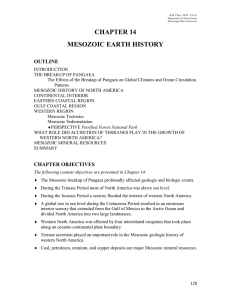
CHAPTER 14
... metamorphism (through heat and/or pressure). It is logical that Paleozoic coals have experienced greater metamorphism because of their location along the eastern coast of North America. This was the site of continental-continental collision during the formation of the supercontinent, Pangaea. The ar ...
... metamorphism (through heat and/or pressure). It is logical that Paleozoic coals have experienced greater metamorphism because of their location along the eastern coast of North America. This was the site of continental-continental collision during the formation of the supercontinent, Pangaea. The ar ...

PowerPoint
... Deep within the Earth's crust rocks can be put under huge pressures and temperatures are very high. These conditions can cause the minerals in the rock to change. This process is called metamorphism. (crayons are again wrapped in aluminum foil, dunked into hot water for a few moments, then squished ...
... Deep within the Earth's crust rocks can be put under huge pressures and temperatures are very high. These conditions can cause the minerals in the rock to change. This process is called metamorphism. (crayons are again wrapped in aluminum foil, dunked into hot water for a few moments, then squished ...

Gamma Ray Logs
... Primitive – crystalline rocks, both igneous and metamorphic. Thought to represent first chemical precipitates from a worldwide ocean. Transition – stony, indurated stratified rocks such as graywacke, limestones, sills. Stratified – obviously stratified fossiliferous rocks, thought to represent the f ...
... Primitive – crystalline rocks, both igneous and metamorphic. Thought to represent first chemical precipitates from a worldwide ocean. Transition – stony, indurated stratified rocks such as graywacke, limestones, sills. Stratified – obviously stratified fossiliferous rocks, thought to represent the f ...

Ch 3
... 3. Sandstone is a sedimentary rock that’s often composed mostly of quartz grains. 4. When sandstone is heated under a lot of pressure, the grains of quartz grow in size and become interlocking, like the pieces of a jigsaw puzzle. 5. The quartz grains in quartzite are not in layers, so quartzite is a ...
... 3. Sandstone is a sedimentary rock that’s often composed mostly of quartz grains. 4. When sandstone is heated under a lot of pressure, the grains of quartz grow in size and become interlocking, like the pieces of a jigsaw puzzle. 5. The quartz grains in quartzite are not in layers, so quartzite is a ...

3 Metamorphic Rocks
... 3. Sandstone is a sedimentary rock that’s often composed mostly of quartz grains. 4. When sandstone is heated under a lot of pressure, the grains of quartz grow in size and become interlocking, like the pieces of a jigsaw puzzle. 5. The quartz grains in quartzite are not in layers, so quartzite is a ...
... 3. Sandstone is a sedimentary rock that’s often composed mostly of quartz grains. 4. When sandstone is heated under a lot of pressure, the grains of quartz grow in size and become interlocking, like the pieces of a jigsaw puzzle. 5. The quartz grains in quartzite are not in layers, so quartzite is a ...

How Do You Study the Past? (The Rock Record: Absolute
... 1. Definition: Dating rocks and fossils by placing them in chronological order without exact dates. 2. Geologic Principles (used in this dating process): a. Original Horizontality • Sedimentary rocks are deposited in horizontal layers b. The Law of Superposition • in an undisturbed sequence the olde ...
... 1. Definition: Dating rocks and fossils by placing them in chronological order without exact dates. 2. Geologic Principles (used in this dating process): a. Original Horizontality • Sedimentary rocks are deposited in horizontal layers b. The Law of Superposition • in an undisturbed sequence the olde ...

Mineral and Mechanical Characterization of Earthen Building
... abundant in the archaeological sites from the Abaucan Valley. Volcanic fragments can also be found in the archaeological sites from the Famatina Valley but they are almost absent in earthen materials from the Vinchina and Gudancol Valleys. The presence of important outcrops of Tertiary and Ordovicia ...
... abundant in the archaeological sites from the Abaucan Valley. Volcanic fragments can also be found in the archaeological sites from the Famatina Valley but they are almost absent in earthen materials from the Vinchina and Gudancol Valleys. The presence of important outcrops of Tertiary and Ordovicia ...

3.4 How are the rock classes Rocks and Rock
... Classic regional metamorphic structures in Scotland Note bands, but also that they are folded back on one another, attesting to the pressure that drives such change. ...
... Classic regional metamorphic structures in Scotland Note bands, but also that they are folded back on one another, attesting to the pressure that drives such change. ...

GEOL 333 - Lab 8 (Clastic Sedimentary Rocks in Hand Sample and
... asphalt paving, mixed with cement to make concrete, or used alone as a base for roads, sidewalks or railroads. Ground up limestone and shale are used to make cement and shale is used to make bricks. In terms of research, paleontologists study fossil-bearing rocks to help determine what types of plan ...
... asphalt paving, mixed with cement to make concrete, or used alone as a base for roads, sidewalks or railroads. Ground up limestone and shale are used to make cement and shale is used to make bricks. In terms of research, paleontologists study fossil-bearing rocks to help determine what types of plan ...
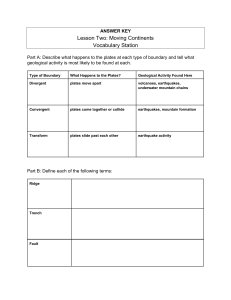
Lesson Two: Moving Continents Vocabulary Station
... According to the Continental Drift Theory, the continents once formed a giant landmass named Pangaea. It wasn’t until the 1950s and 1960s that scientists began to explain how the continents were able to move with their discovery of the midocean ridges and sea-floor spreading. According to this new t ...
... According to the Continental Drift Theory, the continents once formed a giant landmass named Pangaea. It wasn’t until the 1950s and 1960s that scientists began to explain how the continents were able to move with their discovery of the midocean ridges and sea-floor spreading. According to this new t ...
Geologic Time - Tulane University
... 1800s worked out 7 basic principles of stratigraphy that allowed them, and now us, to work out the relative ages of rocks. Once these age relations were worked out, another principle fell into place - the principle of fossil succession. We discuss the 7 principles of stratigraphy first and then see ...
... 1800s worked out 7 basic principles of stratigraphy that allowed them, and now us, to work out the relative ages of rocks. Once these age relations were worked out, another principle fell into place - the principle of fossil succession. We discuss the 7 principles of stratigraphy first and then see ...

porphyry copper-type mineralization and geosynclinal
... The tectonic evolution of the Chilean Andes shows a succession of short compressive stages (Upper Carboniferous; Mid-Late Liassic Upper Jurassic; Cenomanian; Paleocene; Oligocene; Upper Miocene) characterized by folds, reverse faulting and intrusive magmatic pulsations, followed by longer periods of ...
... The tectonic evolution of the Chilean Andes shows a succession of short compressive stages (Upper Carboniferous; Mid-Late Liassic Upper Jurassic; Cenomanian; Paleocene; Oligocene; Upper Miocene) characterized by folds, reverse faulting and intrusive magmatic pulsations, followed by longer periods of ...

Geological processes in the British Isles
... summarise and identify descriptions of the principal features of the main lithotectonic units of the British Isles, namely the Precambrian Basement, the Caledonian Orogenic Belt, the Variscan Orogenic Belt, the Older Cover and the Younger Cover ...
... summarise and identify descriptions of the principal features of the main lithotectonic units of the British Isles, namely the Precambrian Basement, the Caledonian Orogenic Belt, the Variscan Orogenic Belt, the Older Cover and the Younger Cover ...
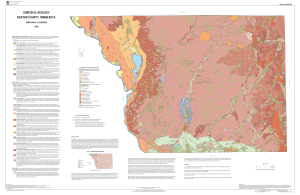
surficial geology benton county, minnesota
... Channel Scarp - Well defined channel scarp or boundary of outwash channel. ...
... Channel Scarp - Well defined channel scarp or boundary of outwash channel. ...

Weathering and Erosion Reference Materials
... Wind can do remarkable things. It can erode rock to make beautiful shapes. Wind has eroded this rock so that it looks like a rabbit. This limestone formation is in the Sahara Desert in Egypt. Water is the most important erosional force even in the desert. But wind makes its mark in many ways. ...
... Wind can do remarkable things. It can erode rock to make beautiful shapes. Wind has eroded this rock so that it looks like a rabbit. This limestone formation is in the Sahara Desert in Egypt. Water is the most important erosional force even in the desert. But wind makes its mark in many ways. ...

Week 4 Sedimentary Rocks on Mars: An Orbital Perspective
... discussion of their three distinct units, “layered”, “massive”, and “thin mesa” units, and the nomenclature regarding the distinction between these units. Specifically, “beds” refer to much smaller-scale features than those identified in the work, which were up to tens of meters thick. In reality, s ...
... discussion of their three distinct units, “layered”, “massive”, and “thin mesa” units, and the nomenclature regarding the distinction between these units. Specifically, “beds” refer to much smaller-scale features than those identified in the work, which were up to tens of meters thick. In reality, s ...
Introducing Igneous Rocks
... Lava can erupt at the surface through cracks called fissures or from a single hole called a vent. In the case of a central vent, the lava will build up a cone shaped mountain as it cools – this is a volcano. The size and shape of the volcano is controlled by the type of eruptions and the products of ...
... Lava can erupt at the surface through cracks called fissures or from a single hole called a vent. In the case of a central vent, the lava will build up a cone shaped mountain as it cools – this is a volcano. The size and shape of the volcano is controlled by the type of eruptions and the products of ...

stAIR Project
... the earth. It takes temperatures between 600 and 1,300 degrees Celsius (1,100 and 2,400 degrees Fahrenheit) to melt a rock, turning it into a substance called magma (molten rock). ...
... the earth. It takes temperatures between 600 and 1,300 degrees Celsius (1,100 and 2,400 degrees Fahrenheit) to melt a rock, turning it into a substance called magma (molten rock). ...

Serendipity and a Bit of Sleuthing at Canfield Creek
... Several of the numerous copper occurrences in the Cumberland Basin were mined on a small scale in the early years of the 20th Century. Canfield Creek represents the largest example of this deposit type known in the ...
... Several of the numerous copper occurrences in the Cumberland Basin were mined on a small scale in the early years of the 20th Century. Canfield Creek represents the largest example of this deposit type known in the ...

mafic and ultmmafic rock associations in the east arc of
... Coleman (I97L) plotted the ul-trarnafic belts on a world map along with the plate boundarles, and found out that they display very cloce correlatlon in space and time. Another feature significant whlch he noted was the intimate assoclaLion of Phanerozol-c ultramafic rocks wlth blue-schLsts. This roc ...
... Coleman (I97L) plotted the ul-trarnafic belts on a world map along with the plate boundarles, and found out that they display very cloce correlatlon in space and time. Another feature significant whlch he noted was the intimate assoclaLion of Phanerozol-c ultramafic rocks wlth blue-schLsts. This roc ...

Falls Lake geology_from_CGS1994 guidebook
... Diabase Dikes Early Mesozoic diabase dikes (not shown on Figure 2) cut across the Jonesboro fault and Triassic sedimentary strata of the Durham sub-basin, as well as older rocks throughout this region of the Piedmont (Horton and others, 1992). Most of the dikes on the 1:24,000-scale geologic map by ...
... Diabase Dikes Early Mesozoic diabase dikes (not shown on Figure 2) cut across the Jonesboro fault and Triassic sedimentary strata of the Durham sub-basin, as well as older rocks throughout this region of the Piedmont (Horton and others, 1992). Most of the dikes on the 1:24,000-scale geologic map by ...

Igneous Rocks
... crystals in a fine matrix, or vesicular, or frothy scoria. Unweathered basalt is black or grey. On Earth, most basalt magmas have formed by decompression melting of the mantle. Basalt has also formed on Earth's Moon, Mars, Venus, and even on the asteroid Vesta. Source rocks for the partial melts pro ...
... crystals in a fine matrix, or vesicular, or frothy scoria. Unweathered basalt is black or grey. On Earth, most basalt magmas have formed by decompression melting of the mantle. Basalt has also formed on Earth's Moon, Mars, Venus, and even on the asteroid Vesta. Source rocks for the partial melts pro ...
Geology of Great Britain

The geology of Great Britain is renowned for its diversity. As a result of its eventful geological history, Great Britain shows a rich variety of landscapes across the constituent countries of England, Wales and Scotland. Rocks of almost all geological ages are represented at outcrop, from the Archaean onwards.