
PETLAB3-14
... known as ’spinifex’ that has a platy habit. Spinifex texture is best developed in the upper chilled margin of komatiite lava flows. Komatiites are typically somewhat lighter green in colour than associated mafic volcanic rocks such as basalts because of the formers high Mg content, and they were oft ...
... known as ’spinifex’ that has a platy habit. Spinifex texture is best developed in the upper chilled margin of komatiite lava flows. Komatiites are typically somewhat lighter green in colour than associated mafic volcanic rocks such as basalts because of the formers high Mg content, and they were oft ...

Americas, Asia will join to form a supercontinent
... Geological analysis suggest the current-day continents we know and love will drift together, forming a new supercontinent like ones that existed many millions of years ago. What’s not certain is where that supercontinent will be. The authors of a new Nature study suggest that the next supercontinent ...
... Geological analysis suggest the current-day continents we know and love will drift together, forming a new supercontinent like ones that existed many millions of years ago. What’s not certain is where that supercontinent will be. The authors of a new Nature study suggest that the next supercontinent ...

The Salinian terrane and Franciscan Complex of the Bodega Bay area
... granitoid. This is a profound contrast in rock type and indicates an important turn of events in the geological history. The granitoid is very old and formed deep under the earth's surface. The sand layers look like the ones forming today on the beach, so they must be very young and formed at the su ...
... granitoid. This is a profound contrast in rock type and indicates an important turn of events in the geological history. The granitoid is very old and formed deep under the earth's surface. The sand layers look like the ones forming today on the beach, so they must be very young and formed at the su ...

`lhe Martin Group in the Greater Beaverlodge Area by F. F. Langford
... therefore that the 'Ihluicho Group was not their source. The absence of ma.fie volcanic fragrrents, which might be ~ t e d to derive from basaltic horizons in the Gillies Channel Fonnation, supports the idea that the Charlot Point clasts were derived from the Beaverlodge Formation before the Gillies ...
... therefore that the 'Ihluicho Group was not their source. The absence of ma.fie volcanic fragrrents, which might be ~ t e d to derive from basaltic horizons in the Gillies Channel Fonnation, supports the idea that the Charlot Point clasts were derived from the Beaverlodge Formation before the Gillies ...

Field relation, petrochemistry and classification of the volcanic rocks
... flows, occupy an area of 20 km 2 in a narrow belt around the north, east and southeast coast of Tioman Island. Pyroclastic rocks exhibit a broad variation in both colour and texture. The main pyroclastic type is agglomerate containing various types of blocks up to 0.5 m in diameter (Figs. 2 and 3). ...
... flows, occupy an area of 20 km 2 in a narrow belt around the north, east and southeast coast of Tioman Island. Pyroclastic rocks exhibit a broad variation in both colour and texture. The main pyroclastic type is agglomerate containing various types of blocks up to 0.5 m in diameter (Figs. 2 and 3). ...

Sketch of The Geology of Iowa
... differ with the location of the well. At Holstein it was reached at 1,970 feet, at Tipton at 2,245 feet and at Lansing at 751 feet. The same formation appears again at the surface in central Wisconsin, where it is known as the Baraboo quartzite. The Sioux quartzite makes splendid structural material ...
... differ with the location of the well. At Holstein it was reached at 1,970 feet, at Tipton at 2,245 feet and at Lansing at 751 feet. The same formation appears again at the surface in central Wisconsin, where it is known as the Baraboo quartzite. The Sioux quartzite makes splendid structural material ...
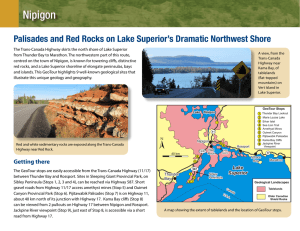
Nipigon GeoTour
... Hidden beneath the waters of Lake Superior is the geological secret to its existence: a thick sequence of rocks that fills an ancient rift valley. These rocks underlie the entire lake, but only to the west and south are they well exposed on land. The history of these ancient rift rocks began 1.1 bil ...
... Hidden beneath the waters of Lake Superior is the geological secret to its existence: a thick sequence of rocks that fills an ancient rift valley. These rocks underlie the entire lake, but only to the west and south are they well exposed on land. The history of these ancient rift rocks began 1.1 bil ...

Geologic Time - Kean University
... different from the planet we call home today. About 3.9 billion years ago Earth would have been much hotter with surface temperatures around 50 to 70oC (compared with 15oC today), there would have been more extensive volcanism, the Sun was less bright, there was no oxygen in the atmosphere and no oz ...
... different from the planet we call home today. About 3.9 billion years ago Earth would have been much hotter with surface temperatures around 50 to 70oC (compared with 15oC today), there would have been more extensive volcanism, the Sun was less bright, there was no oxygen in the atmosphere and no oz ...
Geologic Time
... different from the planet we call home today. About 3.9 billion years ago Earth would have been much hotter with surface temperatures around 50 to 70oC (compared with 15oC today), there would have been more extensive volcanism, the Sun was less bright, there was no oxygen in the atmosphere and no oz ...
... different from the planet we call home today. About 3.9 billion years ago Earth would have been much hotter with surface temperatures around 50 to 70oC (compared with 15oC today), there would have been more extensive volcanism, the Sun was less bright, there was no oxygen in the atmosphere and no oz ...
semester 5 - St. Xavier`s College
... b. Determining the angle between two lines c. True strike and Dip from apparent dips d. Attitude of intersection of two planes ...
... b. Determining the angle between two lines c. True strike and Dip from apparent dips d. Attitude of intersection of two planes ...

Chapter 2: Rocks of the Southeastern US
... The amazing diversity of rocks in the Southeast records over a billion years of history—from 1.8-billion-year-old Precambrian gneisses to sedimentary deposits from the most recent ice age. Colliding plates, rifting, inland seas, deposition, erosion, igneous and metamorphic activity, and recent glaci ...
... The amazing diversity of rocks in the Southeast records over a billion years of history—from 1.8-billion-year-old Precambrian gneisses to sedimentary deposits from the most recent ice age. Colliding plates, rifting, inland seas, deposition, erosion, igneous and metamorphic activity, and recent glaci ...


The Mineral Newsletter - Northern Virginia Mineral Club
... Sugarloaf Mountain looms over the rolling hills of Maryland’s Piedmont like a mysterious outlier of the Blue Ridge Mountains to the west. The average elevation of the area is about 500 feet; Sugarloaf reaches almost 1,300 feet, much higher than anything nearby until you reach Catoctin Mountain, wher ...
... Sugarloaf Mountain looms over the rolling hills of Maryland’s Piedmont like a mysterious outlier of the Blue Ridge Mountains to the west. The average elevation of the area is about 500 feet; Sugarloaf reaches almost 1,300 feet, much higher than anything nearby until you reach Catoctin Mountain, wher ...

The Geology of Crowders Mountain State Park, North Carolina – A
... prospects or other geologic features. To produce a geologic map, a geologist systematically walks and/or drives the subject area looking for rock outcrop, other geologic material, evidence for faults, and active and former mines and prospects. The geologic map is the fundamental starting point in un ...
... prospects or other geologic features. To produce a geologic map, a geologist systematically walks and/or drives the subject area looking for rock outcrop, other geologic material, evidence for faults, and active and former mines and prospects. The geologic map is the fundamental starting point in un ...

MOUNTAINS - cravenccgeology
... Although folding is often the most obvious sign of these forces, thrust faulting, metamorphism, and igneous activity are always present in varying degrees. Most mountain building occurs at convergent plate boundaries, which can involve both oceanic and continental crust. Mountain building occurs at ...
... Although folding is often the most obvious sign of these forces, thrust faulting, metamorphism, and igneous activity are always present in varying degrees. Most mountain building occurs at convergent plate boundaries, which can involve both oceanic and continental crust. Mountain building occurs at ...

Igneous Rocks
... rocks is by the magma from which they form. An igneous rock can form from, granitic, andesitic, or basaltic magma. ...
... rocks is by the magma from which they form. An igneous rock can form from, granitic, andesitic, or basaltic magma. ...

identifying igneous rocks in the field
... In contrast to mafic melts, which typically form lava flows, the more felsic melts are more silica‐ and volatile‐rich, therefore more viscous, and the bulk of them are involved in explosive volcanism, producing fragmental volcanic rocks. Rapidly cooled felsic lavas can produce obsid ...
... In contrast to mafic melts, which typically form lava flows, the more felsic melts are more silica‐ and volatile‐rich, therefore more viscous, and the bulk of them are involved in explosive volcanism, producing fragmental volcanic rocks. Rapidly cooled felsic lavas can produce obsid ...

U6-Geologic History Power Point
... what life and the environment were like at that particular time and in that particular location. For example, coral fossils found in limestone would warm shallow, ocean water indicate what type of environment? _____________________________ Of all the species on Earth, over __________ 99% of them hav ...
... what life and the environment were like at that particular time and in that particular location. For example, coral fossils found in limestone would warm shallow, ocean water indicate what type of environment? _____________________________ Of all the species on Earth, over __________ 99% of them hav ...

Sediment-hosted Cu deposits
... syngenetic/diagenetic ores found in shallow marine sediments associated with major transgressions. Anoxic conditions and bacterial reduction of sea water sulphate were important controls on mineralization. The ores have both lateral and vertical mineralogical zonation related to palaeogeographical c ...
... syngenetic/diagenetic ores found in shallow marine sediments associated with major transgressions. Anoxic conditions and bacterial reduction of sea water sulphate were important controls on mineralization. The ores have both lateral and vertical mineralogical zonation related to palaeogeographical c ...

QUS 112 Intro Engineering Geology - Unesco
... 6. The dust particles collide with each other and form into larger particles. This goes on until the particles get to the size of boulders or small asteroids. 7. Run away growth. Once the larger of these particles get big enough to have a nontrivial gravity, their growth accelerates. Their gravity ...
... 6. The dust particles collide with each other and form into larger particles. This goes on until the particles get to the size of boulders or small asteroids. 7. Run away growth. Once the larger of these particles get big enough to have a nontrivial gravity, their growth accelerates. Their gravity ...

Continental Drift - Ashland Independent Schools
... Glacial deposits and rock surfaces scoured and polished by glaciers are found in several land masses. (South America, Africa, India, and Australia). This shows that parts of these continents were covered with glaciers in the past. PAGE 184 ...
... Glacial deposits and rock surfaces scoured and polished by glaciers are found in several land masses. (South America, Africa, India, and Australia). This shows that parts of these continents were covered with glaciers in the past. PAGE 184 ...
1 Minerals - yr11geology
... the breaking up of rock, with fragments being physically moved apart. This can be caused by: water freezing in cracks in the rock, plant roots forcing cracks apart, swelling minerals like clays expanding between grains as they get wet and dry out, or even just the expansion and contraction due to he ...
... the breaking up of rock, with fragments being physically moved apart. This can be caused by: water freezing in cracks in the rock, plant roots forcing cracks apart, swelling minerals like clays expanding between grains as they get wet and dry out, or even just the expansion and contraction due to he ...

Part 4 - NSW Department of Education
... the oldest rocks in Australia are found in the Yilgarn and Pilbara Blocks in Western Australia. These rocks have been dated at about 3800 million years old and include such rock types as granite, gneiss and greenstone which is a metamorphosed basalt. (See the map on the following page.) Over the nex ...
... the oldest rocks in Australia are found in the Yilgarn and Pilbara Blocks in Western Australia. These rocks have been dated at about 3800 million years old and include such rock types as granite, gneiss and greenstone which is a metamorphosed basalt. (See the map on the following page.) Over the nex ...

fossil record
... – whether a layer of basalt within a sequence – of sedimentary rocks – is a buried lava flow or a sill? – A lava flow forms in sequence with the sedimentary layers. • Rocks below the lava will have signs of heating but not the rocks above. • The rocks above may have lava ...
... – whether a layer of basalt within a sequence – of sedimentary rocks – is a buried lava flow or a sill? – A lava flow forms in sequence with the sedimentary layers. • Rocks below the lava will have signs of heating but not the rocks above. • The rocks above may have lava ...

Rock Manual for Field Geology in Kumaun Region
... Formation: regional metamorphism (greater T and P compared to Phyllite, but less than Gneiss) ...
... Formation: regional metamorphism (greater T and P compared to Phyllite, but less than Gneiss) ...
Geology of Great Britain

The geology of Great Britain is renowned for its diversity. As a result of its eventful geological history, Great Britain shows a rich variety of landscapes across the constituent countries of England, Wales and Scotland. Rocks of almost all geological ages are represented at outcrop, from the Archaean onwards.