
Askival–Hallival
... layered ultrabasic rocks are often bounded by rather variable gabbroic rocks which usually, but not always, separate them from the earlier Tertiary intrusions and Torridonian sediments. Marginal gabbros are exposed in the stream sections of Allt na h-Uamha (NM 409 968) and Allt Mor na h-Uamha (NM 40 ...
... layered ultrabasic rocks are often bounded by rather variable gabbroic rocks which usually, but not always, separate them from the earlier Tertiary intrusions and Torridonian sediments. Marginal gabbros are exposed in the stream sections of Allt na h-Uamha (NM 409 968) and Allt Mor na h-Uamha (NM 40 ...
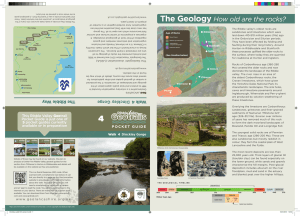
The Geology How old are the rocks?
... www.lancashire-geologists.co.uk The Geologists’ Association (GA) was formed in 1858, and actively promotes the study of geology to all who are interested in Earth Sciences. The Lancashire Group is a local branch of the GA which meets monthly in Clitheroe. It is an informal, friendly and inclusive or ...
... www.lancashire-geologists.co.uk The Geologists’ Association (GA) was formed in 1858, and actively promotes the study of geology to all who are interested in Earth Sciences. The Lancashire Group is a local branch of the GA which meets monthly in Clitheroe. It is an informal, friendly and inclusive or ...
Mesozoic sediments and structures onshore Norway and in the
... Andøya. These are the youngest rocks on land anywhere in Norway. Triassic dykes occur in West Norway, while Mesozoic structures and fault products are common at major and minor fault zones in various parts of coastal Norway. Sedimentary rocks occur in half-grabens in many fjords, especially in Mid N ...
... Andøya. These are the youngest rocks on land anywhere in Norway. Triassic dykes occur in West Norway, while Mesozoic structures and fault products are common at major and minor fault zones in various parts of coastal Norway. Sedimentary rocks occur in half-grabens in many fjords, especially in Mid N ...

Distribution of velocities of longitudinal body waves (P waves) in an
... Basalt occurs as lava; gabbro occurs as plutonic rock. So we call gabbros the deepseated equialents of basat. The intermediate grain-sized igneous magmatic rock having the same composition as basalt and gabbro is called a dolerite (Americans and continental Europeans call it diabase. In the United K ...
... Basalt occurs as lava; gabbro occurs as plutonic rock. So we call gabbros the deepseated equialents of basat. The intermediate grain-sized igneous magmatic rock having the same composition as basalt and gabbro is called a dolerite (Americans and continental Europeans call it diabase. In the United K ...
chapter 11—the mesozoic era
... FIGURE 15–1 (p. 453) Although not specifically mentioned in the chapter, one would surmise that fossils would be the evidence for a milder Antarctic climate during the early Tertiary. Such evidence includes actual spore and pollen fossils from early Tertiary rocks in Antarctica. Before Antarctica se ...
... FIGURE 15–1 (p. 453) Although not specifically mentioned in the chapter, one would surmise that fossils would be the evidence for a milder Antarctic climate during the early Tertiary. Such evidence includes actual spore and pollen fossils from early Tertiary rocks in Antarctica. Before Antarctica se ...

Open-file Report 405: Geology of the Zuni Salt Lake 7.5 minute
... Stratigraphic expression of the fault is questionable northeastward from Zuni Salt Lake, however, it would appear to be continuous and trend toward Ceno Prieto, a late Tertiary basaltic neck (Fig. 1). From Zuni Salt Lake southwestward to the Arizona state line the fault strikes approximately N 50" E ...
... Stratigraphic expression of the fault is questionable northeastward from Zuni Salt Lake, however, it would appear to be continuous and trend toward Ceno Prieto, a late Tertiary basaltic neck (Fig. 1). From Zuni Salt Lake southwestward to the Arizona state line the fault strikes approximately N 50" E ...
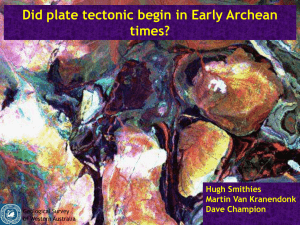
Did PT begin in Early Archean time?
... 1989: Nutman et al. Recognised that "homogeneous grey gneisses” had variable geochronologic and isotopic histories, and could be divided into distinct terranes separated by thin mylonite zones 1997: Nutman et al. Recognised that Isua was comprised at least two chronologically and lithologically diff ...
... 1989: Nutman et al. Recognised that "homogeneous grey gneisses” had variable geochronologic and isotopic histories, and could be divided into distinct terranes separated by thin mylonite zones 1997: Nutman et al. Recognised that Isua was comprised at least two chronologically and lithologically diff ...

Mercian 2005 v16 p138 Charnwood excursion, Carney 483KB
... volcaniclastic rocks is intrusive, rather than being everywhere faulted as some have supposed. Here, the diorite darkens and fines progressively in grain size within about 10 m of the contact, indicative of chilling. It then develops a very fine-grained porphyritic selvage (resembling a volcaniclast ...
... volcaniclastic rocks is intrusive, rather than being everywhere faulted as some have supposed. Here, the diorite darkens and fines progressively in grain size within about 10 m of the contact, indicative of chilling. It then develops a very fine-grained porphyritic selvage (resembling a volcaniclast ...

Overview - Learning Center of the American Southwest
... because of the numerous rock pinnacles, columns, and balanced rocks. The maze of rock columns and passageways provided a stronghold for the Apaches during conflicts with the U.S. military during the nineteenth century. Protection of the picturesque rock pinnacles was the purpose for establishing the ...
... because of the numerous rock pinnacles, columns, and balanced rocks. The maze of rock columns and passageways provided a stronghold for the Apaches during conflicts with the U.S. military during the nineteenth century. Protection of the picturesque rock pinnacles was the purpose for establishing the ...
volcanic and geologic terms
... Active Volcano: A volcano that is erupting, or one that is not presently erupting, but that has erupted within historical time and is considered likely to do so in the future. Alkalic: A rock which is richer in sodium and/or potassium than is normal for the group of rocks to which it belongs. For ex ...
... Active Volcano: A volcano that is erupting, or one that is not presently erupting, but that has erupted within historical time and is considered likely to do so in the future. Alkalic: A rock which is richer in sodium and/or potassium than is normal for the group of rocks to which it belongs. For ex ...

Chapter 9: Sediments and Sedimentary Rocks - McGraw
... The OLC at www.mcgrawhill.ca/college/plummer includes a password-protected Web site for Instructors. The site offers downloadable supplements and access to PageOut, the McGraw-Hill Ryerson Web site development centre. Instructor’s Manual – The IM contains a chapter overview, list of changes per chap ...
... The OLC at www.mcgrawhill.ca/college/plummer includes a password-protected Web site for Instructors. The site offers downloadable supplements and access to PageOut, the McGraw-Hill Ryerson Web site development centre. Instructor’s Manual – The IM contains a chapter overview, list of changes per chap ...


1 - cloudfront.net
... The transfer of materials during tectonic processes defines which rocks and minerals form during volcanism. The distribution of materials their chemical composition tells us a lot about the processes that take Understanding what are the sources of magma during subduction-related volcanism is one of ...
... The transfer of materials during tectonic processes defines which rocks and minerals form during volcanism. The distribution of materials their chemical composition tells us a lot about the processes that take Understanding what are the sources of magma during subduction-related volcanism is one of ...
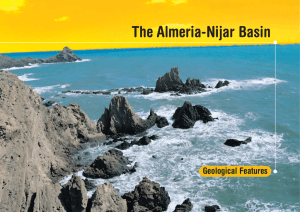
The Almeria-Nijar Basin
... Magmas are formed through the partial melting and emplacement of rocks at high temperature in the interior of the Earth. They consist of a mixture of liquid, dissolved gases (water vapour and carbon dioxide) and minerals. Magmas that come directly from the partial melting of rocks at depth are calle ...
... Magmas are formed through the partial melting and emplacement of rocks at high temperature in the interior of the Earth. They consist of a mixture of liquid, dissolved gases (water vapour and carbon dioxide) and minerals. Magmas that come directly from the partial melting of rocks at depth are calle ...

4 - East Kazakhstan gold ore belt
... and Siberian lithospheric plates. The area corresponds to the junction plates is Zaysan suture zone (Fig. 6). Zaysan suture zone this is a large collisional tectonic structure of the regional rank type (the length more than 1000 km, the width of 60-80 km), brings together the territory of West Qalba ...
... and Siberian lithospheric plates. The area corresponds to the junction plates is Zaysan suture zone (Fig. 6). Zaysan suture zone this is a large collisional tectonic structure of the regional rank type (the length more than 1000 km, the width of 60-80 km), brings together the territory of West Qalba ...

a non-technical guide to the geology of the burren region, co
... approximately 250 million years. Each phase of uplift would have eroded rocks exposed at the surface, relieving the pressure on the rocks underneath. This “depressurisation” would have allowed the underlying rocks to relax and expand, forming microscopic fractures in the rocks. Such fractures are ex ...
... approximately 250 million years. Each phase of uplift would have eroded rocks exposed at the surface, relieving the pressure on the rocks underneath. This “depressurisation” would have allowed the underlying rocks to relax and expand, forming microscopic fractures in the rocks. Such fractures are ex ...

HISTORICAL_GEOLOGY_fossils
... today is the same way that natural laws governed geologic processes that operated in the past. We can therefore use our understanding of present-day geologic processes to interpret past geologic events. • Sometimes this principle is paraphrased as "the present is the key to the past", but be careful ...
... today is the same way that natural laws governed geologic processes that operated in the past. We can therefore use our understanding of present-day geologic processes to interpret past geologic events. • Sometimes this principle is paraphrased as "the present is the key to the past", but be careful ...
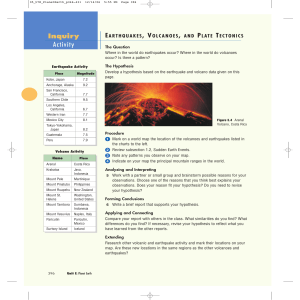
05c_U7E_PlanetEarth_p396-410
... At converging boundaries, plates are moving toward each other. Although plates move very slowly, they are so huge that we experience the effects of their collision. We can feel the earthquakes and see the mountains, including volcanoes, that grow up at or near these boundaries. There are two kinds o ...
... At converging boundaries, plates are moving toward each other. Although plates move very slowly, they are so huge that we experience the effects of their collision. We can feel the earthquakes and see the mountains, including volcanoes, that grow up at or near these boundaries. There are two kinds o ...

Cretaceous–early Tertiary arc and fore
... Eocene sediments reveal notable stratigraphical and petrological similarities to the Marianas fore-arc and the eastern Halmahera Basement Complex is interpreted as a pre-Oligocene fore-arc lacking an accretionary complex. There is some evidence that the pre-Oligocene volcanic arc behind this fore-ar ...
... Eocene sediments reveal notable stratigraphical and petrological similarities to the Marianas fore-arc and the eastern Halmahera Basement Complex is interpreted as a pre-Oligocene fore-arc lacking an accretionary complex. There is some evidence that the pre-Oligocene volcanic arc behind this fore-ar ...


Geology of the Cripple Creek gold
... Stop 10: Exposures of Cresson Pipe (lamprophyric breccias; 487446E 4286321N) The Cresson Pipe, a lamprophyre breccia, represents one of the more notable geologic features in the district. Lamprophyric rocks are the youngest known igneous rocks exposed in the district. Although they constitute only 1 ...
... Stop 10: Exposures of Cresson Pipe (lamprophyric breccias; 487446E 4286321N) The Cresson Pipe, a lamprophyre breccia, represents one of the more notable geologic features in the district. Lamprophyric rocks are the youngest known igneous rocks exposed in the district. Although they constitute only 1 ...

Lecture Chapter 4 - Lynn Fuller`s Page
... Cooling History and Grain Size • The texture of a rock is a description of its grain size. • Cooling rates influence the texture of the igneous rock. • Lava cools much more quickly than magma because lava is on the surface of the Earth, where temperatures are much lower than they are at depth. • Ex ...
... Cooling History and Grain Size • The texture of a rock is a description of its grain size. • Cooling rates influence the texture of the igneous rock. • Lava cools much more quickly than magma because lava is on the surface of the Earth, where temperatures are much lower than they are at depth. • Ex ...
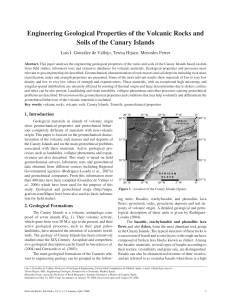
Engineering Geological Properties of the Volcanic Rocks and Soils
... the lava flows. Basalt layers are affected by vertical columnar joints, which are generally fairly open. Horizontal or spherical discontinuities may also appear. Apart from discontinuities, it can be found cavities, mostly no larger than half a meter in diameter. Occasional caves may appear, and les ...
... the lava flows. Basalt layers are affected by vertical columnar joints, which are generally fairly open. Horizontal or spherical discontinuities may also appear. Apart from discontinuities, it can be found cavities, mostly no larger than half a meter in diameter. Occasional caves may appear, and les ...
The Geologic Time Scale
... – About 11,000 years ago, continental glaciers covered the northern part of the United States. (Indiana) – Varves are bands of alternating light- and dark-colored sediments of sand, clay, and silt found in lakes that resulted from summer and winter runoff from glaciers. – Varves from different lakes ...
... – About 11,000 years ago, continental glaciers covered the northern part of the United States. (Indiana) – Varves are bands of alternating light- and dark-colored sediments of sand, clay, and silt found in lakes that resulted from summer and winter runoff from glaciers. – Varves from different lakes ...
Geology of Great Britain

The geology of Great Britain is renowned for its diversity. As a result of its eventful geological history, Great Britain shows a rich variety of landscapes across the constituent countries of England, Wales and Scotland. Rocks of almost all geological ages are represented at outcrop, from the Archaean onwards.