
Powerpoint Presentation Physical Geology, 10/e
... – Mountain belts are common at convergent boundaries – May contain large amounts of metamorphic rock ...
... – Mountain belts are common at convergent boundaries – May contain large amounts of metamorphic rock ...

Mwynau a Chreigiau Crisialau syml neu gymhleth
... amphibole. Many sandstones also consist of quartz and feldspar but they are fragments broken from other rocks. Rock Families There are several thousand rock types. Our pebbles are made of only about 30 types, but that’s quite enough to be confusing. However, there are only 3 main rock families and i ...
... amphibole. Many sandstones also consist of quartz and feldspar but they are fragments broken from other rocks. Rock Families There are several thousand rock types. Our pebbles are made of only about 30 types, but that’s quite enough to be confusing. However, there are only 3 main rock families and i ...
What brought them up? Exhumation of the Dabie Shan ultrahigh
... rocks through the crust encompassed two stages. (1) South-dipping foliation, southeastplunging stretching lineation, lineation-parallel isoclinal folds, and boudins indicate extreme subhorizontal shortening and subvertical extension during top-to-northwest shearing at 200 –180 Ma. Syntectonic recrys ...
... rocks through the crust encompassed two stages. (1) South-dipping foliation, southeastplunging stretching lineation, lineation-parallel isoclinal folds, and boudins indicate extreme subhorizontal shortening and subvertical extension during top-to-northwest shearing at 200 –180 Ma. Syntectonic recrys ...
J.G. Hinchey and V. McNicoll - Department of Natural Resources
... rhyolite and felsic tuffs that host the Long Lake VMS deposit and have high concentrations of high-field strength and rare-earth elements, and 2) an ‘upper stratigraphic’ division of ca. 506 Ma blue-quartz-phyric felsic to intermediate tuff having significantly lower concentrations of high-field str ...
... rhyolite and felsic tuffs that host the Long Lake VMS deposit and have high concentrations of high-field strength and rare-earth elements, and 2) an ‘upper stratigraphic’ division of ca. 506 Ma blue-quartz-phyric felsic to intermediate tuff having significantly lower concentrations of high-field str ...

Petrogenesis of Bir Madi Gabbro-Diorite and Tonalite
... Abstract. The Neoproterozoic rocks of the Bir Madi area, south eastern desert, comprise a Metagabbro-Diorite Complex (GDC) and a Tonalite-Granodiorite Suite (TGrS). The GDC has a weak tonalitic to strong calc-alkaline character and is made up of olivine gabbro, hornblende gabbro, diorite and monzodi ...
... Abstract. The Neoproterozoic rocks of the Bir Madi area, south eastern desert, comprise a Metagabbro-Diorite Complex (GDC) and a Tonalite-Granodiorite Suite (TGrS). The GDC has a weak tonalitic to strong calc-alkaline character and is made up of olivine gabbro, hornblende gabbro, diorite and monzodi ...

No Slide Title
... – that some kind of plate tectonics – took place during the Archean as well – but it differed in detail from today ...
... – that some kind of plate tectonics – took place during the Archean as well – but it differed in detail from today ...
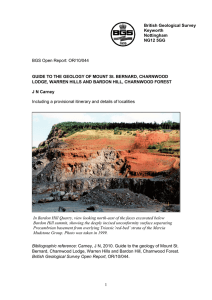
1 BGS Open Report: OR/10/044 GUIDE TO THE GEOLOGY OF
... the Charnian anticline (Figure 2), and also a highly penetrative west-northwesterly cleavage. The recrystallisation of minerals to form the micas that define the cleavage planes occurred at a depth of about 10 km and temperatures of 350o C – conditions that would have prevailed within the ‘roots’ of ...
... the Charnian anticline (Figure 2), and also a highly penetrative west-northwesterly cleavage. The recrystallisation of minerals to form the micas that define the cleavage planes occurred at a depth of about 10 km and temperatures of 350o C – conditions that would have prevailed within the ‘roots’ of ...

Geology: Cryptic crustal events elucidated through
... demonstrates that sediment had been tectonically buried to depths exceeding 25–30 km and heated to about 800°, and therefore that orogeny was well underway, by about 500 Ma. Rabun and Whiteside Plutons: Ages, Timing of Deformation, and Nature of Ancient Basement The nearly 100 m.y. disparity betwee ...
... demonstrates that sediment had been tectonically buried to depths exceeding 25–30 km and heated to about 800°, and therefore that orogeny was well underway, by about 500 Ma. Rabun and Whiteside Plutons: Ages, Timing of Deformation, and Nature of Ancient Basement The nearly 100 m.y. disparity betwee ...

geology and chromite deposits of the camaguey district camaguey
... rise above the general level, however, and those parts of the area not underlain by serpentine support a luxuriant vegetation. The most prominent feature of the district is the Sierra de Cubitas, an arcuate northwesttrending limestone range 25 to 30 miles long, which culminates in Loma Tuabaquey, 98 ...
... rise above the general level, however, and those parts of the area not underlain by serpentine support a luxuriant vegetation. The most prominent feature of the district is the Sierra de Cubitas, an arcuate northwesttrending limestone range 25 to 30 miles long, which culminates in Loma Tuabaquey, 98 ...
The 10th Legion Thrust, Zeehan District
... and Leaman, 1987). These two granitic bodies thecefore "pin" the thrust and as their ages range between 330 and 380 Ma, with the oveclap in respective ages spanning the ...
... and Leaman, 1987). These two granitic bodies thecefore "pin" the thrust and as their ages range between 330 and 380 Ma, with the oveclap in respective ages spanning the ...

Ch06 Sedimentary Rocks
... Erosion—removal of sediment grains from parent rock. Transportation—dispersal by gravity, wind, water, and ice. Deposition—settling out of the transporting fluid. Lithification—transformation into solid rock. ...
... Erosion—removal of sediment grains from parent rock. Transportation—dispersal by gravity, wind, water, and ice. Deposition—settling out of the transporting fluid. Lithification—transformation into solid rock. ...

Igneous Rock Classification.
... The chemical composition, which determines what minerals will crystallize, can be expressed as the sum of a number of oxides of common cations. For igneous rocks, the most important oxide is SiO2, or silica, most usually not in the form of the mineral quartz. The silica content ranges between approx ...
... The chemical composition, which determines what minerals will crystallize, can be expressed as the sum of a number of oxides of common cations. For igneous rocks, the most important oxide is SiO2, or silica, most usually not in the form of the mineral quartz. The silica content ranges between approx ...

Chapter 4—Rocks and Minerals: Documents that
... viscous lava; generally forms the upper parts of lava flows. olivine (56): A glassy looking iron and magnesium silicate, often with an olive green color. Common mineral in dark, mafic rocks. The gem variety is called peridot. oöid (71): Found in back-reef facies along with carbonate sands and muds. ...
... viscous lava; generally forms the upper parts of lava flows. olivine (56): A glassy looking iron and magnesium silicate, often with an olive green color. Common mineral in dark, mafic rocks. The gem variety is called peridot. oöid (71): Found in back-reef facies along with carbonate sands and muds. ...

reconnaissance field study of the sarmiento ophiolite with emphasis
... The Sarmiento ophiolite (Fig. 1b) is flanked on both sides by gabbro bodies and dike swarms that intrude both the pre-Jurassic continetal basement (Staines Metamorphic Complex), and a Middle-Late Jurassic silicic volcanic unit (Tobífera formation), the last formed during the early stage of continent ...
... The Sarmiento ophiolite (Fig. 1b) is flanked on both sides by gabbro bodies and dike swarms that intrude both the pre-Jurassic continetal basement (Staines Metamorphic Complex), and a Middle-Late Jurassic silicic volcanic unit (Tobífera formation), the last formed during the early stage of continent ...

Mineral resources 2
... Gold • Hydrothermal process for gold formation • Hot saline fluids passing through country rock • Gold picked up in fluids which pass through cracks, fractures and soluble rocks • As the fluids move away from heat source, fluids crystalise (mostly silica -> quartz, therefore quartz veins) and gold ...
... Gold • Hydrothermal process for gold formation • Hot saline fluids passing through country rock • Gold picked up in fluids which pass through cracks, fractures and soluble rocks • As the fluids move away from heat source, fluids crystalise (mostly silica -> quartz, therefore quartz veins) and gold ...

Metamorphic Rocks
... The heat and pressure comes from inside the earth. From the upper mantle up to within a few kilometers of the surface of the earth there is a tremendous amount of heat and pressure. This heat and pressure increase with depth. It is estimated that the temperature increases about 20o to 30o C per kil ...
... The heat and pressure comes from inside the earth. From the upper mantle up to within a few kilometers of the surface of the earth there is a tremendous amount of heat and pressure. This heat and pressure increase with depth. It is estimated that the temperature increases about 20o to 30o C per kil ...

EPS 421 Lecture 14 Volcaniclastic sediments
... Problems in the study of Volcaniclastic rocks 1) It is often difficult (and dangerous) to observe modern volcanic processes and mostly the eruptions that can be studied are relatively small-scale. 2) The techniques used for studying Recent volcaniclastics, such as sieving for grain-size analyses ar ...
... Problems in the study of Volcaniclastic rocks 1) It is often difficult (and dangerous) to observe modern volcanic processes and mostly the eruptions that can be studied are relatively small-scale. 2) The techniques used for studying Recent volcaniclastics, such as sieving for grain-size analyses ar ...

Origin, Texture, and Classification of Metamorphic Rocks
... Metamorphic rocks are igneous, sedimentary, or other metamorphic rocks that have been changed by heat, pressure, and chemical reactions with fluids and gases (see Igneous and Metamorphic Petrology; Pressure, Temperature, Fluid Pressure Conditions of Metamorphism). The textures and composition of the ...
... Metamorphic rocks are igneous, sedimentary, or other metamorphic rocks that have been changed by heat, pressure, and chemical reactions with fluids and gases (see Igneous and Metamorphic Petrology; Pressure, Temperature, Fluid Pressure Conditions of Metamorphism). The textures and composition of the ...

4.5 Billion Years ago
... motion following currents of heat generated deep within the planet. When these currents rise and the rifts form, the plates are pushed apart with new ocean crust created within the gap. When the mantle current sinks back down in to the earth, they drag the old oceanic plate down back into the interi ...
... motion following currents of heat generated deep within the planet. When these currents rise and the rifts form, the plates are pushed apart with new ocean crust created within the gap. When the mantle current sinks back down in to the earth, they drag the old oceanic plate down back into the interi ...
Evidence of rain shadow in the geologic record
... have existed from the Precambrian to the Recent, existing in the past as they do today on wide continental landmasses positioned in the arid subtropical belt straddling approximately 30 degrees of the equator, particularly when and where mountains surrounded these areas. In the examples that follow ...
... have existed from the Precambrian to the Recent, existing in the past as they do today on wide continental landmasses positioned in the arid subtropical belt straddling approximately 30 degrees of the equator, particularly when and where mountains surrounded these areas. In the examples that follow ...

The Origin of Oil and Gas
... done, then the gas moves into the fractures, from where it may then be retrieved. The water that is first produced must be disposed of in a way that complies with existing regulations (see paper by Olson, this volume). SUMMARY ...
... done, then the gas moves into the fractures, from where it may then be retrieved. The water that is first produced must be disposed of in a way that complies with existing regulations (see paper by Olson, this volume). SUMMARY ...

Geology and Hydrocarbon Potential of the Northern Dreki Area
... basaltic lava flows which was erupted over the pre-existing continent during the events leading to the creation of the ocean basin east of the ridge (Norway Basin). The western margin developed as a result of rifting within the Greenland continental shelf and seafloor spreading on the Iceland Platea ...
... basaltic lava flows which was erupted over the pre-existing continent during the events leading to the creation of the ocean basin east of the ridge (Norway Basin). The western margin developed as a result of rifting within the Greenland continental shelf and seafloor spreading on the Iceland Platea ...

New K-Ar ages of basalts from the Harrat Ash Shaam volcanic field
... Harrat Ash Shaam system to western Syria, as far north as the Bitlis suture in the Taurides. The Harrat Ash Shaam volcanic system in Jordan consists of northwest-trending dikes and a volcanic field that together encompass a width of 220 km. In terms of width, direction, and age of the main volcanic ...
... Harrat Ash Shaam system to western Syria, as far north as the Bitlis suture in the Taurides. The Harrat Ash Shaam volcanic system in Jordan consists of northwest-trending dikes and a volcanic field that together encompass a width of 220 km. In terms of width, direction, and age of the main volcanic ...
Chapter 4 - Teacher Friendly Guides
... Does your region have rolling hills? Mountainous areas? Flat land where you never have to bike up a hill? The answers to these questions can help others understand the basic topography of your region. The term topography is used to describe the shape of the land surface as measured by how elevation— ...
... Does your region have rolling hills? Mountainous areas? Flat land where you never have to bike up a hill? The answers to these questions can help others understand the basic topography of your region. The term topography is used to describe the shape of the land surface as measured by how elevation— ...
a review of the carboniferous and permian rocks of the west coast of
... these formations is obvious and they offer excellent opportunity for such study. Nevertheless, the known lithological characteres and associations of the beds suggest very strongly deposition on a shelf, stable, though locally affected by small but rapid vertical movements. As yet the nature of thes ...
... these formations is obvious and they offer excellent opportunity for such study. Nevertheless, the known lithological characteres and associations of the beds suggest very strongly deposition on a shelf, stable, though locally affected by small but rapid vertical movements. As yet the nature of thes ...
Geology of Great Britain

The geology of Great Britain is renowned for its diversity. As a result of its eventful geological history, Great Britain shows a rich variety of landscapes across the constituent countries of England, Wales and Scotland. Rocks of almost all geological ages are represented at outcrop, from the Archaean onwards.