THE ORIGIN AND GROWTH OF CONTINENTS 1 Geophysical
... about 500 km is the same on a broad scale beneath oceans and continents. (2) The heat flow in shield areas is less than in erogenic areas and the mantle under shield areas is cooler than under the oceans. (3) The average continental crust is about 40 km thick. Shield areas are 40-45 km thick and ero ...
... about 500 km is the same on a broad scale beneath oceans and continents. (2) The heat flow in shield areas is less than in erogenic areas and the mantle under shield areas is cooler than under the oceans. (3) The average continental crust is about 40 km thick. Shield areas are 40-45 km thick and ero ...
Bio 1309 Early Earth History 4 Billion Years old! Horrible Place!
... • Additional evidence for Pangaea found in geology of adjacent continents – Includes matching geological trends between eastern coast of South America and western coast of Africa ...
... • Additional evidence for Pangaea found in geology of adjacent continents – Includes matching geological trends between eastern coast of South America and western coast of Africa ...

Offshore geology of Pakistan and non
... The bottom features of the northern Arabian Sea are shown in figure.2. An outstanding feature of the seafloor is the northeast -southwest trending graben and ridge system. This is comprised of the Owen Fracture Zone and Murray Ridge. This assymetric ridge system divides the northern Arabian Sea in t ...
... The bottom features of the northern Arabian Sea are shown in figure.2. An outstanding feature of the seafloor is the northeast -southwest trending graben and ridge system. This is comprised of the Owen Fracture Zone and Murray Ridge. This assymetric ridge system divides the northern Arabian Sea in t ...

Hoodoos
... time span of more than 240 million years. Fossils of long-extinct animals and plants have been found embedded in the rock layers. ...
... time span of more than 240 million years. Fossils of long-extinct animals and plants have been found embedded in the rock layers. ...


Glossary of Terms - Department of Natural Resources
... CALDERA: a large-scale, roughly circular volcanic depression, formed near the top of a volcano when huge eruptions empties the magma chamber under the volcano. The caldera can then be filled with sediments and volcanics and intruded by younger intrusions. More than one caldera can form in any one ar ...
... CALDERA: a large-scale, roughly circular volcanic depression, formed near the top of a volcano when huge eruptions empties the magma chamber under the volcano. The caldera can then be filled with sediments and volcanics and intruded by younger intrusions. More than one caldera can form in any one ar ...
Geologic Time - North Coast Distance Education
... rocks of Great Britain, he visualized “no vestige of a beginning—no prospect of an end.” In a way, what Copernicus did for space, Hutton did for time. The universe does not revolve around Earth, and time is not measured by the life span of humans. Before Hutton, human history was all of history. Sin ...
... rocks of Great Britain, he visualized “no vestige of a beginning—no prospect of an end.” In a way, what Copernicus did for space, Hutton did for time. The universe does not revolve around Earth, and time is not measured by the life span of humans. Before Hutton, human history was all of history. Sin ...

Homework05 n large samples
... (a) secreting acid that dissolves rocks and minerals. (b) increasing the exposure of rocks and minerals to weathering agents. (c) grinding rocks and minerals into smaller pieces. (d) ingesting the minerals that are necessary for nutrition. 3. Stability (resistance to weathering) of silicate minerals ...
... (a) secreting acid that dissolves rocks and minerals. (b) increasing the exposure of rocks and minerals to weathering agents. (c) grinding rocks and minerals into smaller pieces. (d) ingesting the minerals that are necessary for nutrition. 3. Stability (resistance to weathering) of silicate minerals ...

TRANSITIONAL PYROCLASTIC, VOLCANIC
... Description of outcrops and petrographic studies of drill-hole samples show a low greenschist facies (Fe-chlorite zone) metamorphosed mafic (quartz-chlorite to Mgchlorite schists, with clinochlore, illite, vermiculite, epidote, pyrite, pyrrhotite and chalcopyrite, besides elongated retangular ripifo ...
... Description of outcrops and petrographic studies of drill-hole samples show a low greenschist facies (Fe-chlorite zone) metamorphosed mafic (quartz-chlorite to Mgchlorite schists, with clinochlore, illite, vermiculite, epidote, pyrite, pyrrhotite and chalcopyrite, besides elongated retangular ripifo ...

Chapter 4—Rocks and Minerals: Documents that Record
... igneous rock (55): A rock formed by the cooling and solidification of magma or lava. They constitute over 90% of the volume of the Earth’s crust. intrusive igneous rock (56): Igneous rocks that have formed from magma that has penetrated into other rocks and solidified before reaching the surface. Ve ...
... igneous rock (55): A rock formed by the cooling and solidification of magma or lava. They constitute over 90% of the volume of the Earth’s crust. intrusive igneous rock (56): Igneous rocks that have formed from magma that has penetrated into other rocks and solidified before reaching the surface. Ve ...

Igneous rocks
... • Igneous and sedimentary rocks may be transformed by heat, pressure and chemical reactions into metamorphic rocks. • Metamorphic rocks may be changed or metamorphosed into other metamorphic rocks. They may also be remelted into and igneous rock. Or a metamorphic rock can be weathered to form a sedi ...
... • Igneous and sedimentary rocks may be transformed by heat, pressure and chemical reactions into metamorphic rocks. • Metamorphic rocks may be changed or metamorphosed into other metamorphic rocks. They may also be remelted into and igneous rock. Or a metamorphic rock can be weathered to form a sedi ...

Lithification of sediments to form sedimentary rocks, Part I
... Dissolution of a grain with no subsequent infilling by minerals leaves a mold, a void in the shape of the original grain. ...
... Dissolution of a grain with no subsequent infilling by minerals leaves a mold, a void in the shape of the original grain. ...

Midterm Review 1
... Rocks can be metamorphosed (changed) into other rocks when subjected to high temperatures and pressures. The presence of fluids increases the rate of metamorphism Metamorphic changes occur in the solid state The three kinds of metamorphism are Regional, Contact and Hydrothermal Regional metamorphism ...
... Rocks can be metamorphosed (changed) into other rocks when subjected to high temperatures and pressures. The presence of fluids increases the rate of metamorphism Metamorphic changes occur in the solid state The three kinds of metamorphism are Regional, Contact and Hydrothermal Regional metamorphism ...

Triassic - Lake Compounce
... the movement of heat by currents within heated material such as gas or liquids. The movement is based on density currents, with the hotter or less dense currents rising compared to cooler, denser currents. ...
... the movement of heat by currents within heated material such as gas or liquids. The movement is based on density currents, with the hotter or less dense currents rising compared to cooler, denser currents. ...

Rocks Section 1: Classifying Rocks »Grain Size
... – Pressure exceeds 2,000 kb – 10,000 kb or (approx. 10 km deep and deeper) ...
... – Pressure exceeds 2,000 kb – 10,000 kb or (approx. 10 km deep and deeper) ...

Major Curriculum Area
... oldest in the state. Some metamorphism of these rocks occurred during the formation of the Appalachian Mountains. ...
... oldest in the state. Some metamorphism of these rocks occurred during the formation of the Appalachian Mountains. ...

Metallogeny of Paleogene and Neogene volcanic belts in Hungary
... block in the north includes the Transdanubian Unit (TU) which has comparable Mesozoic with the Southern Alps, whereas the TISZA in the south is characterised by Mesozoic sequences deposited in the northern (European) margin of the Neo-Tethys Ocean (Kázmér & Kovács, 1985; Csontos 1995). The strongly ...
... block in the north includes the Transdanubian Unit (TU) which has comparable Mesozoic with the Southern Alps, whereas the TISZA in the south is characterised by Mesozoic sequences deposited in the northern (European) margin of the Neo-Tethys Ocean (Kázmér & Kovács, 1985; Csontos 1995). The strongly ...
Chapter 12: The Changing Face of the Land
... generates faulting, which exposes fresh, fractured rock to chemical weathering. ...
... generates faulting, which exposes fresh, fractured rock to chemical weathering. ...

- NERC Open Research Archive
... nappe stacks and related metamorphism that dominate the Greenland and Scandinavian Caledonides. It seems that Northwest Scotland was caught up at the southern end of this tectonic collision. As a consequence, deformed and metamorphosed Neoproterozoic rocks of the Moine Nappe were overthrust to the w ...
... nappe stacks and related metamorphism that dominate the Greenland and Scandinavian Caledonides. It seems that Northwest Scotland was caught up at the southern end of this tectonic collision. As a consequence, deformed and metamorphosed Neoproterozoic rocks of the Moine Nappe were overthrust to the w ...
Igneous and Metamorphic Reservoirs
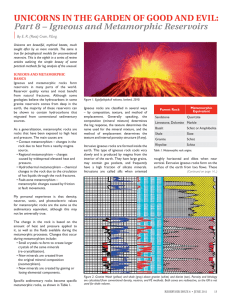
... from natural fractures. Although some geologists believe the hydrocarbons in some granite reservoirs comes from deep in the earth, the majority of these reservoirs can be shown to contain hydrocarbons that migrated from conventional sedimentary sources. As a generalization, metamorphic rocks are roc ...
... from natural fractures. Although some geologists believe the hydrocarbons in some granite reservoirs comes from deep in the earth, the majority of these reservoirs can be shown to contain hydrocarbons that migrated from conventional sedimentary sources. As a generalization, metamorphic rocks are roc ...
Combined field trip guide/program with abstracts
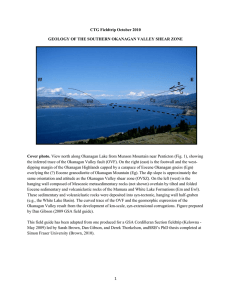
... This outcrop is part of the Vaseux-Bighorn National Wildlife area and care should be taken to leave as small a footprint as possible. These bluffs are part of the California Bighorn sheep habit, and also are home to several rare species of brush and reptiles. Bird watching is very popular here (Cany ...
... This outcrop is part of the Vaseux-Bighorn National Wildlife area and care should be taken to leave as small a footprint as possible. These bluffs are part of the California Bighorn sheep habit, and also are home to several rare species of brush and reptiles. Bird watching is very popular here (Cany ...


Geologic Map of the Deer Lodge and Conleys Lake 71/2
... The broad Deer Lodge Valley is a half graben bounded on the west by range-front faults, but lacking major faults on the east side. With the exception of a small remnant of metasedimentary rocks of the Proterozoic Belt Supergroup on the west side of the Deer Lodge Valley, all rocks exposed in these t ...
... The broad Deer Lodge Valley is a half graben bounded on the west by range-front faults, but lacking major faults on the east side. With the exception of a small remnant of metasedimentary rocks of the Proterozoic Belt Supergroup on the west side of the Deer Lodge Valley, all rocks exposed in these t ...

UNCONFORMITY
... The Togo Units lie immediately to the east of the Buem Formation. It is called the Akwapimian in Ghana and the Atacorian or Atacora Unit in Togo and Benin. It occupies an irregular 5-50 km wide strip bordered on the west by thrust contacts against the Buem Formation, on the east by thrust contacts w ...
... The Togo Units lie immediately to the east of the Buem Formation. It is called the Akwapimian in Ghana and the Atacorian or Atacora Unit in Togo and Benin. It occupies an irregular 5-50 km wide strip bordered on the west by thrust contacts against the Buem Formation, on the east by thrust contacts w ...
Geology of Great Britain

The geology of Great Britain is renowned for its diversity. As a result of its eventful geological history, Great Britain shows a rich variety of landscapes across the constituent countries of England, Wales and Scotland. Rocks of almost all geological ages are represented at outcrop, from the Archaean onwards.