
witts_etal_2011 Barito Basin Kalimantan_IPA
... and we believe the apparent discordance between compositional and textural maturity has been produced by intense tropical processes. The standard plots of detrital modes may therefore mislead in identifying provenance because they were developed in mainly non-tropical settings. ...
... and we believe the apparent discordance between compositional and textural maturity has been produced by intense tropical processes. The standard plots of detrital modes may therefore mislead in identifying provenance because they were developed in mainly non-tropical settings. ...


Unit 3 – Energy, Motion, and Force
... when minerals come out of mineral-rich solution, or are left behind by evaporation. •Sediments are loose materials such as rock fragments, mineral grains, and bits of plant and animal remains that have been moved. ...
... when minerals come out of mineral-rich solution, or are left behind by evaporation. •Sediments are loose materials such as rock fragments, mineral grains, and bits of plant and animal remains that have been moved. ...
Regional alteration systems associated with Snow Lake VMS
... Lake Assemblage are characterized by volumetrically extensive zones of anomalous 1.82 Ga metamorphic minerals, such as porphyroblasts of biotite, chlorite, amphibole, garnet, kyanite, staurolite, anthophyllite, cordierite, sillimanite, and sericite. These minerals and their assemblages are interpret ...
... Lake Assemblage are characterized by volumetrically extensive zones of anomalous 1.82 Ga metamorphic minerals, such as porphyroblasts of biotite, chlorite, amphibole, garnet, kyanite, staurolite, anthophyllite, cordierite, sillimanite, and sericite. These minerals and their assemblages are interpret ...

Presentation
... • Coastal areas in Brazil, specially in the areas near Rio de Janeiro, in Bahia and Espirito Santo, are known for monazite in placers. • The delta of the Nile river in Egypt carries monazite in the so called „Black sands“. Deposits are believed to be the result of far transportation (source in the S ...
... • Coastal areas in Brazil, specially in the areas near Rio de Janeiro, in Bahia and Espirito Santo, are known for monazite in placers. • The delta of the Nile river in Egypt carries monazite in the so called „Black sands“. Deposits are believed to be the result of far transportation (source in the S ...

Geology, Mineral Deposits, and Geochemical and Radiometric
... The bedrock geology of the area is shown on plate 1, which synthesizes data obtained by all authors of this report.' Except for the granite, the distribution of the major lithologic units is controlled mainly by thrust faulting. The main lithologic units consist of (1) the granite stock, which is a ...
... The bedrock geology of the area is shown on plate 1, which synthesizes data obtained by all authors of this report.' Except for the granite, the distribution of the major lithologic units is controlled mainly by thrust faulting. The main lithologic units consist of (1) the granite stock, which is a ...

No Slide Title
... • The radiation disrupts water molecules and releases their oxygen and hydrogen • This could account for 2% of present-day oxygen • but with 2% oxygen, ozone forms, creating a barrier ...
... • The radiation disrupts water molecules and releases their oxygen and hydrogen • This could account for 2% of present-day oxygen • but with 2% oxygen, ozone forms, creating a barrier ...

Minerals and Rocks packet
... quartz, garnet and amphibole. The ESRT’s names it: ____________________ [1] 7. With a fine grain size, it has undergone regional metamorphism; it can split easily into flat surfaces partly due to its mica content. You should call it: ________________. [1] 8. All metamorphic rocks are formed by one o ...
... quartz, garnet and amphibole. The ESRT’s names it: ____________________ [1] 7. With a fine grain size, it has undergone regional metamorphism; it can split easily into flat surfaces partly due to its mica content. You should call it: ________________. [1] 8. All metamorphic rocks are formed by one o ...

West Meadow Beach: Geology and History
... sand, pebbles and cobbles found on the beach. These sediments were and are continuing to be derived from the headlands as the headlands are eroded by waves. These same waves move the sediments southward along the beach in a process known as longshore transport . As the waves roll the pebbles and cob ...
... sand, pebbles and cobbles found on the beach. These sediments were and are continuing to be derived from the headlands as the headlands are eroded by waves. These same waves move the sediments southward along the beach in a process known as longshore transport . As the waves roll the pebbles and cob ...
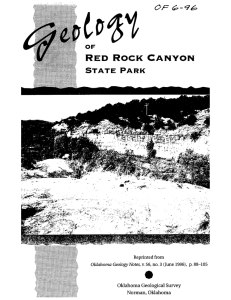
red rock canyon - Oklahoma Geological Survey
... walls, where it is emitted as springs and seeps. Ground water produced from local wells is of high quality; that is, a liter of water contains less than 500 mg oftotal dissolved solids. Well yields also are high: 100500 gallons per minute. The water table probably was near the level of the canyon fl ...
... walls, where it is emitted as springs and seeps. Ground water produced from local wells is of high quality; that is, a liter of water contains less than 500 mg oftotal dissolved solids. Well yields also are high: 100500 gallons per minute. The water table probably was near the level of the canyon fl ...

... what was once an island sank beneath the waves millions of years ago. There are little pot holes ground into gabbro rock, still partially filled with pebbles and sand, and headlands and fossil seastacks (isolated erosional remnants of the island). No beach umbrella, but an old rotting fishing net—th ...

Weathering is the process by which natural forces break down rocks
... Weathering creates sediment which is compacted and cemented together to create sedimentary rock. ...
... Weathering creates sediment which is compacted and cemented together to create sedimentary rock. ...

WC/93/015 Industrial minerals exploration guide. No 1, Biogenic
... soluble in acidic water, many carbonates form prominent scarp and dip features due to their resistance to mechanical erosion. This is particularly marked in gently dipping stata where the carbonate is interbedded with "soft" argillaceous sequences. In flat-lying strata extensive karstic plateaux dev ...
... soluble in acidic water, many carbonates form prominent scarp and dip features due to their resistance to mechanical erosion. This is particularly marked in gently dipping stata where the carbonate is interbedded with "soft" argillaceous sequences. In flat-lying strata extensive karstic plateaux dev ...

M.Sc. Geology Revised Syllabus June 2013 I Semester Code Paper
... Structures in metamorphic rocks, Foliation, Axial plane foliation, transported foliation, other metamorphic foliation. Lineation – problem of lineation indicating extension parallel to fold axis, small scale folds. Structural association, salt domes, diapers, nappe, tectonic melanges 15 hours Unit – ...
... Structures in metamorphic rocks, Foliation, Axial plane foliation, transported foliation, other metamorphic foliation. Lineation – problem of lineation indicating extension parallel to fold axis, small scale folds. Structural association, salt domes, diapers, nappe, tectonic melanges 15 hours Unit – ...

Fossils - Blountstown Middle School
... • Sometimes fossils contain only carbon. • Fossils usually form when sediments bury a dead organism. • As sediment piles up, the organism’s remains are subjected to pressure and heat. • These conditions force gases and liquids from the body. • A thin film of carbon residue is left, forming a silhoue ...
... • Sometimes fossils contain only carbon. • Fossils usually form when sediments bury a dead organism. • As sediment piles up, the organism’s remains are subjected to pressure and heat. • These conditions force gases and liquids from the body. • A thin film of carbon residue is left, forming a silhoue ...
The Geologic Time Scale
... the forces that continually change the surface features of Earth today have been occurring since Earth formed. • Only the rate, intensity, and scale with which the forces occur have changed. • The resulting sediments and rocks all record an environment and fossils within the rocks preserve evidence ...
... the forces that continually change the surface features of Earth today have been occurring since Earth formed. • Only the rate, intensity, and scale with which the forces occur have changed. • The resulting sediments and rocks all record an environment and fossils within the rocks preserve evidence ...

A reassessment of the brittle deformation history, age and attribute
... The onshore Devonian sedimentary rocks of the Orcadian basin host significant localized zones of fracturing, faulting and some folding on all scales. New field and microstructural analyses carried out within the Devonian cover sequences in Scotland and Orkney reveal 3 main groups of structures based ...
... The onshore Devonian sedimentary rocks of the Orcadian basin host significant localized zones of fracturing, faulting and some folding on all scales. New field and microstructural analyses carried out within the Devonian cover sequences in Scotland and Orkney reveal 3 main groups of structures based ...

Year 8 Activity Pack sample - UNIT 8HB
... Intrusive igneous rocks are formed when magma cools down underground. They are named because the magma has ‘intruded’ into rocks that were already present. Most intrusive igneous rocks have large crystals, but not always! The diagram shows three different ways in which magma can be intruded. Large v ...
... Intrusive igneous rocks are formed when magma cools down underground. They are named because the magma has ‘intruded’ into rocks that were already present. Most intrusive igneous rocks have large crystals, but not always! The diagram shows three different ways in which magma can be intruded. Large v ...
Geological and Tectonic Background
... Carpathians gradually filled up the lake, step-by-step through advancing deltas (Juhász et al. 2007; Magyar et al. 1999). By the Pliocene, a fluvial-lacustrine system with large swamps and wetlands replaced the lake. An intense uplift of Transdanubia, the western part of the Danube-Tisza Interfluve, ...
... Carpathians gradually filled up the lake, step-by-step through advancing deltas (Juhász et al. 2007; Magyar et al. 1999). By the Pliocene, a fluvial-lacustrine system with large swamps and wetlands replaced the lake. An intense uplift of Transdanubia, the western part of the Danube-Tisza Interfluve, ...

the White-Inyo field-trip guidebook
... gas at 108.4 mi). Stay on CA-108 for Sonora Pass! Don’t turn right for Yosemite Park! At Knights Ferry we are well into the Mehrten Formation, an andesitic mudflow breccia (lahar) of Oligocene age. Its source was an andesitic volcanic arc deposited on the intensely eroded and peneplained Late Mesozo ...
... gas at 108.4 mi). Stay on CA-108 for Sonora Pass! Don’t turn right for Yosemite Park! At Knights Ferry we are well into the Mehrten Formation, an andesitic mudflow breccia (lahar) of Oligocene age. Its source was an andesitic volcanic arc deposited on the intensely eroded and peneplained Late Mesozo ...

Avigad+ 2003 - Stanford School of Earth, Energy
... Voluminous Paleozoic sandstone sequences were deposited in northern Africa and Arabia following an extended Neoproterozoic orogenic cycle that culminated in the assembly of Gondwana. We measured sensitive high-resolution ion microprobe (SHRIMP) U-Pb ages of detrital zircons separated from several Ca ...
... Voluminous Paleozoic sandstone sequences were deposited in northern Africa and Arabia following an extended Neoproterozoic orogenic cycle that culminated in the assembly of Gondwana. We measured sensitive high-resolution ion microprobe (SHRIMP) U-Pb ages of detrital zircons separated from several Ca ...

Metamorphic Petrology GLY 262 Lecture 1:An introduction to
... • A mineral is a naturally occurring homogeneous solid, inorganically formed, with a definite chemical composition and an ordered atomic arrangement ...
... • A mineral is a naturally occurring homogeneous solid, inorganically formed, with a definite chemical composition and an ordered atomic arrangement ...

Rocks
... by heat, pressure and chemical processes = metamorphism – Minerals may change into other chemicals – Minerals may change size, shape, or separate into bands (layered look) – Hot fluids in magma may change mineral composition by dissolving some minerals and ...
... by heat, pressure and chemical processes = metamorphism – Minerals may change into other chemicals – Minerals may change size, shape, or separate into bands (layered look) – Hot fluids in magma may change mineral composition by dissolving some minerals and ...

Common Rock Types of New Mexico and the World Rock Sample
... Most rocks are a collection of one or more minerals (see below), but some contain noncrystalline inorganic material (like obsidian) or organic material (such as coal). Minerals are naturally occurring inorganic material having an orderly internal arrangement and distinctive chemical composition, cry ...
... Most rocks are a collection of one or more minerals (see below), but some contain noncrystalline inorganic material (like obsidian) or organic material (such as coal). Minerals are naturally occurring inorganic material having an orderly internal arrangement and distinctive chemical composition, cry ...

Preliminary Geologic Map of the - New Mexico Bureau of Geology
... brecciation post-dates lithification of both the Totilto limestone and the Bilk Creek Sandstone, as well as the limestone microbreccia-forming dissolution event. The Bilk Creek Sandstone above the chaotic breccia in areas that are far from preserved gypsum mounds often displays compressional folding ...
... brecciation post-dates lithification of both the Totilto limestone and the Bilk Creek Sandstone, as well as the limestone microbreccia-forming dissolution event. The Bilk Creek Sandstone above the chaotic breccia in areas that are far from preserved gypsum mounds often displays compressional folding ...
Geology of Great Britain

The geology of Great Britain is renowned for its diversity. As a result of its eventful geological history, Great Britain shows a rich variety of landscapes across the constituent countries of England, Wales and Scotland. Rocks of almost all geological ages are represented at outcrop, from the Archaean onwards.