Survey
* Your assessment is very important for improving the work of artificial intelligence, which forms the content of this project
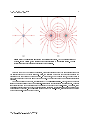
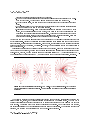
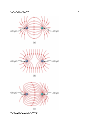
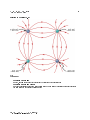
OpenStax Staging4 module: m10495 6 terminate on negative charges or extend out to innity. 2.The number of eld lines originating or terminating at a charge is proportional to the magnitude of that charge. A charge of 2 q will have twice as many lines as a charge of q. 3.At every point in space, the eld vector at that point is tangent to the eld line at that same point. 4.The eld line density at any point in space is proportional to (and therefore is representative of ) the magnitude of the eld at that point in space. 5.Field lines can never cross. Since a eld line represents the direction of the eld at a given point, if two eld lines crossed at some point, that would imply that the electric eld was pointing in two dierent directions at a single point. This in turn would suggest that the (net) force on a test charge placed at that point would point in two dierent directions. Since this is obviously impossible, it follows that eld lines must never cross. Always keep in mind that eld lines serve only as a convenient way to visualize the electric eld; they are not physical entities. Although the direction and relative intensity of the electric eld can be deduced from a set of eld lines, the lines can also be misleading. For example, the eld lines drawn to represent the electric eld in a region must, by necessity, be discrete. However, the actual electric eld in that region exists at every point in space. Field lines for three groups of discrete charges are shown in Figure 5. Since the charges in parts (a) and (b) have the same magnitude, the same number of eld lines are shown starting from or terminating on each charge. In (c), however, we draw three times as many eld lines leaving the +3q charge as entering the The eld lines that do not terminate at âq âq . emanate outward from the charge conguration, to innity. Figure 5: Three typical electric eld diagrams. (a) A dipole. (b) Two identical charges. (c) Two charges with opposite signs and dierent magnitudes. Can you tell from the diagram which charge has the larger magnitude? The ability to construct an accurate electric eld diagram is an important, useful skill; it makes it much easier to estimate, predict, and therefore calculate the electric eld of a source charge. The best way to develop this skill is with software that allows you to place source charges and then will draw the net eld upon request. We strongly urge you to search the Internet for a program. Once you've found one you like, run several simulations to get the essential ideas of eld diagram construction. Then practice drawing eld diagrams, and checking your predictions with the computer-drawn diagrams. http://legacy-staging4.cnx.org/content/m10495/1.5/