

Treatments for depression
... is a high risk of suicide or the patient is too ill to eat, drink or take medications ...
... is a high risk of suicide or the patient is too ill to eat, drink or take medications ...
Depression in the Elderly
... Decreased ability to think/concentrate or indecisiveness Recurrent thoughts of death; suicidal ideation ...
... Decreased ability to think/concentrate or indecisiveness Recurrent thoughts of death; suicidal ideation ...
Am J Psychiatry 167:487
... informants can supplement information provided by the patient (5). Interviews by experienced clinicians seem superior to self-reports, and training of interviewers improves the results further (6, 7). The Morey et al. study represents a major addition to this literature by examining the long-term ou ...
... informants can supplement information provided by the patient (5). Interviews by experienced clinicians seem superior to self-reports, and training of interviewers improves the results further (6, 7). The Morey et al. study represents a major addition to this literature by examining the long-term ou ...

Follow these Instructions
... makes the neuron more likely to fire • inhibitory – neurotransmitter bound to postsynaptic receptor site prevents likelihood of neuron firing – Agonists excite, – Antagonists inhibit • Endorphins block • Heroin tolerance and withdrawal ...
... makes the neuron more likely to fire • inhibitory – neurotransmitter bound to postsynaptic receptor site prevents likelihood of neuron firing – Agonists excite, – Antagonists inhibit • Endorphins block • Heroin tolerance and withdrawal ...

Depressive Disorders
... • Life time prevalence : High(10-25%) • Gender: Female more than Male(2, times) ...
... • Life time prevalence : High(10-25%) • Gender: Female more than Male(2, times) ...

Depression erkennen und verstehen
... depression, its persistent hold can keep a person from feeling good and can intrude upon work, school, and social life. Duration: dysthymia lasts for an average of at least five years. Patients feel depressed during most of the day. They may carry out daily responsibilities, but much of the zest is ...
... depression, its persistent hold can keep a person from feeling good and can intrude upon work, school, and social life. Duration: dysthymia lasts for an average of at least five years. Patients feel depressed during most of the day. They may carry out daily responsibilities, but much of the zest is ...

Triggers for depressed mood in a diverse sample of
... stop taking them?’ And it just, it…it kinda broke my heart, not to be able to give him an answer. Not to be able to tell him, ‘Uncle’s gonna have to take these pills the rest of his life…’” ...
... stop taking them?’ And it just, it…it kinda broke my heart, not to be able to give him an answer. Not to be able to tell him, ‘Uncle’s gonna have to take these pills the rest of his life…’” ...
Neurotransmitters:
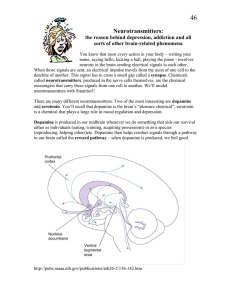
... There are many different neurotransmitters. Two of the most interesting are dopamine and serotonin. You’ll recall that dopamine is the brain’s “pleasure chemical”; serotonin is a chemical that plays a large role in mood regulation and depression. Dopamine is produced in our midbrain whenever we do s ...
... There are many different neurotransmitters. Two of the most interesting are dopamine and serotonin. You’ll recall that dopamine is the brain’s “pleasure chemical”; serotonin is a chemical that plays a large role in mood regulation and depression. Dopamine is produced in our midbrain whenever we do s ...

View Presentation
... Mania – Episodes of abnormally elevated, expansive or irritable mood Hypomania- Milder elevated state Depression – Diminished interest , energy, and ability to enjoy pleasure Mixed mania – Mania or hypomania occurs simultaneously with depressive symptoms Cyclothymia – Mood swings between hypomania a ...
... Mania – Episodes of abnormally elevated, expansive or irritable mood Hypomania- Milder elevated state Depression – Diminished interest , energy, and ability to enjoy pleasure Mixed mania – Mania or hypomania occurs simultaneously with depressive symptoms Cyclothymia – Mood swings between hypomania a ...

Ch. 19 S. 5 Biological Therapy
... ECT was used much less often. In fact, in 1990 the Am. Psychiatric Association recommended that that ECT be used primarily for people with major depression who do not respond to antidepressant drugs. ...
... ECT was used much less often. In fact, in 1990 the Am. Psychiatric Association recommended that that ECT be used primarily for people with major depression who do not respond to antidepressant drugs. ...

Depression
... • Fronto-Limbic Network (FLN) disturbances: • Vicissitudes of mood and affective lability characterize BD and BPD respectively. • Within FLN there are key regions of interest in emotion processing and regulation: – dorsolateral, ventrolateral and dorsomedial prefrontal cortices (dl-PFC, vl-PFC, dm-P ...
... • Fronto-Limbic Network (FLN) disturbances: • Vicissitudes of mood and affective lability characterize BD and BPD respectively. • Within FLN there are key regions of interest in emotion processing and regulation: – dorsolateral, ventrolateral and dorsomedial prefrontal cortices (dl-PFC, vl-PFC, dm-P ...
The American Academy of Child and
... and left parieto-occipital cortices. While it is difficult to directly translate these find ings into clinically useful material, these data do demonstrate the biological under pinnings of ADHD and eventually may help to develop new targets for treatment. For example, another PET study looked at t ...
... and left parieto-occipital cortices. While it is difficult to directly translate these find ings into clinically useful material, these data do demonstrate the biological under pinnings of ADHD and eventually may help to develop new targets for treatment. For example, another PET study looked at t ...
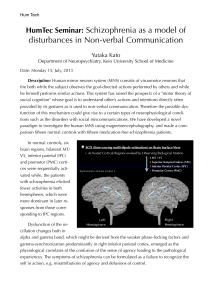
Schizophrenia as a model of disturbances in Non
... fire both while the subject observes the goal-directed actions performed by others and while he himself performs similar actions. This system has raised the prospects of a "motor theory of social cognition" whose goal is to understand other’s actions and intentions directly often provided by its ges ...
... fire both while the subject observes the goal-directed actions performed by others and while he himself performs similar actions. This system has raised the prospects of a "motor theory of social cognition" whose goal is to understand other’s actions and intentions directly often provided by its ges ...

The Reproductive Health Implications of Depression: Postpartum
... affective states are probably not linear or dose-dependent • Estrogen and progesterone modulate each others effects on CNS and that complicates understanding of their individual effects ...
... affective states are probably not linear or dose-dependent • Estrogen and progesterone modulate each others effects on CNS and that complicates understanding of their individual effects ...

Mood Disorders - Texas Christian University
... No manic or hypomanic episode ( hypomanic episode is an episode of increased energy that are not sufficiently severe to classify as full blown mania) Major Depressive Disorder most often follows a course of repeated episodes through life ...
... No manic or hypomanic episode ( hypomanic episode is an episode of increased energy that are not sufficiently severe to classify as full blown mania) Major Depressive Disorder most often follows a course of repeated episodes through life ...

DEPRESSION SELF-RATING SCALE FOR CHILDREN
... These figures assume a prevalence of depressive disorder of approximately 5% in a clinic population. While those with a depression diagnosis scored highly, it was noted that many other children with dysphoric mood also scored over 15. These were children with a range of other diagnoses including con ...
... These figures assume a prevalence of depressive disorder of approximately 5% in a clinic population. While those with a depression diagnosis scored highly, it was noted that many other children with dysphoric mood also scored over 15. These were children with a range of other diagnoses including con ...

Role of Medications, Therapy and Education in the Treatment of
... MDE (mild-to-moderate severity) Subsyndromal depression: sad mood or ...
... MDE (mild-to-moderate severity) Subsyndromal depression: sad mood or ...

Slide 1
... • Affect-Focused STDP (Fosha) • Impulse-Focused P. for Borderlines (Complutense Group) ...
... • Affect-Focused STDP (Fosha) • Impulse-Focused P. for Borderlines (Complutense Group) ...

USVH Disease of the Week #2: Depression in Older Adults
... Why is it important to treat depression in elderly people? First and foremost, proper treatment can prevent suicide. Deteriorating health, a sense of isolation and hopelessness, and difficulty adjusting to new life circumstances can combine to push a person suffering from depression over the edge. F ...
... Why is it important to treat depression in elderly people? First and foremost, proper treatment can prevent suicide. Deteriorating health, a sense of isolation and hopelessness, and difficulty adjusting to new life circumstances can combine to push a person suffering from depression over the edge. F ...

Mood Disorders in Children and Adolescents
... Family involvement and family stability are essential in effective treatment. Pay attention to the role of poverty, limited access to care and family chaos for child and family ...
... Family involvement and family stability are essential in effective treatment. Pay attention to the role of poverty, limited access to care and family chaos for child and family ...


Depression: The Physical and Fiscal Impact on Patient, Society and
... after treatment.19 Thus, rates of recovery diminish with longer duration of depression symptoms. The longer the delay in beginning treatment, the harder it is to get a remission. Emotional and physical symptoms of depression respond differently to treatment. In one study of response to selective ser ...
... after treatment.19 Thus, rates of recovery diminish with longer duration of depression symptoms. The longer the delay in beginning treatment, the harder it is to get a remission. Emotional and physical symptoms of depression respond differently to treatment. In one study of response to selective ser ...

Depression
... An estimated 50% of unsuccessful treatment for depression is due to medical non-compliance. Patients stop taking medication too soon due to unacceptable side effects, financial factors, fears of addiction and/or short-term improvement of symptoms, leading them to believe that continuing treatment is ...
... An estimated 50% of unsuccessful treatment for depression is due to medical non-compliance. Patients stop taking medication too soon due to unacceptable side effects, financial factors, fears of addiction and/or short-term improvement of symptoms, leading them to believe that continuing treatment is ...
Results - Kat Stones` ePortfolio
... Through studies concerning the impact of sleep deprivation on depressive symptomology, it was discovered that sleep deprivation can either be beneficial in reducing symptoms or it can trigger a negative mood state. Studies that have targeted and manipulated the amount of sleep healthy participants r ...
... Through studies concerning the impact of sleep deprivation on depressive symptomology, it was discovered that sleep deprivation can either be beneficial in reducing symptoms or it can trigger a negative mood state. Studies that have targeted and manipulated the amount of sleep healthy participants r ...
Biology of depression

Scientific studies have found that numerous brain areas show altered activity in patients suffering from depression, and this has encouraged advocates of various theories that seek to identify a biochemical origin of the disease, as opposed to theories that emphasize psychological or situational causes. Several theories concerning the biologically based cause of depression have been suggested over the years, of which the most prominent and widely researched is the monoamine hypothesis.