
Counseling for Depression in the Indian Culture
... there seem to be a lack of culturally specific assessment tools for the Indian culture. One assessment tool was recently developed by Mantle (2003) in Great Britain for assessing Indian women for postpartum depression. This tool is called the Dosha Assessment Tool for Postnatal Depression. It was de ...
... there seem to be a lack of culturally specific assessment tools for the Indian culture. One assessment tool was recently developed by Mantle (2003) in Great Britain for assessing Indian women for postpartum depression. This tool is called the Dosha Assessment Tool for Postnatal Depression. It was de ...


Mood Disorders: An overview
... can sometimes occur with a new mother (and sometimes a new father) following the birth of a child. It can have negative effects on the new child. Post partum depression was seen in the past as fairly common, but after more studies it has been shown that postpartum blues tend to be what happens. The ...
... can sometimes occur with a new mother (and sometimes a new father) following the birth of a child. It can have negative effects on the new child. Post partum depression was seen in the past as fairly common, but after more studies it has been shown that postpartum blues tend to be what happens. The ...

Ecstasy
... plays an important role in mood regulation, appetite and your senses. 2. There are 10 serotonin receptors on the receiving neuron that receive the serotonin signal. 3. There are 5 recycling receptors on the synapse of the sending neuron that pick the serotonin back up after it does its job. 4. Serot ...
... plays an important role in mood regulation, appetite and your senses. 2. There are 10 serotonin receptors on the receiving neuron that receive the serotonin signal. 3. There are 5 recycling receptors on the synapse of the sending neuron that pick the serotonin back up after it does its job. 4. Serot ...

Depressive Disorders - New York Medical College
... unrestrained buying sprees, sexual indiscretions, or foolish business investments) Increased activity No major life disruption No need for hospitalization No psychotic symptoms ...
... unrestrained buying sprees, sexual indiscretions, or foolish business investments) Increased activity No major life disruption No need for hospitalization No psychotic symptoms ...
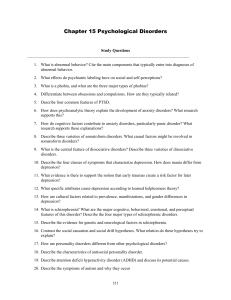
AP Psych 15 sq AP Psych-Psychological Disorders-SQ
... supports this? 7. How do cognitive factors contribute to anxiety disorders, particularly panic disorder? What research supports these explanations? 8. Describe three varieties of somatoform disorders. What causal factors might be involved in somatoform disorders? 9. What is the central feature of di ...
... supports this? 7. How do cognitive factors contribute to anxiety disorders, particularly panic disorder? What research supports these explanations? 8. Describe three varieties of somatoform disorders. What causal factors might be involved in somatoform disorders? 9. What is the central feature of di ...
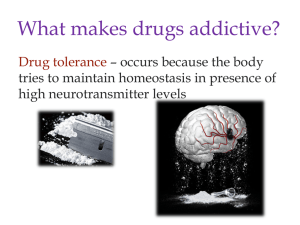
Powerpoint version
... Repeated drug use causes elevated dopamine Body decreases # dopamine receptors, dopamine prod’n “Down regulation” Dopamine receptors ...
... Repeated drug use causes elevated dopamine Body decreases # dopamine receptors, dopamine prod’n “Down regulation” Dopamine receptors ...

Recommendations and Rationale
... examined the effectiveness of screening for depression in primary care settings.9 In eight studies, the only intervention was feedback of screening results to clinicians; remaining studies combined feedback with other interventions for patients or clinicians. The trials reported various outcomes, in ...
... examined the effectiveness of screening for depression in primary care settings.9 In eight studies, the only intervention was feedback of screening results to clinicians; remaining studies combined feedback with other interventions for patients or clinicians. The trials reported various outcomes, in ...

Guideline for Management of Depression and Generalised Anxiety
... Screening questions are useful tools to assess whether a patient should be further investigated for depression and anxiety. Review those with long term physical health conditions as they are associated with higher levels of depression compared to the general population. Undertake screening questions ...
... Screening questions are useful tools to assess whether a patient should be further investigated for depression and anxiety. Review those with long term physical health conditions as they are associated with higher levels of depression compared to the general population. Undertake screening questions ...

Psychopharmacology and Other Biologic Treatments
... • Less likely to experience psychosis • More likely to manifest symptoms of anxiety (fear of separation) and somatic symptoms • Mood may be irritable, rather than sad. • Suicide is a real risk, which peaks during midadolescents. • Mortality from suicide increases steadily through the teens (third le ...
... • Less likely to experience psychosis • More likely to manifest symptoms of anxiety (fear of separation) and somatic symptoms • Mood may be irritable, rather than sad. • Suicide is a real risk, which peaks during midadolescents. • Mortality from suicide increases steadily through the teens (third le ...

Behavioural and Psychological Symptoms of Dementia (BPSD)
... Risperidone-only licenced medication for aggression for short duration This guidance makes clear that people with dementia should only be offered anti-psychotics if they are severely distressed or there is an immediate risk of harm to the person or others There will occasions when the use of d ...
... Risperidone-only licenced medication for aggression for short duration This guidance makes clear that people with dementia should only be offered anti-psychotics if they are severely distressed or there is an immediate risk of harm to the person or others There will occasions when the use of d ...

Unit 12 and 13 Abnormal Psych and Treatments
... effectiveness of psychotherapy? Meta-analysis of a number of studies suggests that thousands of patients benefit more from therapy than those who did not go to therapy. ...
... effectiveness of psychotherapy? Meta-analysis of a number of studies suggests that thousands of patients benefit more from therapy than those who did not go to therapy. ...

Impairment in the Legal Profession
... A quality-of-life survey by the North Carolina Bar Association in 1991 revealed that almost 26% of respondents exhibited symptoms of clinical depression, and almost 12% said they contemplated suicide at least once a month. ...
... A quality-of-life survey by the North Carolina Bar Association in 1991 revealed that almost 26% of respondents exhibited symptoms of clinical depression, and almost 12% said they contemplated suicide at least once a month. ...

Chapter 10 Summary
... relations with family, and suicidal ideation. Current research suggests that there are likely multiple pathways to the development of depression, including genetic factors, neurobiological processes, family/interpersonal relationship problems, stressful life events, cognitive factors, and difficulti ...
... relations with family, and suicidal ideation. Current research suggests that there are likely multiple pathways to the development of depression, including genetic factors, neurobiological processes, family/interpersonal relationship problems, stressful life events, cognitive factors, and difficulti ...

Reward” and “Punishment” Function of the Limbic System
... derangements (e.g., anoxia, hypercapnia, hypoglycemia, or hepatic encephalopathy). Mood disorders, the main two affective (mood) disorders are 1.major depression 2. bipolar disorder, bipolar disorder is expressed by periods of depression alternating with bouts of mania. Drugs that enhance the diffus ...
... derangements (e.g., anoxia, hypercapnia, hypoglycemia, or hepatic encephalopathy). Mood disorders, the main two affective (mood) disorders are 1.major depression 2. bipolar disorder, bipolar disorder is expressed by periods of depression alternating with bouts of mania. Drugs that enhance the diffus ...

SBIRT Governor`s Policy Subcommittee
... o Panel has never heard of “Anti-depressant behavior” or “program of self-care” o Add “an important part of treatment is wellness management” o There are many treatments for depression: medication, talk therapy, combinations…. o Situational and clinical depression can overlap o Leave out “I’m” state ...
... o Panel has never heard of “Anti-depressant behavior” or “program of self-care” o Add “an important part of treatment is wellness management” o There are many treatments for depression: medication, talk therapy, combinations…. o Situational and clinical depression can overlap o Leave out “I’m” state ...

Depressive Disorders
... The same symptoms of mania but with different in period and severity (hypomania is less severity and longer period) it is characterized by: 1. A distinct period of persistently elevated, expensive, or irritable mood, lasting thought at least 4 days, that is clearly different from the usual non depre ...
... The same symptoms of mania but with different in period and severity (hypomania is less severity and longer period) it is characterized by: 1. A distinct period of persistently elevated, expensive, or irritable mood, lasting thought at least 4 days, that is clearly different from the usual non depre ...

Treating Depression and Anxiety in the Geriatric Patient
... (dysthymia) Depressed mood for the majority of the time for at least 2 years 2 of the following: poor appetite or overeating, insomnia/hypersomnia, low energy/fatigue, low self-esteem, poor concentration/indecisive, hopelessness DSM-5 ...
... (dysthymia) Depressed mood for the majority of the time for at least 2 years 2 of the following: poor appetite or overeating, insomnia/hypersomnia, low energy/fatigue, low self-esteem, poor concentration/indecisive, hopelessness DSM-5 ...

File
... b. there is repetition of the information, especially over an extended period of time c. there is a strong stimulus associated with it, including colour, light, smell, or sound a loss of short-term memory. They may not remember what day of the week it is, but they can remember details of their child ...
... b. there is repetition of the information, especially over an extended period of time c. there is a strong stimulus associated with it, including colour, light, smell, or sound a loss of short-term memory. They may not remember what day of the week it is, but they can remember details of their child ...

Staying Well After Psychosis: A Cognitive Interpersonal
... can pick things that have happened years ago, show a symbol of it, show a picture of it, and it’s a horrible experience because you begin to relive those experiences. You don’t have to relive them because they are generally bad experiences, of my schizophrenia, a lot of embarrassment, a lot of humil ...
... can pick things that have happened years ago, show a symbol of it, show a picture of it, and it’s a horrible experience because you begin to relive those experiences. You don’t have to relive them because they are generally bad experiences, of my schizophrenia, a lot of embarrassment, a lot of humil ...

Addiction, Drugs, and the Endocrine System
... Many pharmaceutical drugs Many are “designer” drugs ...
... Many pharmaceutical drugs Many are “designer” drugs ...

Adult Mood Disorders Dr Gillis 2010
... usually fall or winter Full remission also occurs at regular time of year usually spring (or switch to mania) In the last 2 years two major depressive episodes have occurred as above with no nonseasonal episode of MDE occurring in the two years Seasonal episodes of MDE outweigh nonseasonal epi ...
... usually fall or winter Full remission also occurs at regular time of year usually spring (or switch to mania) In the last 2 years two major depressive episodes have occurred as above with no nonseasonal episode of MDE occurring in the two years Seasonal episodes of MDE outweigh nonseasonal epi ...

What Is Depression - Manhasset Schools
... co–existing depression. Research has yielded increasing evidence that treating the depression can also help improve the outcome of treating the co–occurring illness. ...
... co–existing depression. Research has yielded increasing evidence that treating the depression can also help improve the outcome of treating the co–occurring illness. ...
Psych Slide Show
... enjoying anything anymore, even horse riding Blunted affect which she always had been a great source of Physchomotor agitation pleasure Circumstantial speech 2. A depressed man, who has stopped eating, Manic stupor shows little facial expression or emotion and Pressure of speech speaks with a monoto ...
... enjoying anything anymore, even horse riding Blunted affect which she always had been a great source of Physchomotor agitation pleasure Circumstantial speech 2. A depressed man, who has stopped eating, Manic stupor shows little facial expression or emotion and Pressure of speech speaks with a monoto ...
the relationship between depression and cognitive deficits
... during remission may also play a critical role in increasing the individual’s vulnerability for the first onset, maintenance and future recurrence of depressive episodes (Gotlib et al. 2010, Kessing et al. 2001). Cognitive symptoms, such as difficulty making decisions and poor concentration, are inc ...
... during remission may also play a critical role in increasing the individual’s vulnerability for the first onset, maintenance and future recurrence of depressive episodes (Gotlib et al. 2010, Kessing et al. 2001). Cognitive symptoms, such as difficulty making decisions and poor concentration, are inc ...
Biology of depression

Scientific studies have found that numerous brain areas show altered activity in patients suffering from depression, and this has encouraged advocates of various theories that seek to identify a biochemical origin of the disease, as opposed to theories that emphasize psychological or situational causes. Several theories concerning the biologically based cause of depression have been suggested over the years, of which the most prominent and widely researched is the monoamine hypothesis.