
Created with Sketch. Calculating potential and kinetic energy
... In the International System of Units (the SI system), the unit of energy is the joule. The specific heat capacity (or just specific heat) of a material is defined as the amount of heat required to raise the temperature of 1 gram (g) of the material 1 degree Celsius (°C). It takes 4.18 joules to rais ...
... In the International System of Units (the SI system), the unit of energy is the joule. The specific heat capacity (or just specific heat) of a material is defined as the amount of heat required to raise the temperature of 1 gram (g) of the material 1 degree Celsius (°C). It takes 4.18 joules to rais ...


energy - Geophile.net
... • History and Potential – Large scale generation and transmission of water power started around 1900 – Present production is 45,000 MW • Ultimate maximum based on stream flow is 161,000 MW • It appears that some used potential may help compensate for declining fossil fuels ...
... • History and Potential – Large scale generation and transmission of water power started around 1900 – Present production is 45,000 MW • Ultimate maximum based on stream flow is 161,000 MW • It appears that some used potential may help compensate for declining fossil fuels ...

Heat and Thermodynamics
... Tight packing would tend to decrease the insulation value of glass wool because it would squeeze the wool together and give the heat more paths to travel. It is the presence of many small pockets of air, with unattached molecules, that gives glass wool and other similar insulation materials their ...
... Tight packing would tend to decrease the insulation value of glass wool because it would squeeze the wool together and give the heat more paths to travel. It is the presence of many small pockets of air, with unattached molecules, that gives glass wool and other similar insulation materials their ...

Potential and Kinetic Energy
... Differentiate between kinetic and potential energy. 1 - Identify examples of kinetic and potential energy. ...
... Differentiate between kinetic and potential energy. 1 - Identify examples of kinetic and potential energy. ...

Document
... Elasticity can be seen by a reduction, at least partial, of the deformation when the load applied on a body is released. From ambient temperature (or below) and up to relatively high temperatures (T < 1,000°C), ceramics are elastic materials par excellence: their behavior under load is most often li ...
... Elasticity can be seen by a reduction, at least partial, of the deformation when the load applied on a body is released. From ambient temperature (or below) and up to relatively high temperatures (T < 1,000°C), ceramics are elastic materials par excellence: their behavior under load is most often li ...

Potential and Kinetic Energy
... Differentiate between kinetic and potential energy. 1 - Identify examples of kinetic and potential energy. ...
... Differentiate between kinetic and potential energy. 1 - Identify examples of kinetic and potential energy. ...

energy around us
... c. Show your card when instructed to. (The back of your card should have clues.) ...
... c. Show your card when instructed to. (The back of your card should have clues.) ...

Physical Science
... potential energy due to their relative positions in a system. Gravitational, elastic, and chemical energy are all forms of potential energy. P.EN.M.4 Energy Transfer – Different forms of energy can be transferred from place to place by radiation, conduction, or convection. When energy is transferred ...
... potential energy due to their relative positions in a system. Gravitational, elastic, and chemical energy are all forms of potential energy. P.EN.M.4 Energy Transfer – Different forms of energy can be transferred from place to place by radiation, conduction, or convection. When energy is transferred ...

Unit 5 Lesson 1
... • SC.5.P.10.1 Investigate and describe some basic forms of energy, including light, heat, sound, electrical, chemical, and mechanical. • SC.5.P.10.2 Investigate and explain that energy has the ability to cause motion or create change. ...
... • SC.5.P.10.1 Investigate and describe some basic forms of energy, including light, heat, sound, electrical, chemical, and mechanical. • SC.5.P.10.2 Investigate and explain that energy has the ability to cause motion or create change. ...

Topic A Guide
... • A thermosetting polymer is a prepolymer in a soft solid or viscous state that changes irreversibly into a hardened thermoset by curing. • Elastomers are flexible and can be deformed under force but will return to nearly their original shape once the stress is released. • High density polyethene (H ...
... • A thermosetting polymer is a prepolymer in a soft solid or viscous state that changes irreversibly into a hardened thermoset by curing. • Elastomers are flexible and can be deformed under force but will return to nearly their original shape once the stress is released. • High density polyethene (H ...
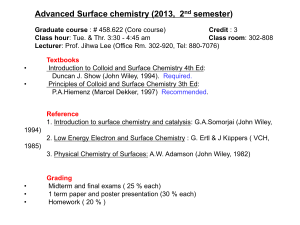

PPT File
... Answer all questions using complete sentences that incorporate the question into the answer you write. Example: 1. The burning of a potato chip is an exothermic reaction. I know this because I saw a bright flame (light energy) and there was heat given off by the reaction which we used to heat water. ...
... Answer all questions using complete sentences that incorporate the question into the answer you write. Example: 1. The burning of a potato chip is an exothermic reaction. I know this because I saw a bright flame (light energy) and there was heat given off by the reaction which we used to heat water. ...


S8P2 Energy Transformations - Mrs. Carnes
... The Law of Conservation of Energy • No matter how energy is transformed, energy itself is not made or destroyed. • Law of Conservation of Energy states while energy may change from one form to another, energy is neither created nor destroyed ...
... The Law of Conservation of Energy • No matter how energy is transformed, energy itself is not made or destroyed. • Law of Conservation of Energy states while energy may change from one form to another, energy is neither created nor destroyed ...


CHAPTER 4: ENERGY
... This energy is stored in the object. Therefore, the object has potential to cause change. Stored energy due to position is called POTENTIAL ENERGY. ...
... This energy is stored in the object. Therefore, the object has potential to cause change. Stored energy due to position is called POTENTIAL ENERGY. ...
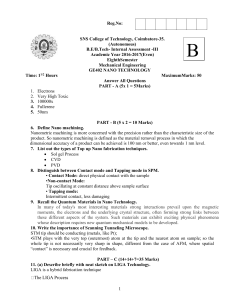

File
... CHEMISTRY: WHMIS – Workplace Hazardous Materials Information System; symbols used to identify dangerous materials Classifying Matter – matter is anything with mass and volume and could be either solid liquid or gas. Matter can be further divided into either a mixture or a pure substance. Atomi ...
... CHEMISTRY: WHMIS – Workplace Hazardous Materials Information System; symbols used to identify dangerous materials Classifying Matter – matter is anything with mass and volume and could be either solid liquid or gas. Matter can be further divided into either a mixture or a pure substance. Atomi ...
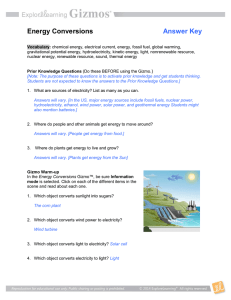
Energy Conversions - Middle School Chaos Mrs. Piper, Mr. Hysell
... energy source, and then explain how each is produced in your own words. A. Wind power: The Sun heats up pockets of air*, which rise. Cooler air rushes in, causing wind. Wind turns the blades of a wind turbine. The blades turn a loop of wire inside a magnet. This causes an electrical current to flow ...
... energy source, and then explain how each is produced in your own words. A. Wind power: The Sun heats up pockets of air*, which rise. Cooler air rushes in, causing wind. Wind turns the blades of a wind turbine. The blades turn a loop of wire inside a magnet. This causes an electrical current to flow ...

Focus Plan - Texarkana Independent School District
... 11.1 The student, for at least 40% of instructional time, conducts field and laboratory investigations using safe, environmentally appropriate, and ethical practices. The student is expected to: (A) demonstrate safe practices during field and laboratory investigations 11.2 The student uses scientifi ...
... 11.1 The student, for at least 40% of instructional time, conducts field and laboratory investigations using safe, environmentally appropriate, and ethical practices. The student is expected to: (A) demonstrate safe practices during field and laboratory investigations 11.2 The student uses scientifi ...
