14631
... • Climate change will eventually become too extreme for humans to live on Earth. We will be forced to live in space or somewhere where there can be no cars or factories to pollute the environment and cause global warming. Polar icecaps will melt more quickly than ever and all Arctic and Antarctic a ...
... • Climate change will eventually become too extreme for humans to live on Earth. We will be forced to live in space or somewhere where there can be no cars or factories to pollute the environment and cause global warming. Polar icecaps will melt more quickly than ever and all Arctic and Antarctic a ...

Climate and Atmospheric Changes
... As temperatures rise, so do the risks of heat-related illness and even death for the most vulnerable human populations. Increase the spread of infectious diseases. ...
... As temperatures rise, so do the risks of heat-related illness and even death for the most vulnerable human populations. Increase the spread of infectious diseases. ...
Global shifts: Climate change
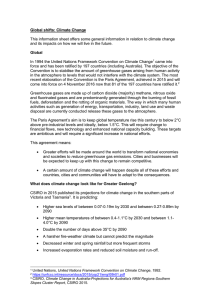
... This information sheet offers some general information in relation to climate change and its impacts on how we will live in the future. Global In 1994 the United Nations Framework Convention on Climate Change1 came into force and has been ratified by 197 countries (including Australia). The objectiv ...
... This information sheet offers some general information in relation to climate change and its impacts on how we will live in the future. Global In 1994 the United Nations Framework Convention on Climate Change1 came into force and has been ratified by 197 countries (including Australia). The objectiv ...

Climate Change - What does it mean? Fact Sheet
... Climate change is the result of changes in our weather patterns because of an increase in the Earth’s average temperature. This is caused by increases in greenhouse gases in the Earth’s atmosphere. These gases soak up heat from the sun but instead of the heat leaving the earth’s atmosphere, some of ...
... Climate change is the result of changes in our weather patterns because of an increase in the Earth’s average temperature. This is caused by increases in greenhouse gases in the Earth’s atmosphere. These gases soak up heat from the sun but instead of the heat leaving the earth’s atmosphere, some of ...

Key Vulnerabilities to Public Health - Jonathan
... • Surface water-related outbreaks had strongest correlation with extreme precipitation in the month of outbreak; groundwater-related outbreaks lagged 2 months following extreme precipitation. Curriero, Patz, et al, 2001. ...
... • Surface water-related outbreaks had strongest correlation with extreme precipitation in the month of outbreak; groundwater-related outbreaks lagged 2 months following extreme precipitation. Curriero, Patz, et al, 2001. ...
An Introduction to Climate Change
... scientists have accumulated a vast body of data from calibrated measurements and well-tested hypotheses using best practices in science. (1) Broadcast meteorologists have a vital, self-identified role as science communicators to the public and can be effective climate educators. ...
... scientists have accumulated a vast body of data from calibrated measurements and well-tested hypotheses using best practices in science. (1) Broadcast meteorologists have a vital, self-identified role as science communicators to the public and can be effective climate educators. ...

Climate change and plant genetic resources for food and agriculture: risks and opportunities
... • Greatest increases for bananas, barley, beans, coffee, groundnuts, maize, millets, potatoes, rice, sorghum and wheat, least for cassava • Asia and Africa experience greatest increases in climatic interdependence ...
... • Greatest increases for bananas, barley, beans, coffee, groundnuts, maize, millets, potatoes, rice, sorghum and wheat, least for cassava • Asia and Africa experience greatest increases in climatic interdependence ...

Read the letter from the government to Clearcast in full
... salinity, wind patterns and aspects of extreme weather including droughts, heavy precipitation, heat waves, and the intensity of tropical cyclones” The conclusions of the AR4 have been further strengthened by more recent scientific findings, as reported at the International Climate Science Congress ...
... salinity, wind patterns and aspects of extreme weather including droughts, heavy precipitation, heat waves, and the intensity of tropical cyclones” The conclusions of the AR4 have been further strengthened by more recent scientific findings, as reported at the International Climate Science Congress ...
The changing climate: adaptation by First Nations in Quebec Forum
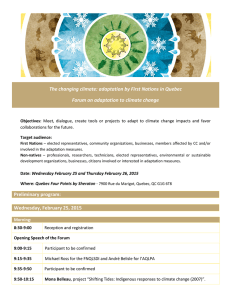
... (FNQLSDI) in collaboration with l’Association québécoise de lutte contre la pollution atmosphérique (AQLPA). ...
... (FNQLSDI) in collaboration with l’Association québécoise de lutte contre la pollution atmosphérique (AQLPA). ...

Channel One News Quiz Week of November 18, 2016 1. Why is
... Why is Antarctica mostly untouched by humans? ...
... Why is Antarctica mostly untouched by humans? ...

IPCC presentation part1
... • Climate change is not just an environmental issue, but a development issue • Global and regional changes have been observed in the chemical composition of the atmosphere, earth's surface temperature, precipitation, extreme climatic events, sea level • These have caused changes in biological, physi ...
... • Climate change is not just an environmental issue, but a development issue • Global and regional changes have been observed in the chemical composition of the atmosphere, earth's surface temperature, precipitation, extreme climatic events, sea level • These have caused changes in biological, physi ...

Document
... • Climate change is not just an environmental issue, but a development issue • Global and regional changes have been observed in the chemical composition of the atmosphere, earth's surface temperature, precipitation, extreme climatic events, sea level • These have caused changes in biological, physi ...
... • Climate change is not just an environmental issue, but a development issue • Global and regional changes have been observed in the chemical composition of the atmosphere, earth's surface temperature, precipitation, extreme climatic events, sea level • These have caused changes in biological, physi ...

Title of Presentation - PSU Glacier Research
... lack of predictability near thresholds, imply that abrupt climate change will always be accompanied by more uncertainty than will gradual climate change. ...
... lack of predictability near thresholds, imply that abrupt climate change will always be accompanied by more uncertainty than will gradual climate change. ...


KUALA LUMPUR DECLARATION 15 GENERAL ASSEMBLY OF
... Cooperate with all countries to develop and implement measures ...
... Cooperate with all countries to develop and implement measures ...

Projecting change
... Climate Change Strategy for Wales • Programme of Action Sets out proposed actions to deliver climate change objectives ...
... Climate Change Strategy for Wales • Programme of Action Sets out proposed actions to deliver climate change objectives ...

Factors responsible for climate change
... (a) the major factors recognized to be responsible for climate changes; (b) whether Government has taken any concrete action to check these factors affecting the climate change and if so, the details thereof; and (c) if not, the reasons therefor? ANSWER MINISTER OF STATE (INDEPENDENT CHARGE) FOR ENV ...
... (a) the major factors recognized to be responsible for climate changes; (b) whether Government has taken any concrete action to check these factors affecting the climate change and if so, the details thereof; and (c) if not, the reasons therefor? ANSWER MINISTER OF STATE (INDEPENDENT CHARGE) FOR ENV ...

World Civic Forum UN-DESA Expert Group Meeting on “Citizen
... Poor communities are also more vulnerable to extreme weather events, like those associated with climate change. Location, lack of services and infrastructure and poor building structures all increase the vulnerability to flooding, storm surges and cyclonic wind and rain. In Bangladesh, 15% of to ...
... Poor communities are also more vulnerable to extreme weather events, like those associated with climate change. Location, lack of services and infrastructure and poor building structures all increase the vulnerability to flooding, storm surges and cyclonic wind and rain. In Bangladesh, 15% of to ...
IEEE on Data Mining Workshops 2009
... Self-Organizing Map U-Matrix Parallel Coordinate Plot Example Conclusion ...
... Self-Organizing Map U-Matrix Parallel Coordinate Plot Example Conclusion ...

national network on climate change (nncc)
... Assist LP in identifying potential climate mitigation / adaptation measures that LEAD Pakistan could implement to reduce impacts of changing climate Help in identifying key knowledge gaps and climate change adaptation options that could be implemented (short\long term) and assess their related polic ...
... Assist LP in identifying potential climate mitigation / adaptation measures that LEAD Pakistan could implement to reduce impacts of changing climate Help in identifying key knowledge gaps and climate change adaptation options that could be implemented (short\long term) and assess their related polic ...

south afriCa`s ChanGinG Climate - Allergy Society of South Africa
... Projecting rainfall trends by means of computer modelling is more difficult. Precipitation patterns in South Africa’s summer rainfall regions may remain unchanged, although some areas may see increased flooding events. However, increased inundations during rain events do not produce ‘useful’ water s ...
... Projecting rainfall trends by means of computer modelling is more difficult. Precipitation patterns in South Africa’s summer rainfall regions may remain unchanged, although some areas may see increased flooding events. However, increased inundations during rain events do not produce ‘useful’ water s ...

29.01.09-The daily Star
... BCAS Executive Director Dr Atiq Rahman and Director of Global Urban Research Centre at the University of Manchester Dr Caroline Moser also spoke at the inaugural session. According to a study on urban poor presented at the conference, 35 percent of total population of Dhaka live in slums occupying o ...
... BCAS Executive Director Dr Atiq Rahman and Director of Global Urban Research Centre at the University of Manchester Dr Caroline Moser also spoke at the inaugural session. According to a study on urban poor presented at the conference, 35 percent of total population of Dhaka live in slums occupying o ...

Simple Blue - Friends Committee on National Legislation
... Friends Committee on National Legislation We seek a world free of war and the threat of war We seek a society with equity and justice for all ...
... Friends Committee on National Legislation We seek a world free of war and the threat of war We seek a society with equity and justice for all ...

Climate and Change 7 ppt for teaching
... introduction to the topic of climate change at Key Stage 3/4. Concepts covered include: naturally occurring greenhouse gases; natural variations in climate; industrialisation and population growth; use of fossil fuels and carbon dioxide emissions. The programme also considers the reasons why climate ...
... introduction to the topic of climate change at Key Stage 3/4. Concepts covered include: naturally occurring greenhouse gases; natural variations in climate; industrialisation and population growth; use of fossil fuels and carbon dioxide emissions. The programme also considers the reasons why climate ...

Effects of global warming on humans

Climate change has brought about possibly permanent alterations to our planet’s geological, biological and ecological systems. The Intergovernmental Panel on Climate Change (IPCC) contended in 2003 that “there is new and stronger evidence that most of the warming observed over the last 50 years is attributable to human activities”. These changes have led to the emergence of large-scale environmental hazards to human health, such as extreme weather, ozone depletion, increased danger of wildland fires, loss of biodiversity, stresses to food-producing systems and the global spread of infectious diseases. The World Health Organization (WHO) estimates that 160,000 deaths, since 1950, are directly attributable to climate change. Many believe this to be a conservative estimate.To date, a neglected aspect of the climate change debate, much less research has been conducted on the impacts of climate change on health, food supply, economic growth, migration, security, societal change, and public goods, such as drinking water, than on the geophysical changes related to global warming. Human impacts can be both negative and positive. Climatic changes in Siberia, for instance, are expected to improve food production and local economic activity, at least in the short to medium term. Numerous studies suggest, however, that the current and future impacts of climate change on human society are and will continue to be overwhelmingly negative.The majority of the adverse effects of climate change are experienced by poor and low-income communities around the world, who have much higher levels of vulnerability to environmental determinants of health, wealth and other factors, and much lower levels of capacity available for coping with environmental change. A report on the global human impact of climate change published by the Global Humanitarian Forum in 2009, estimated more than 300,000 deaths and about $125 billion in economic losses each year, and indicating that most climate change induced mortality is due to worsening floods and droughts in developing countries. This also raises questions of climate justice, since the 50 least developed countries of the world account for not more than 1% of worldwide emissions of greenhouse gases.