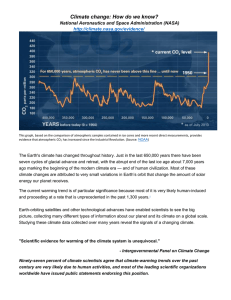
Climate change: How do we know?
... The Earth's climate has changed throughout history. Just in the last 650,000 years there have been seven cycles of glacial advance and retreat, with the abrupt end of the last ice age about 7,000 years ago marking the beginning of the modern climate era — and of human civilization. Most of these cli ...
... The Earth's climate has changed throughout history. Just in the last 650,000 years there have been seven cycles of glacial advance and retreat, with the abrupt end of the last ice age about 7,000 years ago marking the beginning of the modern climate era — and of human civilization. Most of these cli ...
Is Climate Change a Reality? - European Capacity Building Initiative
... Phase I (80ies): does Climate Change occur and how much ...
... Phase I (80ies): does Climate Change occur and how much ...

P58.14 How to achieve global scale climate change
... way to achieve global scale climate change mitigation that could be implemented in 2009. One key feature is that it represents a fundamental shift in policy and tools (P&Ts), of moving out of cost approach P&Ts towards profit seeking ones in the gradual building of what I have named as the Green Cap ...
... way to achieve global scale climate change mitigation that could be implemented in 2009. One key feature is that it represents a fundamental shift in policy and tools (P&Ts), of moving out of cost approach P&Ts towards profit seeking ones in the gradual building of what I have named as the Green Cap ...

Health Implications of Global Warming: Impacts on Vulnerable
... weather events and life is disrupted. Consequences emerge that threaten human health and, ultimately, survival. This is one of several fact sheets produced by Physicians for Social Responsibility that examine recent scientific evidence of global warming’s impact on health. ...
... weather events and life is disrupted. Consequences emerge that threaten human health and, ultimately, survival. This is one of several fact sheets produced by Physicians for Social Responsibility that examine recent scientific evidence of global warming’s impact on health. ...


EP 23: MANAGEMENT PLAN FOR A CONSERVATION AREA
... (1) In Kenya, one of the main impacts of climate change on human health identified by the National Climate Change Response Strategy (NCCRS) is that diseases such as malaria, cholera, ebola, lyme disease, plague, tuberculosis, sleeping sickness, yellow fever, and Rift valley fever are expected to spr ...
... (1) In Kenya, one of the main impacts of climate change on human health identified by the National Climate Change Response Strategy (NCCRS) is that diseases such as malaria, cholera, ebola, lyme disease, plague, tuberculosis, sleeping sickness, yellow fever, and Rift valley fever are expected to spr ...

Summary for Policy Makers
... Established in 1988 by • World Meteorological Organization (WMO) • United Nations Environment Programme ...
... Established in 1988 by • World Meteorological Organization (WMO) • United Nations Environment Programme ...

A resource for climate change
... executive Ian Kirk. “Our organisation is paying claims now to farmers and property owners in the southern Cape for fire damage. Two-and-a-half years ago they were under water. It’s affecting us and we have to rise up to this, ” Kirk said. ...
... executive Ian Kirk. “Our organisation is paying claims now to farmers and property owners in the southern Cape for fire damage. Two-and-a-half years ago they were under water. It’s affecting us and we have to rise up to this, ” Kirk said. ...

South Africa submision under NWP (Health)
... 2.4 Climate change is expected to increase the frequency, duration and intensity of droughts and high temperatures and increase rainfall variability in many areas. This would affect food systems, compromising food availability, access and utilization, leading to food insecurity. South Africa have ex ...
... 2.4 Climate change is expected to increase the frequency, duration and intensity of droughts and high temperatures and increase rainfall variability in many areas. This would affect food systems, compromising food availability, access and utilization, leading to food insecurity. South Africa have ex ...

Chemistry-Climate Model Simulations of secular Trends in
... • Temperature Dependence of: O + O2 + M => O3 + M • Changes the O/Ox partitioning; K ~ [300/T]2.3 ...
... • Temperature Dependence of: O + O2 + M => O3 + M • Changes the O/Ox partitioning; K ~ [300/T]2.3 ...

Climate Change and Adapted Land Use
... Africa in an integrated, cross-disciplinary and multisectoral manner. State-of-the-art modelling tools will be used for innovative analysis of environmental and socio-economic datasets to produce quantitative results for predicting and assessing the impacts of climate change with the view towards pr ...
... Africa in an integrated, cross-disciplinary and multisectoral manner. State-of-the-art modelling tools will be used for innovative analysis of environmental and socio-economic datasets to produce quantitative results for predicting and assessing the impacts of climate change with the view towards pr ...

CLIMATE CHANGE ADABTATION IN SONGKHLA LAKE BASIN
... Thale Noi biodiversity has been identified as seriously vulnerable to climate change ...
... Thale Noi biodiversity has been identified as seriously vulnerable to climate change ...

One Book One Northwestern Discussion Guides
... strong forecasting, Silver argues that “…a forecast [does not] do much good if there is no one willing to listen to it.” When do you trust weather forecasts, and when do you not? Why? How can government and private agencies improve the likelihood of people listening to their forecasts? Silver ar ...
... strong forecasting, Silver argues that “…a forecast [does not] do much good if there is no one willing to listen to it.” When do you trust weather forecasts, and when do you not? Why? How can government and private agencies improve the likelihood of people listening to their forecasts? Silver ar ...

One Book One Northwestern Book Group Discussion
... strong forecasting, Silver argues that “…a forecast [does not] do much good if there is no one willing to listen to it.” When do you trust weather forecasts, and when do you not? Why? ¡ How can government and private agencies improve the likelihood of people listening to their forecasts? ¡ Silve ...
... strong forecasting, Silver argues that “…a forecast [does not] do much good if there is no one willing to listen to it.” When do you trust weather forecasts, and when do you not? Why? ¡ How can government and private agencies improve the likelihood of people listening to their forecasts? ¡ Silve ...

Climate Change Science: The IPCC Report and More Recent Updates
... floods, storms, fires and droughts; increases in malnutrition; etc.) Cities that currently experience heat waves are expected to face an increased number, intensity and duration of heat waves. Global water stress (decrease in freshwater availability) is expected, with an increasing competition for o ...
... floods, storms, fires and droughts; increases in malnutrition; etc.) Cities that currently experience heat waves are expected to face an increased number, intensity and duration of heat waves. Global water stress (decrease in freshwater availability) is expected, with an increasing competition for o ...

Lesson 3: Effects of Climate Change on Living Things (Powerpoint)
... Glacial Recession and Landscape Changes (Animation) ...
... Glacial Recession and Landscape Changes (Animation) ...
Introduction - Coastal Climate Wiki
... Responding to Change Our nation's experience in managing and protecting its inhabitants, resources, and infrastructure has been based on our relatively stable historic climate. But adaptation to climate change requires an appreciation of possible conditions that lie outside the realm of experie ...
... Responding to Change Our nation's experience in managing and protecting its inhabitants, resources, and infrastructure has been based on our relatively stable historic climate. But adaptation to climate change requires an appreciation of possible conditions that lie outside the realm of experie ...
Climate Sensitivity - Earth and Environmental Sciences
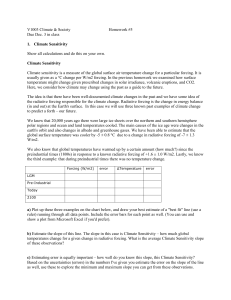
... Show all calculations and do this on your own. Climate Sensitivity Climate sensitivity is a measure of the global surface air temperature change for a particular forcing. It is usually given as a °C change per W/m2 forcing. In the previous homework we examined how surface temperature might change gi ...
... Show all calculations and do this on your own. Climate Sensitivity Climate sensitivity is a measure of the global surface air temperature change for a particular forcing. It is usually given as a °C change per W/m2 forcing. In the previous homework we examined how surface temperature might change gi ...
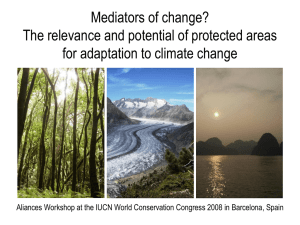
Mediators of Change? The relevance and potential of
... Mediators of change? The relevance and potential of protected areas for adaptation to climate change ...
... Mediators of change? The relevance and potential of protected areas for adaptation to climate change ...

Rethinking Climate Change Governance IISD Side Event Facilitator
... Role of Nation-States • Obstacle to progress – negotiation overpowers forums for implementing activities • Departments responsible for negotiation at international level may not play large role in implementation • Burden on developing countries to meet institutional requirements of many bodies • Di ...
... Role of Nation-States • Obstacle to progress – negotiation overpowers forums for implementing activities • Departments responsible for negotiation at international level may not play large role in implementation • Burden on developing countries to meet institutional requirements of many bodies • Di ...

Impacts of Climate Change - 2 - PowerPoint Presentation
... The Washington Post, What the Earth will be like in 10,000 years, according to scientists. https://www.washingtonpost.com/news/energyenvironment/wp/2016/02/08/what-the-earth-will-be-like-in10000-years-according-to-scientists/ ...
... The Washington Post, What the Earth will be like in 10,000 years, according to scientists. https://www.washingtonpost.com/news/energyenvironment/wp/2016/02/08/what-the-earth-will-be-like-in10000-years-according-to-scientists/ ...

ONR-EA PowerPoint Template Rev 1
... within the site – Confidence that the site can be developed safely – Reassurance about risks off-site – An understanding of ‘service resilience’ – Confidence that climate change has been adequately considered ...
... within the site – Confidence that the site can be developed safely – Reassurance about risks off-site – An understanding of ‘service resilience’ – Confidence that climate change has been adequately considered ...

1 decade down, 9 decades to go
... lessons for coping with climate change 1. Quick recovery is sometimes impossible. Be prepared for it. 2. Bad situations can continue for a long time. 3. Prepare many people to cope with disasters because victims are the real first responders. 4. Uncertainty–based risk management is necessary. 5. We ...
... lessons for coping with climate change 1. Quick recovery is sometimes impossible. Be prepared for it. 2. Bad situations can continue for a long time. 3. Prepare many people to cope with disasters because victims are the real first responders. 4. Uncertainty–based risk management is necessary. 5. We ...
Slide 1
... atmosphere will affect our climate for many centuries. If we continue to produce greenhouse gases at or above current rates, it is more than 90 percent certain that climate change will accelerate in the 21st century. ...
... atmosphere will affect our climate for many centuries. If we continue to produce greenhouse gases at or above current rates, it is more than 90 percent certain that climate change will accelerate in the 21st century. ...
Effects of global warming on humans

Climate change has brought about possibly permanent alterations to our planet’s geological, biological and ecological systems. The Intergovernmental Panel on Climate Change (IPCC) contended in 2003 that “there is new and stronger evidence that most of the warming observed over the last 50 years is attributable to human activities”. These changes have led to the emergence of large-scale environmental hazards to human health, such as extreme weather, ozone depletion, increased danger of wildland fires, loss of biodiversity, stresses to food-producing systems and the global spread of infectious diseases. The World Health Organization (WHO) estimates that 160,000 deaths, since 1950, are directly attributable to climate change. Many believe this to be a conservative estimate.To date, a neglected aspect of the climate change debate, much less research has been conducted on the impacts of climate change on health, food supply, economic growth, migration, security, societal change, and public goods, such as drinking water, than on the geophysical changes related to global warming. Human impacts can be both negative and positive. Climatic changes in Siberia, for instance, are expected to improve food production and local economic activity, at least in the short to medium term. Numerous studies suggest, however, that the current and future impacts of climate change on human society are and will continue to be overwhelmingly negative.The majority of the adverse effects of climate change are experienced by poor and low-income communities around the world, who have much higher levels of vulnerability to environmental determinants of health, wealth and other factors, and much lower levels of capacity available for coping with environmental change. A report on the global human impact of climate change published by the Global Humanitarian Forum in 2009, estimated more than 300,000 deaths and about $125 billion in economic losses each year, and indicating that most climate change induced mortality is due to worsening floods and droughts in developing countries. This also raises questions of climate justice, since the 50 least developed countries of the world account for not more than 1% of worldwide emissions of greenhouse gases.