
How We Know It Hurts: Item Analysis of Written - Saxelab
... The response in these regions is influenced by the affective aspects of painful experiences, and not just the sensory aspects (for more details see [12]). For example, activity in insula and AMCC is modulated by participants’ anxiety and fear associated with anticipating pain, even prior to any actu ...
... The response in these regions is influenced by the affective aspects of painful experiences, and not just the sensory aspects (for more details see [12]). For example, activity in insula and AMCC is modulated by participants’ anxiety and fear associated with anticipating pain, even prior to any actu ...
mechanism of action of atypical antipsychotic drugs
... and ventral tegmentum, respectively, followed by a gradual decrease in the activity of DA neurons, and, ultimately, complete inactivation of DA neuron firing in both regions (6). This so-called depolarization block was suggested to be the reason for the slow onset of antipsychotic action, which is o ...
... and ventral tegmentum, respectively, followed by a gradual decrease in the activity of DA neurons, and, ultimately, complete inactivation of DA neuron firing in both regions (6). This so-called depolarization block was suggested to be the reason for the slow onset of antipsychotic action, which is o ...
Atypical Development of Resting Respiratory Sinus Arrhythmia in Children at
... At intake, control participants had to be free of any lifetime major psychiatric disorder. Controls also were recruited in various ways: from other studies during childhood or adolescence wherein they served as ‘‘normal controls,’’ by using the Cole directory to target neighborhoods matching proband ...
... At intake, control participants had to be free of any lifetime major psychiatric disorder. Controls also were recruited in various ways: from other studies during childhood or adolescence wherein they served as ‘‘normal controls,’’ by using the Cole directory to target neighborhoods matching proband ...
The Role of Ventromedial Prefrontal Cortex in Decision Making
... 2005; Volz et al. 2006), reinforcement learning, or choice tasks (reviewed in O’Doherty 2004; Montague et al. 2006). However, both single-unit and fMRI studies have found that many other areas of the brain, including midbrain nuclei, striatum, parietal cortex, and dorsolateral prefrontal cortex also ...
... 2005; Volz et al. 2006), reinforcement learning, or choice tasks (reviewed in O’Doherty 2004; Montague et al. 2006). However, both single-unit and fMRI studies have found that many other areas of the brain, including midbrain nuclei, striatum, parietal cortex, and dorsolateral prefrontal cortex also ...
The Neural Basis of Human Error Processing: Reinforcement
... cingulate cortex. On the other hand, other researchers have argued that the mesencephalic dopamine system conveys reinforcement learning signals to the basal ganglia and frontal cortex, where they are used to facilitate the development of adaptive motor programs. Although the reinforcement learning ...
... cingulate cortex. On the other hand, other researchers have argued that the mesencephalic dopamine system conveys reinforcement learning signals to the basal ganglia and frontal cortex, where they are used to facilitate the development of adaptive motor programs. Although the reinforcement learning ...
Basal Ganglia Functional Connectivity Based on
... a specific set of motor or cognitive tasks, depending on the cortical area that belongs to it. Modifications of this model and further subdivisions of specific loops have been proposed (Fig. 1B) (Lawrence and others 1998; Nakano and others 2000). Other investigators have divided the striatum into 3 fun ...
... a specific set of motor or cognitive tasks, depending on the cortical area that belongs to it. Modifications of this model and further subdivisions of specific loops have been proposed (Fig. 1B) (Lawrence and others 1998; Nakano and others 2000). Other investigators have divided the striatum into 3 fun ...
ASSESSMENT OF ANXIETY, DEPRESSIVE DISORDERS AND
... showed that 7/10 patients affected by headache or migraine attacks also suffered from anxiety or depressive disorders, and 1 out of 2 patients suffered from both disorders. Anxiety and depression are often described as a consequence of headache(23), but our findings suggestthat co morbidity with men ...
... showed that 7/10 patients affected by headache or migraine attacks also suffered from anxiety or depressive disorders, and 1 out of 2 patients suffered from both disorders. Anxiety and depression are often described as a consequence of headache(23), but our findings suggestthat co morbidity with men ...

.... _ ACKNOWLEDGMENT !_ This monograph is based on the
... function of the nervous system is not sufficient to entrust a single endpoint with predicting the neurotoxic potential of a substance. The purpose of structural assessments is to provide a convincing picture of the location and extent of damage to the nervous system. Silver stains that selectively r ...
... function of the nervous system is not sufficient to entrust a single endpoint with predicting the neurotoxic potential of a substance. The purpose of structural assessments is to provide a convincing picture of the location and extent of damage to the nervous system. Silver stains that selectively r ...
A Stress-Induced Shift From Trace to Delay Conditioning Depends
... intermixed a CS1 that coterminated with the US (CS1delay) (Figure 2), another CS1 that was followed by the US after an interval of 3 seconds (CS1trace), and a third stimulus that was never reinforced (conditioned stimulus not paired with the US, CS-) (27). Three gray-scaled pictures of neutral male ...
... intermixed a CS1 that coterminated with the US (CS1delay) (Figure 2), another CS1 that was followed by the US after an interval of 3 seconds (CS1trace), and a third stimulus that was never reinforced (conditioned stimulus not paired with the US, CS-) (27). Three gray-scaled pictures of neutral male ...

(Nurr1, Nur77 and Nor-1) by Typical and Atypical Antipsychotics in
... (Wadenberg et al., 2001). Receptor interaction analysis revealed that atypical antipsychotics tend to have a lower affinity for D2 receptors and higher affinity for serotonin 5-HT2A receptors, compared to typical drugs. In fact, a high 5-HT2A/D2 affinity ratio can be used to predict an atypical prof ...
... (Wadenberg et al., 2001). Receptor interaction analysis revealed that atypical antipsychotics tend to have a lower affinity for D2 receptors and higher affinity for serotonin 5-HT2A receptors, compared to typical drugs. In fact, a high 5-HT2A/D2 affinity ratio can be used to predict an atypical prof ...
Consensus paper on bipolar depression
... incidence and risk of recurrence. We do not know how frequently clinically significant mood elevation is a late development occurring in mid- and late life (Leboyer et al., 2005). In addition, the natural course and the factors, including treatment, that may influence the risk of depressive and (hyp ...
... incidence and risk of recurrence. We do not know how frequently clinically significant mood elevation is a late development occurring in mid- and late life (Leboyer et al., 2005). In addition, the natural course and the factors, including treatment, that may influence the risk of depressive and (hyp ...
Carlsson J Neurosci 2007 (pdf 2,2 MB)
... monitored in rotometer bowls, and the animals’ right and left 90° body turns were recorded using a computerized hardware and a specialized software (AccuScan Instrument, Columbus, OH). In all cases, the testing sessions were performed over 90 min, and the data are expressed as total net full-body tu ...
... monitored in rotometer bowls, and the animals’ right and left 90° body turns were recorded using a computerized hardware and a specialized software (AccuScan Instrument, Columbus, OH). In all cases, the testing sessions were performed over 90 min, and the data are expressed as total net full-body tu ...
Slide 1
... (depicted in tracings on the right). Postulated inhibitory connections are shown as red circles; postulated excitatory connections as green circles; and cholinergic pontine nuclei are shown as blue circles. It should be noted that the actual synaptic signs of many of the aminergic and reticular path ...
... (depicted in tracings on the right). Postulated inhibitory connections are shown as red circles; postulated excitatory connections as green circles; and cholinergic pontine nuclei are shown as blue circles. It should be noted that the actual synaptic signs of many of the aminergic and reticular path ...
decision-making in the primate brain
... term goes to 0 and remains unchanged when the combined stimulus AX is followed by a reward in stage 2; hence, no new learning occurs for the redundant cue. Over the past decade, Wolfram Schultz and colleagues have demonstrated that the activation of dopamine neurons in the midbrain represents, at le ...
... term goes to 0 and remains unchanged when the combined stimulus AX is followed by a reward in stage 2; hence, no new learning occurs for the redundant cue. Over the past decade, Wolfram Schultz and colleagues have demonstrated that the activation of dopamine neurons in the midbrain represents, at le ...

Cerebral cortex and the clinical expression of
... a progressive movement disorder dominated by neostriatal pathology represent.The availability of novel neuroimaging methods has enabled us to evaluate cerebral cortical changes in HD, which we have found to occur early and to be topographically selective. What is less clear, however, is how these ch ...
... a progressive movement disorder dominated by neostriatal pathology represent.The availability of novel neuroimaging methods has enabled us to evaluate cerebral cortical changes in HD, which we have found to occur early and to be topographically selective. What is less clear, however, is how these ch ...
Dysphoric mania, mixed states, and mania with mixed features
... restlessness, depression, and anxiety; a feeling of unpleasantness or discomfort”14; “an emotional state marked by anxiety, depression, and restlessness”15; or “a disorder of affect characterized by depression and anguish.”16 Indeed, Swann11 said dysphoria “can refer to many ways of feeling bad” (p ...
... restlessness, depression, and anxiety; a feeling of unpleasantness or discomfort”14; “an emotional state marked by anxiety, depression, and restlessness”15; or “a disorder of affect characterized by depression and anguish.”16 Indeed, Swann11 said dysphoria “can refer to many ways of feeling bad” (p ...

(Nurr1, Nur77, and Nor-1) by Typical and Atypical Antipsychotics i
... interaction analysis revealed that atypical antipsychotics tend to have a lower affinity for D2 receptors and higher affinity for 5-HT2A (serotonin) receptors, compared with typical drugs. In fact, a high 5-HT2A/D2 affinity ratio can be used to predict an atypical profile for most antipsychotic drug ...
... interaction analysis revealed that atypical antipsychotics tend to have a lower affinity for D2 receptors and higher affinity for 5-HT2A (serotonin) receptors, compared with typical drugs. In fact, a high 5-HT2A/D2 affinity ratio can be used to predict an atypical profile for most antipsychotic drug ...

Very short-term plasticity in hippocampal synapses
... tightly defined when measured as an increase in the bursting rate. This result suggests that bursts may be the relevant activity in hippocampal spatial function. Given that bursts with interspike intervals of 2–10 msec may be particularly relevant to the functional behavior of hippocampal neurons, i ...
... tightly defined when measured as an increase in the bursting rate. This result suggests that bursts may be the relevant activity in hippocampal spatial function. Given that bursts with interspike intervals of 2–10 msec may be particularly relevant to the functional behavior of hippocampal neurons, i ...

LO 9.5 - Images
... cortex to explain the activation by the brain stem of cortical cells during REM sleep periods. ...
... cortex to explain the activation by the brain stem of cortical cells during REM sleep periods. ...

Postoperative Left Prefrontal Repetitive Transcranial Magnetic
... trodes controls neuropathic pain.1– 4 The antinociceptive mechanisms of MCS are unclear; however, the magnitude of pain relief is correlated with activation of portions of the anterior cingulate and orbitofrontal cortex.5,6 Thus, MCS may exert some of its analgesic effect by altering the affective d ...
... trodes controls neuropathic pain.1– 4 The antinociceptive mechanisms of MCS are unclear; however, the magnitude of pain relief is correlated with activation of portions of the anterior cingulate and orbitofrontal cortex.5,6 Thus, MCS may exert some of its analgesic effect by altering the affective d ...

M100,907, a selective 5-HT antagonist, attenuates dopamine
... However, the specific role of 5-HT 2A receptors localized within the medial prefrontal cortex (mPFC) is not known. The present study employed in vivo microdialysis to examine the role of this receptor in the modulation of basal and K 1 -stimulated (Ca 21 -dependent) DA release. The selective 5-HT 2A ...
... However, the specific role of 5-HT 2A receptors localized within the medial prefrontal cortex (mPFC) is not known. The present study employed in vivo microdialysis to examine the role of this receptor in the modulation of basal and K 1 -stimulated (Ca 21 -dependent) DA release. The selective 5-HT 2A ...
Control of Wake and Sleep States
... Sleep effects are mediated through IL-1 type receptor and TNF-55kDa receptor. TNF-alpha inhibits expression of clock genes. Extracellular ATP release associated with neurotransmitter release during waking prompts astrocytic production of IL-1 and TNF-alpha. Adminstration of IL-1 into DRN or LC induc ...
... Sleep effects are mediated through IL-1 type receptor and TNF-55kDa receptor. TNF-alpha inhibits expression of clock genes. Extracellular ATP release associated with neurotransmitter release during waking prompts astrocytic production of IL-1 and TNF-alpha. Adminstration of IL-1 into DRN or LC induc ...

cerebral cortex - Global Anatomy Home Page
... 1) BLOOD SUPPLY. You will see a very large number of patients with deficits resulting from problems with the blood supply of the cerebral hemispheres (cortex, internal capsule, and basal ganglia) even if you don’t become a neurologist or neurosurgeon. You should overlearn this material to the point ...
... 1) BLOOD SUPPLY. You will see a very large number of patients with deficits resulting from problems with the blood supply of the cerebral hemispheres (cortex, internal capsule, and basal ganglia) even if you don’t become a neurologist or neurosurgeon. You should overlearn this material to the point ...

120408.DClauw.Fibromyalgia - Open.Michigan
... { Content the copyright holder, author, or law permits you to use, share and adapt. } Public Domain – Government: Works that are produced by the U.S. Government. (17 USC § 105) Public Domain – Expired: Works that are no longer protected due to an expired copyright term. Public Domain – Self Dedicate ...
... { Content the copyright holder, author, or law permits you to use, share and adapt. } Public Domain – Government: Works that are produced by the U.S. Government. (17 USC § 105) Public Domain – Expired: Works that are no longer protected due to an expired copyright term. Public Domain – Self Dedicate ...
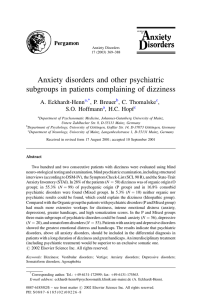
Anxiety disorders and other psychiatric subgroups in patients
... with the classification criteria of the International Classification of Disorders (ICD-10) (Dilling, Mombour, Schmidt, & Schulte-Markwort, 1994) as well as those of the DSM-IV. Diagnostic encoding was performed according to both classification systems, but only the DSM-IV categories are used here.3 ...
... with the classification criteria of the International Classification of Disorders (ICD-10) (Dilling, Mombour, Schmidt, & Schulte-Markwort, 1994) as well as those of the DSM-IV. Diagnostic encoding was performed according to both classification systems, but only the DSM-IV categories are used here.3 ...
Biology of depression

Scientific studies have found that numerous brain areas show altered activity in patients suffering from depression, and this has encouraged advocates of various theories that seek to identify a biochemical origin of the disease, as opposed to theories that emphasize psychological or situational causes. Several theories concerning the biologically based cause of depression have been suggested over the years, of which the most prominent and widely researched is the monoamine hypothesis.