
Am I Depressed? - Counseling
... There are many types of depression and depression can be triggered by different things, some of which are: poor diet, a Vitamin D deficiency, insomnia, hypothyroidism, low self-esteem, a chemical imbalance, hormonal changes, loneliness, environmental conditions (being incarcerated or living in a sta ...
... There are many types of depression and depression can be triggered by different things, some of which are: poor diet, a Vitamin D deficiency, insomnia, hypothyroidism, low self-esteem, a chemical imbalance, hormonal changes, loneliness, environmental conditions (being incarcerated or living in a sta ...

1 PSYCH 335 Psychological Disorders Agenda/Overview Mood
... Same 5 general symptoms: emotional; motivational; behavioral; cognitive; & physical – ...
... Same 5 general symptoms: emotional; motivational; behavioral; cognitive; & physical – ...

Depression and Sight Loss
... compromised immune systems – Depressed women have decreased bone mineral density and are at greater risk of hip fractures – Often have additional risk factors for ill-health, eg, they smoke more and use more alcohol ...
... compromised immune systems – Depressed women have decreased bone mineral density and are at greater risk of hip fractures – Often have additional risk factors for ill-health, eg, they smoke more and use more alcohol ...

ASSESSMENT AND DIAGNOSIS OF DEPRESSION
... conditions. Part of the assessment of depression is the exclusion of such conditions. The major differential diagnoses for depressive symptoms are: Drug and alcohol problems. These may produce significant depressive symptoms. Alcohol in particular is a powerful depressant and may produce not only ...
... conditions. Part of the assessment of depression is the exclusion of such conditions. The major differential diagnoses for depressive symptoms are: Drug and alcohol problems. These may produce significant depressive symptoms. Alcohol in particular is a powerful depressant and may produce not only ...

Chapter 16: DEVELOPMENTAL PSYCHOPATHOLOGY
... Alcohol and drugs are problems Eating disorders – Anorexia nervosa; more girls (10/1) – Bulemia nervosa; binge-eating – Binge eating disorder – Some genetic predisposition; stress also – Psychological treatment usually successful ...
... Alcohol and drugs are problems Eating disorders – Anorexia nervosa; more girls (10/1) – Bulemia nervosa; binge-eating – Binge eating disorder – Some genetic predisposition; stress also – Psychological treatment usually successful ...
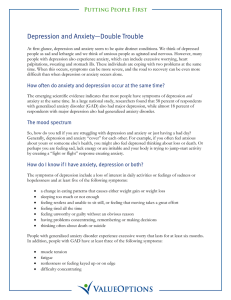
Depression and Anxiety—Double Trouble
... also cause undesirable side effects such as sedation and dependence. Recently, antidepressants are now replacing benzodiazepines as the first line of treatment for many anxiety disorders. Selective serotonin reuptake inhibitors (SSRIs) such as Prozac® and Paxil®, as well as selective serotonin norep ...
... also cause undesirable side effects such as sedation and dependence. Recently, antidepressants are now replacing benzodiazepines as the first line of treatment for many anxiety disorders. Selective serotonin reuptake inhibitors (SSRIs) such as Prozac® and Paxil®, as well as selective serotonin norep ...

AFFECTIVE DISORDERS
... Treatment of Bipolar Disorder:• A. Pharmacological:: Lithium = effective in 80%,-- takes 7-10 days,-- full trail at least for 4 wks.,-- blood level 0.6 – 1.2 mEq/L,-starting dose 300mg tid,- usual dose range 900-2000mg ...
... Treatment of Bipolar Disorder:• A. Pharmacological:: Lithium = effective in 80%,-- takes 7-10 days,-- full trail at least for 4 wks.,-- blood level 0.6 – 1.2 mEq/L,-starting dose 300mg tid,- usual dose range 900-2000mg ...

Mood Disorders
... than from homicide. • Women outnumber men 3 to 1 in suicide attempts • Men outnumber women 4 to 1 in suicide deaths • Suicide rate has increased by over 300% over the last four decades • Highest suicide rate occurs in those over age 75. ...
... than from homicide. • Women outnumber men 3 to 1 in suicide attempts • Men outnumber women 4 to 1 in suicide deaths • Suicide rate has increased by over 300% over the last four decades • Highest suicide rate occurs in those over age 75. ...

The Review
... 5. What are the lobes of the brain? What is each lobe responsible for? 6. What is the somatosensory cortex and primary motor cortex? 7. Who is Phineas Gage, what happen to him, what were the effects? 8. What parts make up the hindbrain? What is the function of each part? 9. What makes up the midbrai ...
... 5. What are the lobes of the brain? What is each lobe responsible for? 6. What is the somatosensory cortex and primary motor cortex? 7. Who is Phineas Gage, what happen to him, what were the effects? 8. What parts make up the hindbrain? What is the function of each part? 9. What makes up the midbrai ...

8-AFFECTIVE DISORDERS
... 9. Grief: - sadness secondary to major loss.—not Dep., remits with time, no suicide or helplessness. 10. Depression in children: - not uncommon, same s/s. Masked dep. = running away from home, school Phobia, substance abuse & suicide. 11. Double Dep.: - Major dep. On top of dysthymia. 12. Atypical D ...
... 9. Grief: - sadness secondary to major loss.—not Dep., remits with time, no suicide or helplessness. 10. Depression in children: - not uncommon, same s/s. Masked dep. = running away from home, school Phobia, substance abuse & suicide. 11. Double Dep.: - Major dep. On top of dysthymia. 12. Atypical D ...

Chapter 14, Mood Disorders
... • Severely depressed individuals are especially likely to show reduced brain activity in the left frontal lobe ...
... • Severely depressed individuals are especially likely to show reduced brain activity in the left frontal lobe ...

a severe mood disorder characterized by major depressive
... goes from high to low distress. b) Chronic Grief: grief pattern in which the mourner remains distressed for an unusually long time and may impact the mourner’s long term psychological and physical health. ...
... goes from high to low distress. b) Chronic Grief: grief pattern in which the mourner remains distressed for an unusually long time and may impact the mourner’s long term psychological and physical health. ...
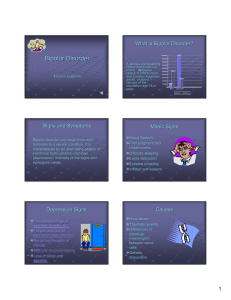
Bipolar Disorder.pdf
... Bipolar disorder can range from mild transition to a severe condition. It is characterized by an alternating pattern of emotional highs (mania) and lows (depression). Intensity of the signs and symptoms varies. ...
... Bipolar disorder can range from mild transition to a severe condition. It is characterized by an alternating pattern of emotional highs (mania) and lows (depression). Intensity of the signs and symptoms varies. ...

THE EFFECT OF COMORBIDITY IN ADULT MAJOR DEPRESSION
... There were two main reasons for my choice of alcohol dependence and panic disorder as the comorbid conditions I would investigate. Firstly, they are both common disorders, often with major effects on people’s lives. In the study referred to above, the two most common diagnoses comorbid with major de ...
... There were two main reasons for my choice of alcohol dependence and panic disorder as the comorbid conditions I would investigate. Firstly, they are both common disorders, often with major effects on people’s lives. In the study referred to above, the two most common diagnoses comorbid with major de ...

Major Depressive Disorder and the “Bereavement Exclusion”
... Major Depressive Disorder and the “Bereavement Exclusion” Major Depressive Disorder (MDD) is a medical illness that affects how you feel, think and behave causing persistent feelings of sadness and loss of interest in previously enjoyed activities. Depression can lead to a variety of emotional and p ...
... Major Depressive Disorder and the “Bereavement Exclusion” Major Depressive Disorder (MDD) is a medical illness that affects how you feel, think and behave causing persistent feelings of sadness and loss of interest in previously enjoyed activities. Depression can lead to a variety of emotional and p ...

citalopram-induced major depression in a patient with panic disorder
... the induction of major depression? Humble and Wistedt (1992) emphasize that the therapeutic effect of SSRIs in panic disorder shows a latency of 2 to 6 weeks and in the initial phase of treatment, even paradoxical anxiogenic effects of SSRIs have been observed (Humble & Wistedt 1992, Zuardi 1990). U ...
... the induction of major depression? Humble and Wistedt (1992) emphasize that the therapeutic effect of SSRIs in panic disorder shows a latency of 2 to 6 weeks and in the initial phase of treatment, even paradoxical anxiogenic effects of SSRIs have been observed (Humble & Wistedt 1992, Zuardi 1990). U ...

Depression and Diabetes - University of Colorado Denver
... Diminishes the longer a person takes AD Must monitor closely during acute phase and after titrations ...
... Diminishes the longer a person takes AD Must monitor closely during acute phase and after titrations ...

Diagnosing and Treating Mood Disorders: The Science and Ethics
... chemical one – Theses chemical signals are called neurotransmitters • Neurotransmitters can fit into many receptors, but receptor sites can only receive specific transmitters • Upon release the transmitter is broken down by mono amine oxidase (MAO) or its taken back in by the neuron that released it ...
... chemical one – Theses chemical signals are called neurotransmitters • Neurotransmitters can fit into many receptors, but receptor sites can only receive specific transmitters • Upon release the transmitter is broken down by mono amine oxidase (MAO) or its taken back in by the neuron that released it ...
mental illness
... • Disorder in which real or imagined fears prevent a person from enjoying life – Phobia: when a person goes to extreme measures to avoid a fear – General anxiety disorder: feels anxious, fearful, and upset most of the time, but for no specific ...
... • Disorder in which real or imagined fears prevent a person from enjoying life – Phobia: when a person goes to extreme measures to avoid a fear – General anxiety disorder: feels anxious, fearful, and upset most of the time, but for no specific ...

Due to our conception of depression in AD?
... Late life depression and cytokines Cytokines as chemical messengers between immune cells and endothelial cells, playing a key role in mediating immune and inflammatory responses which can lead to neurochemical (serotonin), neuroendocrine (HPA axis) and behavioural effects (depression) ...
... Late life depression and cytokines Cytokines as chemical messengers between immune cells and endothelial cells, playing a key role in mediating immune and inflammatory responses which can lead to neurochemical (serotonin), neuroendocrine (HPA axis) and behavioural effects (depression) ...

2._Mood_Disorders
... differences in duration. People with RBD have depressive episodes about once per month, with individual episodes lasting less than two weeks and typically less than 2–3 days. Diagnosis of RBD requires that the episodes occur over the span of at least one year and, in female patients, independently o ...
... differences in duration. People with RBD have depressive episodes about once per month, with individual episodes lasting less than two weeks and typically less than 2–3 days. Diagnosis of RBD requires that the episodes occur over the span of at least one year and, in female patients, independently o ...
Drugs and Behavior - UEN Instructure Canvas
... activity of GABA (which dampens neural activity) Often wrongly prescribed to treat depression or panic disorders. Tranquilizers include Valium, Xanax ...
... activity of GABA (which dampens neural activity) Often wrongly prescribed to treat depression or panic disorders. Tranquilizers include Valium, Xanax ...

Mood Disorder: Management in the Modern Age
... • 2 weeks of depressed mood or loss of interest and pleasure almost every day and all day plus 3 or 4: change in sleep pattern and unrefreshed change in appetite/weight loss of energy slowed down or agitated poor concentration/ ability to decide decreased confidence, self-worth excessive guilt thoug ...
... • 2 weeks of depressed mood or loss of interest and pleasure almost every day and all day plus 3 or 4: change in sleep pattern and unrefreshed change in appetite/weight loss of energy slowed down or agitated poor concentration/ ability to decide decreased confidence, self-worth excessive guilt thoug ...

Definitions
... the development of the later released tricyclics. • It is not as commonly used today but sometimes used to treat major depression as a second-line treatment. ...
... the development of the later released tricyclics. • It is not as commonly used today but sometimes used to treat major depression as a second-line treatment. ...
Biology of depression

Scientific studies have found that numerous brain areas show altered activity in patients suffering from depression, and this has encouraged advocates of various theories that seek to identify a biochemical origin of the disease, as opposed to theories that emphasize psychological or situational causes. Several theories concerning the biologically based cause of depression have been suggested over the years, of which the most prominent and widely researched is the monoamine hypothesis.