Climate Change over Recent Millennia
... • Cools the troposphere by up to 0.5-1.0°C for only 24 years. • Warms the Stratosphere by 2-3°C (!) • Short-term but significant impact ...
... • Cools the troposphere by up to 0.5-1.0°C for only 24 years. • Warms the Stratosphere by 2-3°C (!) • Short-term but significant impact ...

Lecture
... The increase in atmospheric carbon dioxide over the past century is a consequence of human activity There has been an increase in average global temperature during the past century. Carbon dioxide and other gases generated by human activity are responsible for this temperature increase The average g ...
... The increase in atmospheric carbon dioxide over the past century is a consequence of human activity There has been an increase in average global temperature during the past century. Carbon dioxide and other gases generated by human activity are responsible for this temperature increase The average g ...

Lecture #23 - chem.uwec.edu
... as well as in the upper troposphere. The increase is events… broadly consistent with the extra water vapour that warmer air can hold ...
... as well as in the upper troposphere. The increase is events… broadly consistent with the extra water vapour that warmer air can hold ...

Diapositive 1
... – On going discussion : capacity building for NGO’s and delegates in less developped countries to the COP Poznan & Copenhagen ...
... – On going discussion : capacity building for NGO’s and delegates in less developped countries to the COP Poznan & Copenhagen ...

Chapter 20 Climate Change and Ozone Depletion Core Case Study
... 1. How many degrees did the Earth cool after the eruption of Mount Pinatubo in the Philippines? ...
... 1. How many degrees did the Earth cool after the eruption of Mount Pinatubo in the Philippines? ...
Slide 1
... Uncertainty and conservatism in the projections of the IPCC projections Precautionary principle might require a reduction target on 80 % by 2050 ...
... Uncertainty and conservatism in the projections of the IPCC projections Precautionary principle might require a reduction target on 80 % by 2050 ...

climate change paper - Ladeja Warrens biology website
... Climate Change is a long term change in global or regional climate patterns. The debate on whether humans are the main reason for climate change is a hard thing to argue. The facts give us reason to believe that humans may or may not be one of the main causes for the change in climate. There are als ...
... Climate Change is a long term change in global or regional climate patterns. The debate on whether humans are the main reason for climate change is a hard thing to argue. The facts give us reason to believe that humans may or may not be one of the main causes for the change in climate. There are als ...

TO: _____ Corporate Headquarters _____ USA ______, is the
... Intergovernmental Panel on Climate Change (IPCC) produced a series of major findings about the serious dangers of Climate Change. http://www.climatechange2013.org/images/uploads/WG1AR5_Headlines.pdf These impacts include: "...unequivocal warming since the 1950s" "atmospheric concentrations of ca ...
... Intergovernmental Panel on Climate Change (IPCC) produced a series of major findings about the serious dangers of Climate Change. http://www.climatechange2013.org/images/uploads/WG1AR5_Headlines.pdf These impacts include: "...unequivocal warming since the 1950s" "atmospheric concentrations of ca ...

Role play
... bodies like the United Nations Intergovernmental Panel on Climate Change (IPCC) and the U.S. National Academy of Sciences (NAS). What do scientists agree on? Scientists do agree that: 1) global average temperature is about 0.6°Celsius—or just over 1° Fahrenheit—higher than it was a century ago; 2) ...
... bodies like the United Nations Intergovernmental Panel on Climate Change (IPCC) and the U.S. National Academy of Sciences (NAS). What do scientists agree on? Scientists do agree that: 1) global average temperature is about 0.6°Celsius—or just over 1° Fahrenheit—higher than it was a century ago; 2) ...

1. - Scholastic
... • An “ice age” is a period of hundreds or even millions of years when Earth’s atmosphere is much colder than usual. The last one ended about 10,000 years ago. • Glaciers (thick sheets of ice) covered much of Earth. As the atmosphere gradually warmed, the glaciers receded. Water from melted ice-age ...
... • An “ice age” is a period of hundreds or even millions of years when Earth’s atmosphere is much colder than usual. The last one ended about 10,000 years ago. • Glaciers (thick sheets of ice) covered much of Earth. As the atmosphere gradually warmed, the glaciers receded. Water from melted ice-age ...
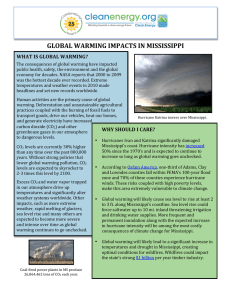
GLOBAL WARMING IMPACTS IN MISSISSIPPI
... • Global warming will likely cause sea level to rise at least 2 impacts, such as more extreme to 3 ft. along Mississippi’s coastline. Sea level rise could weather, rapid melting of glaciers, force ...
... • Global warming will likely cause sea level to rise at least 2 impacts, such as more extreme to 3 ft. along Mississippi’s coastline. Sea level rise could weather, rapid melting of glaciers, force ...

PPT
... The fear is that global warming will result in a positive feedback which cause temperatures to increase very rapidly. ...
... The fear is that global warming will result in a positive feedback which cause temperatures to increase very rapidly. ...

FOR IMMEDIATE RELEASE CONTACT: KEVEN KENNEDY
... WASHINGTON, DC – According to a new Latino Decisions poll, over 70 percent of Latinos deeply care about the environment and how it impacts their families. This finding is in direct contrast to the assumption that working class and Latino communities are disinterested in environmental issues. “What t ...
... WASHINGTON, DC – According to a new Latino Decisions poll, over 70 percent of Latinos deeply care about the environment and how it impacts their families. This finding is in direct contrast to the assumption that working class and Latino communities are disinterested in environmental issues. “What t ...

File
... Briefly describe projections of the major climate models regarding changes in mean surface temperature and average sea level. List eight important factors that lend considerable uncertainty to climate models and their projections. ...
... Briefly describe projections of the major climate models regarding changes in mean surface temperature and average sea level. List eight important factors that lend considerable uncertainty to climate models and their projections. ...

Amy W. Ando Diversifying to Manage Climate‐ Change Risk in Conservation
... Graduate Studies, Dept. of Agricultural and Consumer Economics, University of Illinois Urbana‐Champaign Climate change and other forces make it hard for conservation planners to choose the best places for long term investments because they don’t know what things will look like on the ground in ...
... Graduate Studies, Dept. of Agricultural and Consumer Economics, University of Illinois Urbana‐Champaign Climate change and other forces make it hard for conservation planners to choose the best places for long term investments because they don’t know what things will look like on the ground in ...

ASD Chapter 12 updated 2014_small_part1
... Source: Hansen, James, and Makiko Sato. 2012. “Paleoclimate Implications for Human-Made Climate Change.” In Climate Change: Inferences from Paleoclimate and Regional Aspects, ed. André Berger, Fedor Mesinger, and Djordjie Šijački, 21–48. Heidelberg: Springer. ...
... Source: Hansen, James, and Makiko Sato. 2012. “Paleoclimate Implications for Human-Made Climate Change.” In Climate Change: Inferences from Paleoclimate and Regional Aspects, ed. André Berger, Fedor Mesinger, and Djordjie Šijački, 21–48. Heidelberg: Springer. ...
Introduction to Global Warming and Climate Change
... • Climate “variability” are smaller-scale changes in the energy balance • Climate “change” may affect the intensity and frequency of ENSO events ...
... • Climate “variability” are smaller-scale changes in the energy balance • Climate “change” may affect the intensity and frequency of ENSO events ...

PPT
... global climate is currently limited because the expected signal is still emerging from the noise of natural variability…’” – 1995 IPPC Summary, cited by 2001 EPA global warming web site • “In the light of new evidence . . . most of the observed warming over the last 50 years is likely to have been d ...
... global climate is currently limited because the expected signal is still emerging from the noise of natural variability…’” – 1995 IPPC Summary, cited by 2001 EPA global warming web site • “In the light of new evidence . . . most of the observed warming over the last 50 years is likely to have been d ...

Global warming
... Ocean Acidification: The ongoing decrease in the pH of the Earth's oceans caused by the uptake of CO2 from the atmosphere. A more acidic ocean could wipe out species, disrupt the food web and impact fishing and tourism. ...
... Ocean Acidification: The ongoing decrease in the pH of the Earth's oceans caused by the uptake of CO2 from the atmosphere. A more acidic ocean could wipe out species, disrupt the food web and impact fishing and tourism. ...

Factors responsible for climate change
... 2008 which outlines India’s strategy to meet the challenge of Climate Change. Two of the eight National Missions, i.e., National Solar Mission and National Mission on Enhanced Energy Efficiency relate to mitigation of emissions and include ambitious programmes aimed at generating solar power and con ...
... 2008 which outlines India’s strategy to meet the challenge of Climate Change. Two of the eight National Missions, i.e., National Solar Mission and National Mission on Enhanced Energy Efficiency relate to mitigation of emissions and include ambitious programmes aimed at generating solar power and con ...

Climate Change Misconceptions
... or temperature can have a large effect, especially on the marine environment. A 6-degree-Celsius rise in water temperature caused global biomass to decrease by 50% (O’Connor 2009) ◦ Krill reproduce in smaller numbers in warmer water ◦ Global warming can cause stronger storm systems and disrupt the o ...
... or temperature can have a large effect, especially on the marine environment. A 6-degree-Celsius rise in water temperature caused global biomass to decrease by 50% (O’Connor 2009) ◦ Krill reproduce in smaller numbers in warmer water ◦ Global warming can cause stronger storm systems and disrupt the o ...
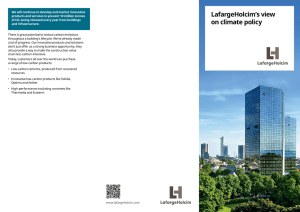
LafargeHolcim climate leaflet
... products and services to prevent 10 million tonnes of CO2 being released every year from buildings and infrastructure. There is great potential to reduce carbon emissions throughout a building’s lifecycle. We’ve already made a lot of progress. Our innovative products and solutions don’t just offer u ...
... products and services to prevent 10 million tonnes of CO2 being released every year from buildings and infrastructure. There is great potential to reduce carbon emissions throughout a building’s lifecycle. We’ve already made a lot of progress. Our innovative products and solutions don’t just offer u ...
Effects of global warming on Australia

Predictions measuring the effects of global warming on Australia assert that global warming will negatively impact the continent's environment, economy, and communities. Australia has been designated as one of the countries most vulnerable to climate change, according to the Stern report and others, due partially to the importance of its agricultural sector and the prominence of its coast.Australia is vulnerable to the effects of global warming projected for the next 50 to 100 years because of its extensive arid and semi-arid areas, high annual rainfall variability, and existing pressures on water supply. The continent's high fire risk increases this susceptibility to change in temperature and climate. Additionally, Australia's population is highly concentrated in coastal areas, and its important tourism industry depends on the health of the Great Barrier Reef and other fragile ecosystems. Impacts of climate change will be complex and to some degree uncertain, but increased foresight may enable the country to safeguard its future through planned mitigation and adaptation. Mitigation may reduce the ultimate extent of climate change and its impacts, but requires global solutions and cooperation, while adaptation can be performed at national and local levels.