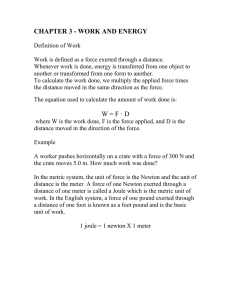
chapter 4 - work and energy
... Solar Power uses energy directly from the sun to supply heat or light. This energy can also be stored in thermal masses to be released later. Photovotaic cells can convert sunlight into electricity which can be used immediately or stored in batteries or capacitors for later use. Problems are efficie ...
... Solar Power uses energy directly from the sun to supply heat or light. This energy can also be stored in thermal masses to be released later. Photovotaic cells can convert sunlight into electricity which can be used immediately or stored in batteries or capacitors for later use. Problems are efficie ...

What is Energy?
... Everything obeys this law The law of Conservation of Energy: Energy cannot be created or destroyed. It may be transformed from one form into another; however, the total amount of energy in the universe remains constant. (Transformers) Energy conversions occur without a gain or loss in energy Due to ...
... Everything obeys this law The law of Conservation of Energy: Energy cannot be created or destroyed. It may be transformed from one form into another; however, the total amount of energy in the universe remains constant. (Transformers) Energy conversions occur without a gain or loss in energy Due to ...

Unit 9: Energy, Work, and Power
... Kinetic energy is the energy of motion. If an object is moving, then it has kinetic energy. The faster an object is moving, the more kinetic energy it has. In most situations, as kinetic energy increases, potential energy decreases. ...
... Kinetic energy is the energy of motion. If an object is moving, then it has kinetic energy. The faster an object is moving, the more kinetic energy it has. In most situations, as kinetic energy increases, potential energy decreases. ...
Energy - danmicksee
... greenhouse effect (brief outline only), land/sea use and nuclear waste. 3.1.5 evaluate the advantages and disadvantages of using various energy resources to generate electricity. This should ...
... greenhouse effect (brief outline only), land/sea use and nuclear waste. 3.1.5 evaluate the advantages and disadvantages of using various energy resources to generate electricity. This should ...

Anthropology of Physics: Energy, Matter and Culture
... wrong designation in this article, forgive me in your logic. “Culture is Energy” instead these statements I have proposed that “Energy is culture”. That is energy is viewed here by the lens which is defined by the social science scholars as CULTURE. From this point view we can be divided culture int ...
... wrong designation in this article, forgive me in your logic. “Culture is Energy” instead these statements I have proposed that “Energy is culture”. That is energy is viewed here by the lens which is defined by the social science scholars as CULTURE. From this point view we can be divided culture int ...

Slide 1
... nuclei. The nucleus of an atom is held together by strong and weak nuclear forces giving it great potential energy. • Nuclear energy is released by two processes: fission and fusion. Energy is released in fission by splitting apart atomic nuclei. It is the process used by nuclear power plants to gen ...
... nuclei. The nucleus of an atom is held together by strong and weak nuclear forces giving it great potential energy. • Nuclear energy is released by two processes: fission and fusion. Energy is released in fission by splitting apart atomic nuclei. It is the process used by nuclear power plants to gen ...

Energy - Dr. Haleys Physics Class
... If you double the height a stone that is being held above the ground, what happens to its GPE? If you half the height a stone that is being held above the ground, what happens to its GPE? ...
... If you double the height a stone that is being held above the ground, what happens to its GPE? If you half the height a stone that is being held above the ground, what happens to its GPE? ...

Document
... toward the realization of a *solid-state thin-film SiC-based **fuel cell and gas sensor for use in harsh environments. Our objective is to use novel porous Silicon Carbide (PSC) materials to develop an all-solid state fuel cell that will more than double the output power of Si-based fuel cells while ...
... toward the realization of a *solid-state thin-film SiC-based **fuel cell and gas sensor for use in harsh environments. Our objective is to use novel porous Silicon Carbide (PSC) materials to develop an all-solid state fuel cell that will more than double the output power of Si-based fuel cells while ...

5E Student Lesson Planning Template
... speed up and slow down they either gain or lose energy. They may gain potential energy as they slow down and gain kinetic energy as they speed up. This is called a continuous transformation of energy. Did you know that roller coasters use potential and kinetic energy? When the roller coaster cars ar ...
... speed up and slow down they either gain or lose energy. They may gain potential energy as they slow down and gain kinetic energy as they speed up. This is called a continuous transformation of energy. Did you know that roller coasters use potential and kinetic energy? When the roller coaster cars ar ...

Correct Energy Powerpoint
... storing its energy. • If you let the rubber band go, it sails across the room. – As it flies through the air it has kinetic energy due to its motion. ...
... storing its energy. • If you let the rubber band go, it sails across the room. – As it flies through the air it has kinetic energy due to its motion. ...

Review and Future Trend of Energy Harvesting Methods
... since it will boost several benefits for the user. Regarding this, and based on the methods already mentioned, [18] created an electrical nanogenerator that will be use in the manufacture of medical implants and sensors. The nanogenerator is capable to convert the mechanical energy of human body mot ...
... since it will boost several benefits for the user. Regarding this, and based on the methods already mentioned, [18] created an electrical nanogenerator that will be use in the manufacture of medical implants and sensors. The nanogenerator is capable to convert the mechanical energy of human body mot ...

Potential and Kinetic Energy
... in so many different activities? Energy can be defined as the ability to do work. If an object or organism does work (exerts a force over a distance to move an object) the object or organism uses energy. ...
... in so many different activities? Energy can be defined as the ability to do work. If an object or organism does work (exerts a force over a distance to move an object) the object or organism uses energy. ...

Energy Notes
... Energy transfer describes the process of transferring energy from one location or object to another. The two ways that energy can be transferred are by doing work (Changing an object’s motion energy) and heat transfer (Changing an object’s temperature) If you were to drop a book into a pool, the mot ...
... Energy transfer describes the process of transferring energy from one location or object to another. The two ways that energy can be transferred are by doing work (Changing an object’s motion energy) and heat transfer (Changing an object’s temperature) If you were to drop a book into a pool, the mot ...

Document
... the ground once it is released. The reverse of a spontaneous event, like water flowing up a waterfall, will not occur except perhaps in the world of special effects for movies. The probability of finding a highly ordered situation (e.g., a deck of cards in order) is much lower than a highly disorder ...
... the ground once it is released. The reverse of a spontaneous event, like water flowing up a waterfall, will not occur except perhaps in the world of special effects for movies. The probability of finding a highly ordered situation (e.g., a deck of cards in order) is much lower than a highly disorder ...

Unit Name: Transformation of Energy
... Temperature is a measure of the motion of the particles. The higher the temperature of the material, the greater the motion of the particles. (Essential) Standard 3.2.F The addition or removal of heat energy from a material changes its temperature or its physical state. (Important) Standard 3.2.G He ...
... Temperature is a measure of the motion of the particles. The higher the temperature of the material, the greater the motion of the particles. (Essential) Standard 3.2.F The addition or removal of heat energy from a material changes its temperature or its physical state. (Important) Standard 3.2.G He ...

Work and Energy - The Lesson Locker
... lifting a good sized apple at a constant velocity straight up for a distance of 1 m requires about 1 J of work. While work can be positive or negative and its calculation depends on direction, it is not a vector. Work is a scalar. Direction is important for calculating work, but work itself has ...
... lifting a good sized apple at a constant velocity straight up for a distance of 1 m requires about 1 J of work. While work can be positive or negative and its calculation depends on direction, it is not a vector. Work is a scalar. Direction is important for calculating work, but work itself has ...

Sliding friction
... Stretch a rubber band between your thumb and index finger. Keep the rubber band stretch without any motion. How long can you hold it this way? After a short while you begin to sense the energy in the rubber band. Yet the rubber band is not moving! The stretched rubber band has energy stored in it. Y ...
... Stretch a rubber band between your thumb and index finger. Keep the rubber band stretch without any motion. How long can you hold it this way? After a short while you begin to sense the energy in the rubber band. Yet the rubber band is not moving! The stretched rubber band has energy stored in it. Y ...
Properties of Matter - Red Clay Secondary Science Wiki
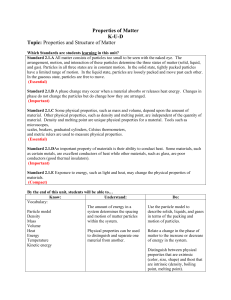
... and gas). Particles in all three states are in constant motion. In the solid state, tightly packed particles have a limited range of motion. In the liquid state, particles are loosely packed and move past each other. In the gaseous state, particles are free to move. (Essential) Standard 2.1.B A phas ...
... and gas). Particles in all three states are in constant motion. In the solid state, tightly packed particles have a limited range of motion. In the liquid state, particles are loosely packed and move past each other. In the gaseous state, particles are free to move. (Essential) Standard 2.1.B A phas ...

Energy Background - Lewiston School District
... water. It bakes a cake in the oven and keeps ice frozen in the freezer. It plays our favorite songs on the radio and lights our homes. Energy makes our bodies grow and allows our minds to think. Scientists define energy as the ability to do work. FORMS OF ENERGY Energy is found in different forms, s ...
... water. It bakes a cake in the oven and keeps ice frozen in the freezer. It plays our favorite songs on the radio and lights our homes. Energy makes our bodies grow and allows our minds to think. Scientists define energy as the ability to do work. FORMS OF ENERGY Energy is found in different forms, s ...
Energy Basics
... an infinite amount of power in nuclear energy. This is what powers stars like our sun. Hydrogen is turned into helium. This process will continue until our sun runs out of hydrogen. This will be in about 4 billion years. ...
... an infinite amount of power in nuclear energy. This is what powers stars like our sun. Hydrogen is turned into helium. This process will continue until our sun runs out of hydrogen. This will be in about 4 billion years. ...

Notes
... Math Example: Gravitational Potential Energy A 65 kg rock climber ascends a cliff. What is the climber’s gravitational potential energy at a point 35 m above the base of the cliff? ...
... Math Example: Gravitational Potential Energy A 65 kg rock climber ascends a cliff. What is the climber’s gravitational potential energy at a point 35 m above the base of the cliff? ...

Final Exam Review whole thing
... How does Newton’s first law relate to a person crashing a bike into a wall? The bike has inertia, it wants to continue going forward at the same rate of speed until the wall exerts a force on the bike to stop it. What about the person on the bike? What would stop the bike if there was no wall? ...
... How does Newton’s first law relate to a person crashing a bike into a wall? The bike has inertia, it wants to continue going forward at the same rate of speed until the wall exerts a force on the bike to stop it. What about the person on the bike? What would stop the bike if there was no wall? ...

Catalytic Detonation of RDX/TNT Blend Explosives for the
... plane of the Fe7C3 crystal. The identification of the phase can be realized in virtue of XRD measurements (Fig. 1). As shown in Fig. 3, it indicate that the mixture result in catalytic detonation reaction and produce nanostructures under the condition. The above data show that the detonation-induced ...
... plane of the Fe7C3 crystal. The identification of the phase can be realized in virtue of XRD measurements (Fig. 1). As shown in Fig. 3, it indicate that the mixture result in catalytic detonation reaction and produce nanostructures under the condition. The above data show that the detonation-induced ...

Energy Lab Key
... height (position). When the gravitational force is the only force on an object, the gravitational potential energy is calculated from, Gravitational Potential Energy = Weight x Height. Energy that exists by virtue of an object’s motion is called the Kinetic Energy. The law of conservation of energy ...
... height (position). When the gravitational force is the only force on an object, the gravitational potential energy is calculated from, Gravitational Potential Energy = Weight x Height. Energy that exists by virtue of an object’s motion is called the Kinetic Energy. The law of conservation of energy ...