Functions of glycoprotein G of herpes simplex virus type 2
... Aims: To evaluate sgG-2 as type specific antigen in ELISA for detection of HSV-2 infection in a Swedish cohort and define the performance for both sgG-2 and mgG-2 in ELISA for high HSV-2 prevalence cohorts in Tanzania (paper I and II). To elucidate the function of mgG-2, using HSV-2 mutants, in a ge ...
... Aims: To evaluate sgG-2 as type specific antigen in ELISA for detection of HSV-2 infection in a Swedish cohort and define the performance for both sgG-2 and mgG-2 in ELISA for high HSV-2 prevalence cohorts in Tanzania (paper I and II). To elucidate the function of mgG-2, using HSV-2 mutants, in a ge ...

Chapter 3 (Biology and Diseases of Mice)
... What gross lesions are seen with natural PVM infection? What histological lesions are associated with PVM infection? The predominant inflammatory infiltrate is compromised of _________ _____, but some ___________ are present. How is PVM diagnosed? True or False. PVM virus can be detected in tissue b ...
... What gross lesions are seen with natural PVM infection? What histological lesions are associated with PVM infection? The predominant inflammatory infiltrate is compromised of _________ _____, but some ___________ are present. How is PVM diagnosed? True or False. PVM virus can be detected in tissue b ...

The infection risks associated with clothing and household linens in
... As stated above, the aim of targeted hygiene is to maximise protection against infectious diseases by breaking the chain of infection transmission. As specified by Aiello and Larson4, although a single factor (or control point) such as the hands may be a “sufficient cause” of infection transmission ...
... As stated above, the aim of targeted hygiene is to maximise protection against infectious diseases by breaking the chain of infection transmission. As specified by Aiello and Larson4, although a single factor (or control point) such as the hands may be a “sufficient cause” of infection transmission ...

3. Transmission of infection via clothing, household linens and laundry
... As stated above, the aim of targeted hygiene is to maximise protection against infectious diseases by breaking the chain of infection transmission. As specified by Aiello and Larson4, although a single factor (or control point) such as the hands may be a “sufficient cause” of infection transmission ...
... As stated above, the aim of targeted hygiene is to maximise protection against infectious diseases by breaking the chain of infection transmission. As specified by Aiello and Larson4, although a single factor (or control point) such as the hands may be a “sufficient cause” of infection transmission ...
Fate and Transport of Zoonotic Bacterial, Viral, and Parasitic
... manures that also may apply to other types of microbial organisms: (1) temperature effects on virus inactivation may not be direct but reflect temperature-dependent processes in swine manure that affect viral survival and (2) the survival properties of different viruses are very variable, preventing ...
... manures that also may apply to other types of microbial organisms: (1) temperature effects on virus inactivation may not be direct but reflect temperature-dependent processes in swine manure that affect viral survival and (2) the survival properties of different viruses are very variable, preventing ...
MEDICAL MICROBIOLOGY
... • To acquire a basic understanding of the objectives of microbiology in medicine, of the historical development of these sciences and of the impact they have had on humanity and the development of other sciences. • To understand the basic morphological and structural aspects of microorganisms, their ...
... • To acquire a basic understanding of the objectives of microbiology in medicine, of the historical development of these sciences and of the impact they have had on humanity and the development of other sciences. • To understand the basic morphological and structural aspects of microorganisms, their ...

Core Feline Vaccines - Abbott Animal Hospital
... Most communities have legal mandates requiring vaccination against rabies for cats because of the contagious nature of the disease and the fact that rabies poses a danger to people. Rabies vaccination should be administered to kittens at 12 weeks of age and should be boostered one year later. The fr ...
... Most communities have legal mandates requiring vaccination against rabies for cats because of the contagious nature of the disease and the fact that rabies poses a danger to people. Rabies vaccination should be administered to kittens at 12 weeks of age and should be boostered one year later. The fr ...

Chapter 20
... Discovery of Viruses • Near the end of the nineteenth century, scientists were trying to find the cause of tobacco mosaic disease, which stunts the growth of tobacco plants. • In 1935, biologist Wendell Stanley of the Rockefeller Institute purified tobacco mosaic virus (TMV) and determined that the ...
... Discovery of Viruses • Near the end of the nineteenth century, scientists were trying to find the cause of tobacco mosaic disease, which stunts the growth of tobacco plants. • In 1935, biologist Wendell Stanley of the Rockefeller Institute purified tobacco mosaic virus (TMV) and determined that the ...

HB_20_win
... Discovery of Viruses • Near the end of the nineteenth century, scientists were trying to find the cause of tobacco mosaic disease, which stunts the growth of tobacco plants. • In 1935, biologist Wendell Stanley of the Rockefeller Institute purified tobacco mosaic virus (TMV) and determined that the ...
... Discovery of Viruses • Near the end of the nineteenth century, scientists were trying to find the cause of tobacco mosaic disease, which stunts the growth of tobacco plants. • In 1935, biologist Wendell Stanley of the Rockefeller Institute purified tobacco mosaic virus (TMV) and determined that the ...

Infectious Disease Myths (or are they myths?)
... • Many diseases we now know as viral were recognized (smallpox, measles, polio), and even immunized against (smallpox), all of this before viruses were first described. • Dmitry Ivanovsky was the first to show that the infectious agent that caused a disease, in this case tobacco mosaic disease, coul ...
... • Many diseases we now know as viral were recognized (smallpox, measles, polio), and even immunized against (smallpox), all of this before viruses were first described. • Dmitry Ivanovsky was the first to show that the infectious agent that caused a disease, in this case tobacco mosaic disease, coul ...
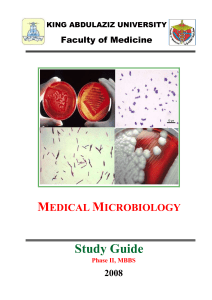
Outcome of the undergraduate Curriculum
... The first part includes general and systematic bacteriology. "General Bacteriology" describes the morphology, structure, growth, metabolism and genetics of bacteria. Antibiotics and chemotherapy, sterilisation and disinfection are also discussed. The "Systemic Bacteriology" outlines the characters o ...
... The first part includes general and systematic bacteriology. "General Bacteriology" describes the morphology, structure, growth, metabolism and genetics of bacteria. Antibiotics and chemotherapy, sterilisation and disinfection are also discussed. The "Systemic Bacteriology" outlines the characters o ...
FREE Sample Here - We can offer most test bank and
... Which one of the following would be consistent with the idea of spontaneous generation? Microorganisms may be cultivated on solid laboratory media. Insects are important in the transmission of disease. Sick people give rise to microorganisms in their body. Disinfection is essential to prevent the sp ...
... Which one of the following would be consistent with the idea of spontaneous generation? Microorganisms may be cultivated on solid laboratory media. Insects are important in the transmission of disease. Sick people give rise to microorganisms in their body. Disinfection is essential to prevent the sp ...
Plant Diseases Caused by Viruses and Viroids
... Generated by Foxit PDF Creator © Foxit Software http://www.foxitsoftware.com For evaluation only. ...
... Generated by Foxit PDF Creator © Foxit Software http://www.foxitsoftware.com For evaluation only. ...
Document
... 45. Match the following definitions with term. ___ 1. disease causing agent ___ 2. the study of body defenses against microorganisms ___ 3. the study of the source, cause and transmission of a disease ___ 4. use of a weakened agent of disease that can provide immunity for a particular disease. ___ 5 ...
... 45. Match the following definitions with term. ___ 1. disease causing agent ___ 2. the study of body defenses against microorganisms ___ 3. the study of the source, cause and transmission of a disease ___ 4. use of a weakened agent of disease that can provide immunity for a particular disease. ___ 5 ...

The SACGM Compendium of guidance - Part 2: Risk
... Part 2: Risk assessment of genetically modified microorganisms (other than those associated with plants) ...
... Part 2: Risk assessment of genetically modified microorganisms (other than those associated with plants) ...
Viruses - Red Wing Public Schools
... Discovery of Viruses • Near the end of the nineteenth century, scientists were trying to find the cause of tobacco mosaic disease, which stunts the growth of tobacco plants. • In 1935, biologist Wendell Stanley of the Rockefeller Institute purified tobacco mosaic virus (TMV) and determined that the ...
... Discovery of Viruses • Near the end of the nineteenth century, scientists were trying to find the cause of tobacco mosaic disease, which stunts the growth of tobacco plants. • In 1935, biologist Wendell Stanley of the Rockefeller Institute purified tobacco mosaic virus (TMV) and determined that the ...
Emerging and Re-emerging Infectious Diseases
... laboratories located in Bethesda, Rockville, and Frederick, Maryland, and in Hamilton, Montana. ...
... laboratories located in Bethesda, Rockville, and Frederick, Maryland, and in Hamilton, Montana. ...

Technical Bulletin - Multi
... About 30% of infected persons have no signs or symptoms. Symptoms are less common in children than adults and can include: jaundice, fatigue, abdominal pain, and loss of appetite, nausea, and vomiting and joint pain. HBV is transmitted when blood or body fluids from an infected person enters the bod ...
... About 30% of infected persons have no signs or symptoms. Symptoms are less common in children than adults and can include: jaundice, fatigue, abdominal pain, and loss of appetite, nausea, and vomiting and joint pain. HBV is transmitted when blood or body fluids from an infected person enters the bod ...
$doc.title
... determined in CEM-‐GFP cells, a tat driven GFP reporter system. Significant RC differences were observed between recombinant viruses from either early or late ...
... determined in CEM-‐GFP cells, a tat driven GFP reporter system. Significant RC differences were observed between recombinant viruses from either early or late ...
German Symposium on Zoonoses Research 2014 7th International
... The potential spread of infectious diseases increases dramatically in our highly mobile time. As a matter of fact, we could never travel from one continent to another as fast as we can today. Never before could animals, goods and food be transported and traded as quickly as now. Due to globalization ...
... The potential spread of infectious diseases increases dramatically in our highly mobile time. As a matter of fact, we could never travel from one continent to another as fast as we can today. Never before could animals, goods and food be transported and traded as quickly as now. Due to globalization ...

Assembly and budding of rabies virus
... PPEY Late domain in M which confers interaction with components of the MVB pathway reduces viral titers by one order of magnitude (Harty et al., 2001). In order to identify new motifs in M which are critical for assembly, an M mutant bank was subjected to a functionality screen (NPgrL assay). Am ...
... PPEY Late domain in M which confers interaction with components of the MVB pathway reduces viral titers by one order of magnitude (Harty et al., 2001). In order to identify new motifs in M which are critical for assembly, an M mutant bank was subjected to a functionality screen (NPgrL assay). Am ...
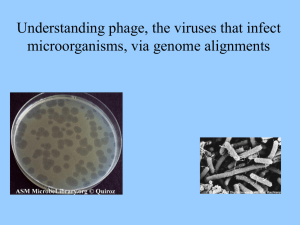
Understanding phage, the viruses that infect
... d'Hérelle, working at the Pasteur Institute in Paris, announced on September 3, 1917 that he discovered "an invisible, antagonistic microbe of the dysentery bacillus". For d’Herelle, there was no question as to the nature of his discovery: "In a flash I had understood: what caused my clear spots was ...
... d'Hérelle, working at the Pasteur Institute in Paris, announced on September 3, 1917 that he discovered "an invisible, antagonistic microbe of the dysentery bacillus". For d’Herelle, there was no question as to the nature of his discovery: "In a flash I had understood: what caused my clear spots was ...
Biological diagnostics, control and treatment of the cholerae.
... In bacteria, the cell wall forms a rigid structure around the cell. The bacterial cell wall surrounds the cell membrane. Inside the cell wall (or rigid peptidoglycan layer) is the plasma (cytoplasmic) membrane; this is usually closely apposed to the wall layer. Outside of cell wall some bacteria hav ...
... In bacteria, the cell wall forms a rigid structure around the cell. The bacterial cell wall surrounds the cell membrane. Inside the cell wall (or rigid peptidoglycan layer) is the plasma (cytoplasmic) membrane; this is usually closely apposed to the wall layer. Outside of cell wall some bacteria hav ...

The Genomics of Emerging Infectious Disease
... When an American robin (Turdus migratorius) showed up in London a few years ago, birders were rapidly all atwitter and many came flocking to town [22]. Why had this one bird created such a stir? For one main reason—it was out of place. This species is normally found in North America and only very ra ...
... When an American robin (Turdus migratorius) showed up in London a few years ago, birders were rapidly all atwitter and many came flocking to town [22]. Why had this one bird created such a stir? For one main reason—it was out of place. This species is normally found in North America and only very ra ...

Characterization of bovine viral diarrhea viruses by their interactions
... BVD viruses Is ether-stable was reported by Taylor et §d. (19). On the basis of size, lack of hemadsorption, and ether stability, these authors suggested that BVD agents could be classified as adenoviruses rather than myxovlruses which are also In a similar size range. Gillespie et al. (26) state: " ...
... BVD viruses Is ether-stable was reported by Taylor et §d. (19). On the basis of size, lack of hemadsorption, and ether stability, these authors suggested that BVD agents could be classified as adenoviruses rather than myxovlruses which are also In a similar size range. Gillespie et al. (26) state: " ...
Social history of viruses

The social history of viruses describes the influence of viruses and viral infections on human history. Epidemics caused by viruses began when human behaviour changed during the Neolithic period, around 12,000 years ago, when humans developed more densely populated agricultural communities. This allowed viruses to spread rapidly and subsequently to become endemic. Viruses of plants and livestock also increased, and as humans became dependent on agriculture and farming, diseases such as potyviruses of potatoes and rinderpest of cattle had devastating consequences.Smallpox and measles viruses are among the oldest that infect humans. Having evolved from viruses that infected other animals, they first appeared in humans in Europe and North Africa thousands of years ago. The viruses were later carried to the New World by Europeans during the time of the Spanish Conquests, but the indigenous people had no natural resistance to the viruses and millions of them died during epidemics. Influenza pandemics have been recorded since 1580, and they have occurred with increasing frequency in subsequent centuries. The pandemic of 1918–19, in which 40–50 million died in less than a year, was one of the most devastating in history.Louis Pasteur and Edward Jenner were the first to develop vaccines to protect against viral infections. The nature of viruses remained unknown until the invention of the electron microscope in the 1930s, when the science of virology gained momentum. In the 20th century many diseases both old and new were found to be caused by viruses. There were epidemics of poliomyelitis that were only controlled following the development of a vaccine in the 1950s. HIV is one of the most pathogenic new viruses to have emerged in centuries. Although scientific interest in them arose because of the diseases they cause, most viruses are beneficial. They drive evolution by transferring genes across species, play important roles in ecosystems and are essential to life.