
Diapositiva 1 - Laboratorio de Genómica Viral y Humana
... protecting the embryo from its mother's immune system. ...
... protecting the embryo from its mother's immune system. ...

Understanding Our Environment
... Raven - Johnson - Biology: 6th Ed. - All Rights Reserved - McGraw Hill Companies ...
... Raven - Johnson - Biology: 6th Ed. - All Rights Reserved - McGraw Hill Companies ...

Station 3 - Scioly.org
... ____ 14. Which of the following might display data similar to that of scrapie? a. cancer cells b. bacterial endospores c. HIV virus d. bacterial capsule ____ 15. Why are prions unlike any other infectious disease? a. They are extremely small. b. They are both infectious and hereditary. c. They affec ...
... ____ 14. Which of the following might display data similar to that of scrapie? a. cancer cells b. bacterial endospores c. HIV virus d. bacterial capsule ____ 15. Why are prions unlike any other infectious disease? a. They are extremely small. b. They are both infectious and hereditary. c. They affec ...

Microbial Risk Levels
... Yellow fever virus some encephalitis viruses Serratia marcescens HIV Rabies Coccidiodes immitis Hepatitis A,B,C Prions Cryptococcus neoformans No parasitic agents Most parasitic agents The organisms found in Biosafety level 1 are often genetically unable to invade human hosts. To some extent these c ...
... Yellow fever virus some encephalitis viruses Serratia marcescens HIV Rabies Coccidiodes immitis Hepatitis A,B,C Prions Cryptococcus neoformans No parasitic agents Most parasitic agents The organisms found in Biosafety level 1 are often genetically unable to invade human hosts. To some extent these c ...

Basic Microbiology
... The study of microorganisms (microbes, pathogens, bugs, germs) • They are living organisms, mostly invisible • The majority can only be seen with a microscope • Make up more than 60% of the Earth’s living matter • About 2-3 billion species share the planet with us! • We all have 3–5 POUNDS of bacter ...
... The study of microorganisms (microbes, pathogens, bugs, germs) • They are living organisms, mostly invisible • The majority can only be seen with a microscope • Make up more than 60% of the Earth’s living matter • About 2-3 billion species share the planet with us! • We all have 3–5 POUNDS of bacter ...
Tobacco Mosaic Virus (TMV)
... directs the plant cell to produce more virus nucleic acid and virus protein, disrupting the normal activity of the cell. TMV can multiply only inside a living cell but it can survive in a dormant state in dead tissue, retaining its ability to infect growing plants for years after the infected plant ...
... directs the plant cell to produce more virus nucleic acid and virus protein, disrupting the normal activity of the cell. TMV can multiply only inside a living cell but it can survive in a dormant state in dead tissue, retaining its ability to infect growing plants for years after the infected plant ...

Bacteria & Viruses PowerPoint
... function normally, an infected person may not appear sick, but they can still transmit the virus in their body fluids. ...
... function normally, an infected person may not appear sick, but they can still transmit the virus in their body fluids. ...

International Society for Analytical Cytology Biosafety Standard for
... manipulation of tissues BSL2, BSL3 for tissue cultures of ...
... manipulation of tissues BSL2, BSL3 for tissue cultures of ...

Microbial Research Commons Including Viruses
... Very few cultures characterized at DNA finger printing level Data not fully computerized and information not available on the web Duplication of cultures in the repository Material Transfer Agreement similar to that in ATCC is followed by most repositories No systems in place to detect or prevent mi ...
... Very few cultures characterized at DNA finger printing level Data not fully computerized and information not available on the web Duplication of cultures in the repository Material Transfer Agreement similar to that in ATCC is followed by most repositories No systems in place to detect or prevent mi ...

MICROBIOLOGY
... provided proof that a bacterium causes anthrax using experimental steps now called the Koch’s Postulates ...
... provided proof that a bacterium causes anthrax using experimental steps now called the Koch’s Postulates ...
Full text in pdf format
... Acridine orange direct counts (AODC). Counts of bacteria were performed from 2 % formalin-preserved samples (Hobbie et al. 1977). Briefly, a few m1 of seawater was stained with acridine orange (0.1% w/v) filtered at 20 kPa onto (replicate)0.2 pm pore size polycarbonate (Nuclepore) filters, and count ...
... Acridine orange direct counts (AODC). Counts of bacteria were performed from 2 % formalin-preserved samples (Hobbie et al. 1977). Briefly, a few m1 of seawater was stained with acridine orange (0.1% w/v) filtered at 20 kPa onto (replicate)0.2 pm pore size polycarbonate (Nuclepore) filters, and count ...

Presentation 8
... •GM animal, human and plant has enabled us to test novel therapies (drugs, organ transplantation, food additives) and vaccines among others •GM microbe, plant, animal and human have revolutionized the production of complex pharmaceuticals by enabling the generation of more adapted, safer and cheaper ...
... •GM animal, human and plant has enabled us to test novel therapies (drugs, organ transplantation, food additives) and vaccines among others •GM microbe, plant, animal and human have revolutionized the production of complex pharmaceuticals by enabling the generation of more adapted, safer and cheaper ...

Microbes on Surfaces
... 10% had E.coli 40% of sterile cloths washed in unbleached laundry picked up fecal bacteria • At high temperatures (131F) some bacteria (E.coli) killed, however some Salmonella survived – As did HAV, Rotavirus and Adenovirus ...
... 10% had E.coli 40% of sterile cloths washed in unbleached laundry picked up fecal bacteria • At high temperatures (131F) some bacteria (E.coli) killed, however some Salmonella survived – As did HAV, Rotavirus and Adenovirus ...
exanthems exanthems
... Associated with viral illness Virus-associated exanthem Most often in children aged 2-6 years of age Generalized lymphadenopathy may be seen Infrequently pruritic May last 6-8 weeks ...
... Associated with viral illness Virus-associated exanthem Most often in children aged 2-6 years of age Generalized lymphadenopathy may be seen Infrequently pruritic May last 6-8 weeks ...

Respiratory infections
... and wheezing. chest pains, fever, and fatigue. In addition, bronchitis caused by Adenovirus may cause systemic and gastrointestinal symptoms. the coughs due to bronchitis can continue for up to three weeks or more even after all other symptoms have subsided ...
... and wheezing. chest pains, fever, and fatigue. In addition, bronchitis caused by Adenovirus may cause systemic and gastrointestinal symptoms. the coughs due to bronchitis can continue for up to three weeks or more even after all other symptoms have subsided ...
Human herpes virus: Bacteria and periodontium
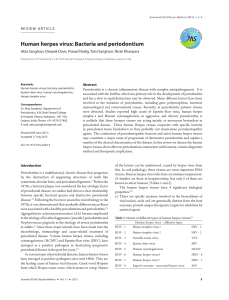
... Periodontitis is a chronic inflammatory disease with complex aetiopathogenesis. It is associated with the biofilm, which has primary role in the development of periodontitis and has a slow to rapid destruction may be observed. Many different factors have been involved in the initiation of periodonti ...
... Periodontitis is a chronic inflammatory disease with complex aetiopathogenesis. It is associated with the biofilm, which has primary role in the development of periodontitis and has a slow to rapid destruction may be observed. Many different factors have been involved in the initiation of periodonti ...
Human herpes virus: Bacteria and periodontium
... emerged as a putative pathogens in destructing progressive periodontal disease in the past few years.[5] In various types of periodontal diseases, human herpes viruses have emerged as putative pathogens since mid-1900s. They are the leading cause of human viral diseases. Greek word Herpein from whic ...
... emerged as a putative pathogens in destructing progressive periodontal disease in the past few years.[5] In various types of periodontal diseases, human herpes viruses have emerged as putative pathogens since mid-1900s. They are the leading cause of human viral diseases. Greek word Herpein from whic ...
Viral Clearance Studies - Charles River Laboratories
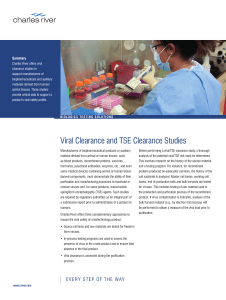
... should be model viruses which represent identified contaminates or potential contaminates of the product. The model viruses should also present a wide range of physicochemical properties in order to evaluate the robustness of the purification process to remove or inactivate a range of biophysically ...
... should be model viruses which represent identified contaminates or potential contaminates of the product. The model viruses should also present a wide range of physicochemical properties in order to evaluate the robustness of the purification process to remove or inactivate a range of biophysically ...

Transgene Presents Pre-Clinical Data at AACR on a New
... of its Next Generation Armed Oncolytic Virus at the AACR Annual Meeting in Washington, DC Strasbourg, France, March 30, 2017, 5:45 p.m. CET - Transgene (Euronext Paris: TNG), a biotechnology company focused on designing and developing viral-based immune-targeted therapies for the treatment of cancer ...
... of its Next Generation Armed Oncolytic Virus at the AACR Annual Meeting in Washington, DC Strasbourg, France, March 30, 2017, 5:45 p.m. CET - Transgene (Euronext Paris: TNG), a biotechnology company focused on designing and developing viral-based immune-targeted therapies for the treatment of cancer ...
Features of Hepatitis Viruses: Hepatitis Viruses Antigens
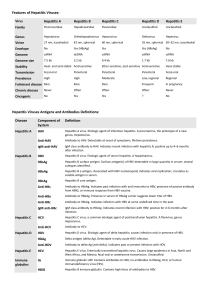
... Antibody to HBsAg. Indicates past infection with and immunity to HBV, presence of passive antibody from HBIG, or immune response from HBV vaccine. ...
... Antibody to HBsAg. Indicates past infection with and immunity to HBV, presence of passive antibody from HBIG, or immune response from HBV vaccine. ...

View detailed information
... We offer a wide variety of packaging options that are great for kits, offices, purses, bags, hospitals, travel, workshops and more!!! ...
... We offer a wide variety of packaging options that are great for kits, offices, purses, bags, hospitals, travel, workshops and more!!! ...
Hepatitis B shots are recommended for all new babies
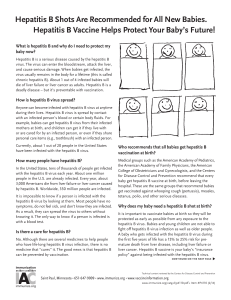
... Is hepatitis B vaccine safe? Yes. Hepatitis B vaccine has been shown to be very safe when given to people of all ages. More than one billion hepatitis B shots have been given worldwide. In the United States, more than 120 million people, including infants, children, and adults have received hepatiti ...
... Is hepatitis B vaccine safe? Yes. Hepatitis B vaccine has been shown to be very safe when given to people of all ages. More than one billion hepatitis B shots have been given worldwide. In the United States, more than 120 million people, including infants, children, and adults have received hepatiti ...
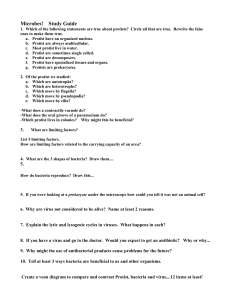
Microbes! Study Guide 1. Which of the following statements are true
... 1. Which of the following statements are true about protists? Circle all that are true. Rewrite the false ones to make them true. a. Protist have an organized nucleus. b. Protist are always multicellular. c. Most protist live in water. d. Protist are sometimes single celled. e. Protist are decompose ...
... 1. Which of the following statements are true about protists? Circle all that are true. Rewrite the false ones to make them true. a. Protist have an organized nucleus. b. Protist are always multicellular. c. Most protist live in water. d. Protist are sometimes single celled. e. Protist are decompose ...

Viruses
... • All algal cells consist of cytoplasm, a cell wall (usually), cell membrane, a nucleus, plastids, ribosomes, mitochondria and Golgi bodies. • Some have a pellicle, a stigma and/or flagella • Algae range in size from unicellular microscopic organisms (e.g., diatoms) to large, multi-cellular organism ...
... • All algal cells consist of cytoplasm, a cell wall (usually), cell membrane, a nucleus, plastids, ribosomes, mitochondria and Golgi bodies. • Some have a pellicle, a stigma and/or flagella • Algae range in size from unicellular microscopic organisms (e.g., diatoms) to large, multi-cellular organism ...

Chapter 28 Notes
... • Viral Diseases in Humans – Antiviral Drugs • Antibiotics are most effective against viruses • Some antiviral drugs interfere with viral replication • Other antiviral drugs may affect virus attachment • Many times, no drugs are available for viral infections. ...
... • Viral Diseases in Humans – Antiviral Drugs • Antibiotics are most effective against viruses • Some antiviral drugs interfere with viral replication • Other antiviral drugs may affect virus attachment • Many times, no drugs are available for viral infections. ...
Social history of viruses

The social history of viruses describes the influence of viruses and viral infections on human history. Epidemics caused by viruses began when human behaviour changed during the Neolithic period, around 12,000 years ago, when humans developed more densely populated agricultural communities. This allowed viruses to spread rapidly and subsequently to become endemic. Viruses of plants and livestock also increased, and as humans became dependent on agriculture and farming, diseases such as potyviruses of potatoes and rinderpest of cattle had devastating consequences.Smallpox and measles viruses are among the oldest that infect humans. Having evolved from viruses that infected other animals, they first appeared in humans in Europe and North Africa thousands of years ago. The viruses were later carried to the New World by Europeans during the time of the Spanish Conquests, but the indigenous people had no natural resistance to the viruses and millions of them died during epidemics. Influenza pandemics have been recorded since 1580, and they have occurred with increasing frequency in subsequent centuries. The pandemic of 1918–19, in which 40–50 million died in less than a year, was one of the most devastating in history.Louis Pasteur and Edward Jenner were the first to develop vaccines to protect against viral infections. The nature of viruses remained unknown until the invention of the electron microscope in the 1930s, when the science of virology gained momentum. In the 20th century many diseases both old and new were found to be caused by viruses. There were epidemics of poliomyelitis that were only controlled following the development of a vaccine in the 1950s. HIV is one of the most pathogenic new viruses to have emerged in centuries. Although scientific interest in them arose because of the diseases they cause, most viruses are beneficial. They drive evolution by transferring genes across species, play important roles in ecosystems and are essential to life.