Killer Angels notes
... no matter how much ______________________________________________________. (193) 16. Lee wants this battle ______________________________________________________. (193) 17. The Union calls one of the hills Little Round Top while the Confederates call it _____________________. ...
... no matter how much ______________________________________________________. (193) 16. Lee wants this battle ______________________________________________________. (193) 17. The Union calls one of the hills Little Round Top while the Confederates call it _____________________. ...
View - OhioLINK Electronic Theses and Dissertations Center
... The essay’s organizational structure follows a chorological progression inspired by the work of David Blight, Timothy B. Smith, and Thomas J. Brown. The remainder of the introduction presents a brief account of the battle itself, its significance in the war, and early efforts at reporting and commem ...
... The essay’s organizational structure follows a chorological progression inspired by the work of David Blight, Timothy B. Smith, and Thomas J. Brown. The remainder of the introduction presents a brief account of the battle itself, its significance in the war, and early efforts at reporting and commem ...
History in the Making
... Lincoln thought he clearly stated his position during the campaign: he would not interfere with slavery where it already existed. Nothing about that had changed since he won, and he did not want to commit himself to a course of action before taking office. Moreover, he believed southern papers would ...
... Lincoln thought he clearly stated his position during the campaign: he would not interfere with slavery where it already existed. Nothing about that had changed since he won, and he did not want to commit himself to a course of action before taking office. Moreover, he believed southern papers would ...
Economics - Deptford Township Schools
... • In an effort to exhaust the Confederate troops, General Grant headed toward Richmond with some 115,000 troops. • In May and June of 1864, the Union and Confederate armies clashed in three major battles: – The Battle of the Wilderness began on May 5, 1864. The armies met in a dense forest in a batt ...
... • In an effort to exhaust the Confederate troops, General Grant headed toward Richmond with some 115,000 troops. • In May and June of 1864, the Union and Confederate armies clashed in three major battles: – The Battle of the Wilderness began on May 5, 1864. The armies met in a dense forest in a batt ...
On Civil War Turning Points
... but this occurred after the treaty was signed rendering its influence inert. The SpanishAmerican War lasted only six months with no Spanish victories, a difficult situation for any TP assignment. The other two wars are Korea and Vietnam, at approximately three and fourteen years (for U.S. involvemen ...
... but this occurred after the treaty was signed rendering its influence inert. The SpanishAmerican War lasted only six months with no Spanish victories, a difficult situation for any TP assignment. The other two wars are Korea and Vietnam, at approximately three and fourteen years (for U.S. involvemen ...
Battlefield Of Franklin Land Preservation Purchase
... [Andrew] Jackson by Washington” when he visited The Hermitage, near Nashville. Throughout his enlistment King exhibited a strong desire to fight until the war was won, and he showed little reluctance to criticize the generals. Don Carlos Buell, in his estimation, was a “traitor.” And when George B. ...
... [Andrew] Jackson by Washington” when he visited The Hermitage, near Nashville. Throughout his enlistment King exhibited a strong desire to fight until the war was won, and he showed little reluctance to criticize the generals. Don Carlos Buell, in his estimation, was a “traitor.” And when George B. ...
Major Battles of the Civil War - sls
... Civil War. Lee was so close to DC, but so far away from ultimate victory. Southern armies would never attack in the North again. The South was on the defensive for the rest of the war. Happening at the same time as the Battle of Gettysburg was a battle on the Mississippi River in a town called Vicks ...
... Civil War. Lee was so close to DC, but so far away from ultimate victory. Southern armies would never attack in the North again. The South was on the defensive for the rest of the war. Happening at the same time as the Battle of Gettysburg was a battle on the Mississippi River in a town called Vicks ...
The Civil War - Wando High School
... The USA’s Plan In addition to the Anaconda Plan, the USA wanted to take Richmond, the capital of the Confederacy, as a symbolic strategy. They also used TOTAL WAR late in the war. This was Grant’s plan to bring the CSA to its knees. It was put into effect most notably by Sherman in his March to the ...
... The USA’s Plan In addition to the Anaconda Plan, the USA wanted to take Richmond, the capital of the Confederacy, as a symbolic strategy. They also used TOTAL WAR late in the war. This was Grant’s plan to bring the CSA to its knees. It was put into effect most notably by Sherman in his March to the ...
Gettysburg: an exhibit for the First
... The Foreign Observer on the Ground to be crossed by Pickett's Division Arthur Fremantle, Three Months in the Southern States: April-June, 1863. New York: John Bradburn, 1864. --Fremantle, an experienced soldier, surveyed the ground with Lee's and Longstreet's staff, recording the distance to be cro ...
... The Foreign Observer on the Ground to be crossed by Pickett's Division Arthur Fremantle, Three Months in the Southern States: April-June, 1863. New York: John Bradburn, 1864. --Fremantle, an experienced soldier, surveyed the ground with Lee's and Longstreet's staff, recording the distance to be cro ...
Areas of the Valley – Part 1
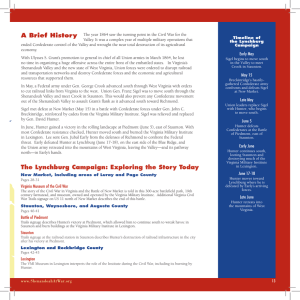
... and transportation networks and destroy Confederate forces and the economic and agricultural resources that supported them. In May, a Federal army under Gen. George Crook advanced south through West Virginia with orders to cut railroad links from Virginia to the west. Union Gen. Franz Sigel was to m ...
... and transportation networks and destroy Confederate forces and the economic and agricultural resources that supported them. In May, a Federal army under Gen. George Crook advanced south through West Virginia with orders to cut railroad links from Virginia to the west. Union Gen. Franz Sigel was to m ...
Clarke County Civil War Driving Tour
... Since Union Gen. Philip H. Sheridan had taken command of Federal forces in the Shenandoah Valley on August 7, 1864, he and Confederate Gen. Jubal A. Early had fought mostly minor actions during a period that became known as “mimic war.” As September began, however, the campaign began to intensify. S ...
... Since Union Gen. Philip H. Sheridan had taken command of Federal forces in the Shenandoah Valley on August 7, 1864, he and Confederate Gen. Jubal A. Early had fought mostly minor actions during a period that became known as “mimic war.” As September began, however, the campaign began to intensify. S ...
Camp 1220 May 2014
... Confederate Veterans, Confederate Chaplains, Southern Writers and Southern Historians before, during, and after the war; we present the facts, opinions, and conclusions stated in the following series. The only cause of the “war” was that the South was invaded and responded to hostile Northern aggres ...
... Confederate Veterans, Confederate Chaplains, Southern Writers and Southern Historians before, during, and after the war; we present the facts, opinions, and conclusions stated in the following series. The only cause of the “war” was that the South was invaded and responded to hostile Northern aggres ...
Chapter 15 Powerpoint
... Defeated the Union at the Second Battle of Bull Run Aug. 29-30, 1862 Second Battle of Bull Run ...
... Defeated the Union at the Second Battle of Bull Run Aug. 29-30, 1862 Second Battle of Bull Run ...
The Dare Mark Line - Civil War in Fauquier
... while Jeb Stuart’s cavalry brigade patrolled east of the river from Waterloo to Kelly’s Ford, and as far inland as Warrenton Junction— where Stuart established his headquarters. ...
... while Jeb Stuart’s cavalry brigade patrolled east of the river from Waterloo to Kelly’s Ford, and as far inland as Warrenton Junction— where Stuart established his headquarters. ...
Upper Rappahannock River Front: The Dare Mark Line Clark B. Hall
... Rappahannock, and considering the Federal artillery was positioned on superior bluffs in Fauquier, Pope’s artillerists trumped in these hot duels. A “continuous and terrific” booming was heard (and felt) for miles up and down the river. On August 22, a Union brigade (1500 men) commanded by Brig. Gen ...
... Rappahannock, and considering the Federal artillery was positioned on superior bluffs in Fauquier, Pope’s artillerists trumped in these hot duels. A “continuous and terrific” booming was heard (and felt) for miles up and down the river. On August 22, a Union brigade (1500 men) commanded by Brig. Gen ...
American History
... (2)14. Explain the Fall of New Orleans and why the Fall was Devastating to the south? (p. 479) ...
... (2)14. Explain the Fall of New Orleans and why the Fall was Devastating to the south? (p. 479) ...
Balloon Operations on the Peninsula in 1862
... these balloon sightings, and they knew that the Union was able to spy on them and their movements. Many soldiers wrote about how they had to deliberately hide from the balloons.xii At one point, the Confederates tried to launch their own balloon but their efforts fell far short of the Union success. ...
... these balloon sightings, and they knew that the Union was able to spy on them and their movements. Many soldiers wrote about how they had to deliberately hide from the balloons.xii At one point, the Confederates tried to launch their own balloon but their efforts fell far short of the Union success. ...
naylonMaurice - Georgetown University
... approach provides valuable insight into the decision-making process. Furthermore, as with any historical judgement, room for debate on my selection exists. With that said, in my judgement, the decisions outlined below most accurately fit the aforementioned parameters for operationallevel action. Dur ...
... approach provides valuable insight into the decision-making process. Furthermore, as with any historical judgement, room for debate on my selection exists. With that said, in my judgement, the decisions outlined below most accurately fit the aforementioned parameters for operationallevel action. Dur ...
Chapter 16-17 Honors Study Guide
... (3)16. What were Three Reasons Lee Invaded the North? A. B. C. (3)17. How were Lee’s Plans in the North Discovered, What was Significant About Antietam, and What were the Costs of the Battle? ) A. B. C. Chapter 17-1 (2)18. Explain why Lincoln did not free the slaves early on and why he finally freed ...
... (3)16. What were Three Reasons Lee Invaded the North? A. B. C. (3)17. How were Lee’s Plans in the North Discovered, What was Significant About Antietam, and What were the Costs of the Battle? ) A. B. C. Chapter 17-1 (2)18. Explain why Lincoln did not free the slaves early on and why he finally freed ...
Chapter 16-17 Study Guide
... (2)14. Explain the Fall of New Orleans and why the Fall was Devastating to the south? (p. 479) ...
... (2)14. Explain the Fall of New Orleans and why the Fall was Devastating to the south? (p. 479) ...
Generals of the Civil War
... wasn’t President Lincoln’s first choice either. Fortunately for Meade, four other officers that outranked him turned down the position. ...
... wasn’t President Lincoln’s first choice either. Fortunately for Meade, four other officers that outranked him turned down the position. ...

Presentation - National Humanities Center
... Is Rogers’ plaster group a celebration or a critique of the sharpshooter’s craft? Given that he made it for display in middle-class homes, was it wise for him to undertake this subject? ...
... Is Rogers’ plaster group a celebration or a critique of the sharpshooter’s craft? Given that he made it for display in middle-class homes, was it wise for him to undertake this subject? ...
Journal Information PPT
... http://www.history.com/topics/american-civil-war/videos#battle-offrederickson ...
... http://www.history.com/topics/american-civil-war/videos#battle-offrederickson ...
Battle of Antietam

The Battle of Antietam /ænˈtiːtəm/, also known as the Battle of Sharpsburg, particularly in the South, fought on September 17, 1862, near Sharpsburg, Maryland, and Antietam Creek as part of the Maryland Campaign, was the first major battle in the American Civil War to take place on Union soil. It is the bloodiest single-day battle in American history, with a combined tally of dead, wounded, and missing at 22,717.After pursuing Confederate General Robert E. Lee into Maryland, Union Army Maj. Gen. George B. McClellan launched attacks against Lee's army, in defensive positions behind Antietam Creek. At dawn on September 17, Maj. Gen. Joseph Hooker's corps mounted a powerful assault on Lee's left flank. Attacks and counterattacks swept across Miller's Cornfield and fighting swirled around the Dunker Church. Union assaults against the Sunken Road eventually pierced the Confederate center, but the Federal advantage was not followed up. In the afternoon, Union Maj. Gen. Ambrose Burnside's corps entered the action, capturing a stone bridge over Antietam Creek and advancing against the Confederate right. At a crucial moment, Confederate Maj. Gen. A. P. Hill's division arrived from Harpers Ferry and launched a surprise counterattack, driving back Burnside and ending the battle. Although outnumbered two-to-one, Lee committed his entire force, while McClellan sent in less than three-quarters of his army, enabling Lee to fight the Federals to a standstill. During the night, both armies consolidated their lines. In spite of crippling casualties, Lee continued to skirmish with McClellan throughout September 18, while removing his battered army south of the Potomac River.Despite having superiority of numbers, McClellan's attacks failed to achieve force concentration, allowing Lee to counter by shifting forces and moving interior lines to meet each challenge. Despite ample reserve forces that could have been deployed to exploit localized successes, McClellan failed to destroy Lee's army. McClellan had halted Lee's invasion of Maryland, but Lee was able to withdraw his army back to Virginia without interference from the cautious McClellan. Although the battle was tactically inconclusive, the Confederate troops had withdrawn first from the battlefield, making it, in military terms, a Union victory. It had significance as enough of a victory to give President Abraham Lincoln the confidence to announce his Emancipation Proclamation, which discouraged the British and French governments from potential plans for recognition of the Confederacy.