America at Mid-19th Century: Abolition, Civil War, Emancipation
... The war came; it lasted four years and claimed over 630,000 American lives from the battlefields, in a nation of barely 33 million souls. But it also brought the Emancipation Proclamation as a presidential order into the mainstream of American life, and forever changed life in America. The end of t ...
... The war came; it lasted four years and claimed over 630,000 American lives from the battlefields, in a nation of barely 33 million souls. But it also brought the Emancipation Proclamation as a presidential order into the mainstream of American life, and forever changed life in America. The end of t ...
How the Confederacy Came To Terms with the American Civil War
... investigates the inner world of white female and male Confederates as they faced losing a war for their freedom as they saw it. An investigation of reasons for this loss reveals many causes, each playing a role in the eventual victory of the United States. The background literature reveals many disc ...
... investigates the inner world of white female and male Confederates as they faced losing a war for their freedom as they saw it. An investigation of reasons for this loss reveals many causes, each playing a role in the eventual victory of the United States. The background literature reveals many disc ...
John Hunt Morgan`s Christmas Raid
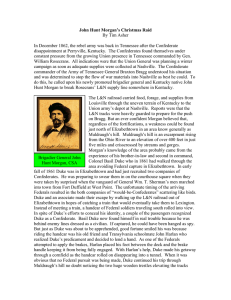
... commander into believing that a huge Federal host occupied the town. He did this by marching his men in a “double file” loop across the brow of a hill in full view to give Morgan the impression that he commanded much greater numbers. Next he sent Morgan word that a Federal force had Morgan surrounde ...
... commander into believing that a huge Federal host occupied the town. He did this by marching his men in a “double file” loop across the brow of a hill in full view to give Morgan the impression that he commanded much greater numbers. Next he sent Morgan word that a Federal force had Morgan surrounde ...
THE BATTLE OF SAILOR`S CREEK: A STUDY IN LEADERSHIP A
... intent, pushed both his cavalry and the supporting infantry relentlessly, not only to cut the Confederate supply lines, but also to capture as many Confederates as he could during the two days of fighting. abandon his lines. ...
... intent, pushed both his cavalry and the supporting infantry relentlessly, not only to cut the Confederate supply lines, but also to capture as many Confederates as he could during the two days of fighting. abandon his lines. ...
American Civil War
... before the new administration took office on March 4, 1861, seven cotton states declared their secession and joined to form the Confederate States of America. Both the outgoing administration of President James Buchanan and the incoming administration rejected the legality of secession, considering ...
... before the new administration took office on March 4, 1861, seven cotton states declared their secession and joined to form the Confederate States of America. Both the outgoing administration of President James Buchanan and the incoming administration rejected the legality of secession, considering ...
The Role of Confederate Nationalism and Popular Will
... large degree to the inability of the Davis government to adequately address the economic and social disparity between the classes. "The greatest failure of Jefferson Davis's leadership lay in the domestic arena, in his inability to create the internal unity and spirit essential for the growth of Co ...
... large degree to the inability of the Davis government to adequately address the economic and social disparity between the classes. "The greatest failure of Jefferson Davis's leadership lay in the domestic arena, in his inability to create the internal unity and spirit essential for the growth of Co ...
The Positive Contributions of the Joint Committee on the Conduct of
... found itself as no exception. A fresh, new, President from a young political party found himself in charge of a nation violently divided. The common perception amongst the North was that victory was assured, sooner rather than later. Why then, in December 1861, eight months after the war’s beginning ...
... found itself as no exception. A fresh, new, President from a young political party found himself in charge of a nation violently divided. The common perception amongst the North was that victory was assured, sooner rather than later. Why then, in December 1861, eight months after the war’s beginning ...
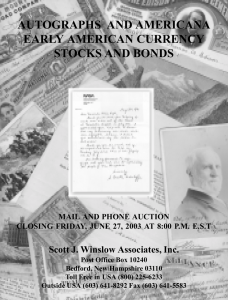
Part II - Scott J. Winslow Associates, Inc.
... that cost Turner his commission. He was dismissed from the Corps on December 11, 1862. As if to prove himself Turner made his way to Chattanooga and three weeks later enlisted as a private in Company B., 1st Kentucky Cavalry on January 1, 1863. In March 1863 his sister’s Hennrietta Turner’s correspo ...
... that cost Turner his commission. He was dismissed from the Corps on December 11, 1862. As if to prove himself Turner made his way to Chattanooga and three weeks later enlisted as a private in Company B., 1st Kentucky Cavalry on January 1, 1863. In March 1863 his sister’s Hennrietta Turner’s correspo ...
reminiscences of the civil war
... Sharpsburg he was wounded five times, but would not leave his troops till the last shot laid him helpless and insensible on the field. A scholarly professor of history in one of our Southern universities recently stated that in his study of the great war on both sides he had found but one prominent ...
... Sharpsburg he was wounded five times, but would not leave his troops till the last shot laid him helpless and insensible on the field. A scholarly professor of history in one of our Southern universities recently stated that in his study of the great war on both sides he had found but one prominent ...
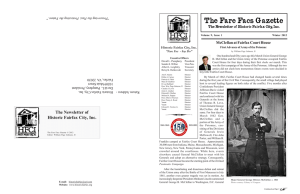
McClellan at Fairfax Court House
... river was to be cleared of all obstructions and enemy batteries; and, 3) that he move on or before March 18th. Fate then quickly intervened in McClellan’s plans. While General McClellan was meeting with the President and his generals, Thaddeus S.C. Lowe, Chief Aeronaut of the recently formed United ...
... river was to be cleared of all obstructions and enemy batteries; and, 3) that he move on or before March 18th. Fate then quickly intervened in McClellan’s plans. While General McClellan was meeting with the President and his generals, Thaddeus S.C. Lowe, Chief Aeronaut of the recently formed United ...

Bolivar Heights-School House Ridge Skirmish Site
... the Confederate batteries at Maryland Heights. Loudoun Heights, and School House Ridge raining fire on the Federal defense on the morning of September l j t hthe outlook was grim. General Jackson described the scene. "At dawn. September 15 . . . Lawton's brigade . . .moved by flank to the bottom bet ...
... the Confederate batteries at Maryland Heights. Loudoun Heights, and School House Ridge raining fire on the Federal defense on the morning of September l j t hthe outlook was grim. General Jackson described the scene. "At dawn. September 15 . . . Lawton's brigade . . .moved by flank to the bottom bet ...

Vermont in the Civil War
... vermont became the united states of america’s fourteenth state in 1791, 14 years after the windsor convention, and in subsequent years its reputation as an upholder of human freedom was enhanced. The state’s strong opposition to the national ...
... vermont became the united states of america’s fourteenth state in 1791, 14 years after the windsor convention, and in subsequent years its reputation as an upholder of human freedom was enhanced. The state’s strong opposition to the national ...
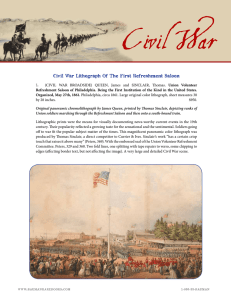
1 Civil War Lithograph Of The First Refreshment Saloon
... association copy inscribed by him in Volume I to a fellow Civil War historian, then serving as an officer in the U.S. Army: “Autographed for Capt. William G. Gavin, U.S. Engineers, with the best wishes of Douglas Southall Freeman,” also with his laid-in typed letter to Gavin, typewritten on Richmond ...
... association copy inscribed by him in Volume I to a fellow Civil War historian, then serving as an officer in the U.S. Army: “Autographed for Capt. William G. Gavin, U.S. Engineers, with the best wishes of Douglas Southall Freeman,” also with his laid-in typed letter to Gavin, typewritten on Richmond ...
Little Rock, AR 72221 • Email: g.hendershott
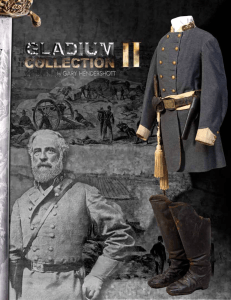
... Confederate General Walter Husted Stevens, General Robert E. Lee’s Staff Chief Engineer of the Confederacy, Army of Northern Virginia The Last Confederate Commander to leave Richmond as it was burning At General Robert E. Lee’s side during the surrender at Appomattox A very rare Confederate General’ ...
... Confederate General Walter Husted Stevens, General Robert E. Lee’s Staff Chief Engineer of the Confederacy, Army of Northern Virginia The Last Confederate Commander to leave Richmond as it was burning At General Robert E. Lee’s side during the surrender at Appomattox A very rare Confederate General’ ...
Stories Behind the Civil War 150 HistoryMobile
... Image courtesy Still Picture Branch of the National Archives and Records Administration Richmond, Virginia became the capital of the Confederacy on May 29, 1861, when Confederate President Jefferson Davis arrived in the city. The water power of the James River, the slave trade, and the city’s market ...
... Image courtesy Still Picture Branch of the National Archives and Records Administration Richmond, Virginia became the capital of the Confederacy on May 29, 1861, when Confederate President Jefferson Davis arrived in the city. The water power of the James River, the slave trade, and the city’s market ...
2016-17 civil war research paper and presentation
... b. Why could the summer and fall of 1863 be described as a “Season of Uncertainty?” c. Discuss the importance of the Battle of Chattanooga. d. Discuss the position of the North and the South leading ...
... b. Why could the summer and fall of 1863 be described as a “Season of Uncertainty?” c. Discuss the importance of the Battle of Chattanooga. d. Discuss the position of the North and the South leading ...
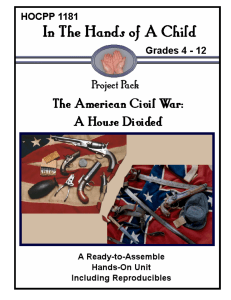
Civil War Lapbook - Monroe County Schools
... laid out in a chapter-like format. This format helps to build students’ listening, reading, and comprehension skills. Included in the Research Guide is a Bibliography, which also makes a great resource for finding information for any rabbit trails you may choose to follow during your study. Related ...
... laid out in a chapter-like format. This format helps to build students’ listening, reading, and comprehension skills. Included in the Research Guide is a Bibliography, which also makes a great resource for finding information for any rabbit trails you may choose to follow during your study. Related ...
SNAKES LURKING IN THE GRASS - The Gilder Lehrman Institute of
... that of the Confederate Army. The Union Army was visibly struggling toward victory with each passing battle and it seemed as if the war was far from concluding. Lincoln’s problems were not just limited to the battlefield, but the president was also burdened in dealing with intense opposition toward ...
... that of the Confederate Army. The Union Army was visibly struggling toward victory with each passing battle and it seemed as if the war was far from concluding. Lincoln’s problems were not just limited to the battlefield, but the president was also burdened in dealing with intense opposition toward ...
Lee, Honor, and the Confederacy
... localistic tendencies to protect family, property, community, and state before national interests affected the outcome of the Civil War. The argument relies on the wartime letters, telegrams, reports, and diaries of Robert E. Lee, who was in frequent contact with politicians in Richmond, the Confede ...
... localistic tendencies to protect family, property, community, and state before national interests affected the outcome of the Civil War. The argument relies on the wartime letters, telegrams, reports, and diaries of Robert E. Lee, who was in frequent contact with politicians in Richmond, the Confede ...
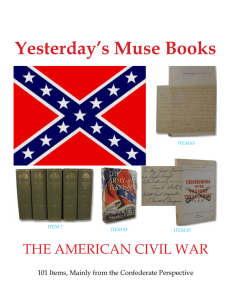
American Civil War - Yesterday`s Muse Books
... at Devil’s Den and Litle Round Top, through the Wheatfield and the Peach Orchard, and against the Union center at Cemetery Ridge. He also details the Union defense that eventually succeeded in beating back these assaults, depriving Lee’s gallant army of victory. Pfanz analyzes decisions and events t ...
... at Devil’s Den and Litle Round Top, through the Wheatfield and the Peach Orchard, and against the Union center at Cemetery Ridge. He also details the Union defense that eventually succeeded in beating back these assaults, depriving Lee’s gallant army of victory. Pfanz analyzes decisions and events t ...
Civil War 150 HistoryMobile Teachers` Guide
... While his father was also in the U.S. Army, his brother-in-law, James Ewell Brown Stuart, left the U.S. Army to join the Confederacy. With your family divided, would you: ...
... While his father was also in the U.S. Army, his brother-in-law, James Ewell Brown Stuart, left the U.S. Army to join the Confederacy. With your family divided, would you: ...
"... Willing Never to Go in Another Fight": The Civil War
... Rufus King wrote, "We had a dreadful march of it over the worst road I ever saw .. ." The men found some relief watching each other slide and fall in the mud. But the pace was grueling and many fell out of the ranks from exhaustion. Rufus King and his comrades "were greatly disappointed on our arriv ...
... Rufus King wrote, "We had a dreadful march of it over the worst road I ever saw .. ." The men found some relief watching each other slide and fall in the mud. But the pace was grueling and many fell out of the ranks from exhaustion. Rufus King and his comrades "were greatly disappointed on our arriv ...
Teacher`s Guide - Missouri State Parks
... This is another chronological guide to Civil War battles all over the United States including Missouri. (Some guides do not include many of Missouri's Civil War battles.) Many entries include maps and all entries give concise summaries of the battle, who the commanders and forces were and exact loca ...
... This is another chronological guide to Civil War battles all over the United States including Missouri. (Some guides do not include many of Missouri's Civil War battles.) Many entries include maps and all entries give concise summaries of the battle, who the commanders and forces were and exact loca ...
Battle of Antietam

The Battle of Antietam /ænˈtiːtəm/, also known as the Battle of Sharpsburg, particularly in the South, fought on September 17, 1862, near Sharpsburg, Maryland, and Antietam Creek as part of the Maryland Campaign, was the first major battle in the American Civil War to take place on Union soil. It is the bloodiest single-day battle in American history, with a combined tally of dead, wounded, and missing at 22,717.After pursuing Confederate General Robert E. Lee into Maryland, Union Army Maj. Gen. George B. McClellan launched attacks against Lee's army, in defensive positions behind Antietam Creek. At dawn on September 17, Maj. Gen. Joseph Hooker's corps mounted a powerful assault on Lee's left flank. Attacks and counterattacks swept across Miller's Cornfield and fighting swirled around the Dunker Church. Union assaults against the Sunken Road eventually pierced the Confederate center, but the Federal advantage was not followed up. In the afternoon, Union Maj. Gen. Ambrose Burnside's corps entered the action, capturing a stone bridge over Antietam Creek and advancing against the Confederate right. At a crucial moment, Confederate Maj. Gen. A. P. Hill's division arrived from Harpers Ferry and launched a surprise counterattack, driving back Burnside and ending the battle. Although outnumbered two-to-one, Lee committed his entire force, while McClellan sent in less than three-quarters of his army, enabling Lee to fight the Federals to a standstill. During the night, both armies consolidated their lines. In spite of crippling casualties, Lee continued to skirmish with McClellan throughout September 18, while removing his battered army south of the Potomac River.Despite having superiority of numbers, McClellan's attacks failed to achieve force concentration, allowing Lee to counter by shifting forces and moving interior lines to meet each challenge. Despite ample reserve forces that could have been deployed to exploit localized successes, McClellan failed to destroy Lee's army. McClellan had halted Lee's invasion of Maryland, but Lee was able to withdraw his army back to Virginia without interference from the cautious McClellan. Although the battle was tactically inconclusive, the Confederate troops had withdrawn first from the battlefield, making it, in military terms, a Union victory. It had significance as enough of a victory to give President Abraham Lincoln the confidence to announce his Emancipation Proclamation, which discouraged the British and French governments from potential plans for recognition of the Confederacy.