
What makes climate change?
... events such as storms, floods, droughts, tornadoes, heat waves Increase in diseases transmitted by mosquitoes, ticks or rodents because of changes in precipitation and temperature Fresh water sources threatened with rapidly shrinking glaciers and drought ...
... events such as storms, floods, droughts, tornadoes, heat waves Increase in diseases transmitted by mosquitoes, ticks or rodents because of changes in precipitation and temperature Fresh water sources threatened with rapidly shrinking glaciers and drought ...
Building on the Results of the Paris Conference on Climate Change
... fuels like coal and oil has increased the concentration of atmospheric carbon dioxide (CO2). This happens because the coal or oil burning process combines carbon with oxygen in the air to make CO2. To a lesser extent, the clearing of land for agriculture, industry, and other human activities have ...
... fuels like coal and oil has increased the concentration of atmospheric carbon dioxide (CO2). This happens because the coal or oil burning process combines carbon with oxygen in the air to make CO2. To a lesser extent, the clearing of land for agriculture, industry, and other human activities have ...

... The aim of this paper is to contribute to the knowledge of the concept of scale for an integrated geogra- phical understanding of socio-environmental problems in Mexico. This objective is accomplished by comparing the same scalar dimensions of two different problems: the first one is adaptation to c ...

Procon.org Climate change overview - LaPazColegio2010-2011
... (NO2), into the atmosphere. As of Apr. 2010, CO2 levels were 389 parts per million (ppm) - reportedly higher than at any time in the last 650,000 years when levels fluctuated between 180 and 300 ppm. [3] This rise took place alongside a 20th century global temperature increase of between 1°F (3.6 KB ...
... (NO2), into the atmosphere. As of Apr. 2010, CO2 levels were 389 parts per million (ppm) - reportedly higher than at any time in the last 650,000 years when levels fluctuated between 180 and 300 ppm. [3] This rise took place alongside a 20th century global temperature increase of between 1°F (3.6 KB ...

Climate Change Science Update
... • It is extremely likely that human influence has been the dominant cause of the observed warming since the mid-20th century. • The human influence on climate is already clear. • Climate will continue to change long into the future. • Limiting future climate change will require substantial and s ...
... • It is extremely likely that human influence has been the dominant cause of the observed warming since the mid-20th century. • The human influence on climate is already clear. • Climate will continue to change long into the future. • Limiting future climate change will require substantial and s ...

Word Document - North Country 350 Alliance
... table to reach a settlement with the twenty-one youths who filed a constitutional climate change lawsuit against the federal government in the U.S. District Court for the District of Oregon in 2015, claiming their constitutional rights to life, liberty, and property have been violated by a governmen ...
... table to reach a settlement with the twenty-one youths who filed a constitutional climate change lawsuit against the federal government in the U.S. District Court for the District of Oregon in 2015, claiming their constitutional rights to life, liberty, and property have been violated by a governmen ...

Waste project 1 - GuideStar India
... climate change. Manipur is facing the hard consequence of natural disasters and climate change. The seasonal monsoons cause enormous pressure on the environment leading to unexpected natural disaster like flood. Such events have caused severe damage to community life, floods and landslides have spoi ...
... climate change. Manipur is facing the hard consequence of natural disasters and climate change. The seasonal monsoons cause enormous pressure on the environment leading to unexpected natural disaster like flood. Such events have caused severe damage to community life, floods and landslides have spoi ...

UNEP Background Guide - Universidad la Salle Cancún
... UNEP has global responsibility for environmental issues among United Nations agencies but talks on addressing global warming. UNEP activities cover an extensive range of issues regarding the marine and terrestrial ecosystems, atmosphere, environmental governance and green economy. It has played a no ...
... UNEP has global responsibility for environmental issues among United Nations agencies but talks on addressing global warming. UNEP activities cover an extensive range of issues regarding the marine and terrestrial ecosystems, atmosphere, environmental governance and green economy. It has played a no ...

The French Water agencies take action against climate change
... Climate change affects water resources throughout the country, e.g. drops in the natural discharge of rivers, notably during low-flow periods, rises in air and water temperatures, lower water quality harming aquatic species, risks of saltwater wedges rising along coasts and of flooding, etc. In resp ...
... Climate change affects water resources throughout the country, e.g. drops in the natural discharge of rivers, notably during low-flow periods, rises in air and water temperatures, lower water quality harming aquatic species, risks of saltwater wedges rising along coasts and of flooding, etc. In resp ...

Main Natural Factors that Affect Climate
... Land Use Change • There are over 6 billion people on Earth. Humans continue replacing forests and natural vegetation with agricultural lands. More and more people move into cities, therefore more houses are built. All this has an impact on climate. • For example, it affects the evaporation of water ...
... Land Use Change • There are over 6 billion people on Earth. Humans continue replacing forests and natural vegetation with agricultural lands. More and more people move into cities, therefore more houses are built. All this has an impact on climate. • For example, it affects the evaporation of water ...


Document
... 1. caused by an increase in the volume of water stored in the oceans. What causes this increase in volume? Increase amount, decrease density 2. increase in the amount: Melting of ice that is on land 3. decrease in the density: thermal expansion 4. estimates of local ...
... 1. caused by an increase in the volume of water stored in the oceans. What causes this increase in volume? Increase amount, decrease density 2. increase in the amount: Melting of ice that is on land 3. decrease in the density: thermal expansion 4. estimates of local ...

(new)GLOBAL WARMING
... parts of North and South America, northern Europe and northern and central Asia. • The frequency of heavy precipitation events has increased over most land areas - consistent with warming and increases of atmospheric water vapor • Drying in the Sahel, the Mediterranean, southern Africa and parts of ...
... parts of North and South America, northern Europe and northern and central Asia. • The frequency of heavy precipitation events has increased over most land areas - consistent with warming and increases of atmospheric water vapor • Drying in the Sahel, the Mediterranean, southern Africa and parts of ...

Climate Change - Weather Underground
... Oxygen isotopes (cold the air, the more isotopes) Bubbles in the ice contain trapped composition of the past atmospheres Dendrochronology Examining tree rings to see growth patterns ...
... Oxygen isotopes (cold the air, the more isotopes) Bubbles in the ice contain trapped composition of the past atmospheres Dendrochronology Examining tree rings to see growth patterns ...

COOL HEADS NEEDED ON GLOBAL WARMING
... were larger and more rapid than those experienced during more recent historical times.”11 It is also a fact that the largest and most important concentration of greenhouse gas in our atmosphere is naturally occurring water vapour. Man’s industrial growth has certainly changed the way we live, but ha ...
... were larger and more rapid than those experienced during more recent historical times.”11 It is also a fact that the largest and most important concentration of greenhouse gas in our atmosphere is naturally occurring water vapour. Man’s industrial growth has certainly changed the way we live, but ha ...

DELIBERATELY CREATING AN ALIEN PLANET John Cairns, Jr
... http://dotearth.blogs.nytimes.com/2012/11/09/science-panel-warns-spy-agencies-arein-the-dark-on-risks-from-warming/. 3 Oreskes, N. and E. Conway. 2010. Merchants of Doubt. Bloomsbury Press, New York. 4 Nuwer, R. 2012. A new tweak for global warming predictions. New York Times 8Nov http://green.blogs ...
... http://dotearth.blogs.nytimes.com/2012/11/09/science-panel-warns-spy-agencies-arein-the-dark-on-risks-from-warming/. 3 Oreskes, N. and E. Conway. 2010. Merchants of Doubt. Bloomsbury Press, New York. 4 Nuwer, R. 2012. A new tweak for global warming predictions. New York Times 8Nov http://green.blogs ...
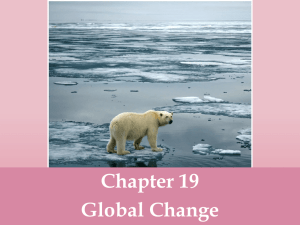
Ch 19 Climate Change powerpoint
... animals have the potential to be harmed if they can’t move to better climates. Humans may have to relocate, some diseases like those carried by mosquitoes could increase and there could be economic consequences. ...
... animals have the potential to be harmed if they can’t move to better climates. Humans may have to relocate, some diseases like those carried by mosquitoes could increase and there could be economic consequences. ...


ASD Chapter 12 updated 2014_small_part1
... Source: Hansen, James, and Makiko Sato. 2012. “Paleoclimate Implications for Human-Made Climate Change.” In Climate Change: Inferences from Paleoclimate and Regional Aspects, ed. André Berger, Fedor Mesinger, and Djordjie Šijački, 21–48. Heidelberg: Springer. ...
... Source: Hansen, James, and Makiko Sato. 2012. “Paleoclimate Implications for Human-Made Climate Change.” In Climate Change: Inferences from Paleoclimate and Regional Aspects, ed. André Berger, Fedor Mesinger, and Djordjie Šijački, 21–48. Heidelberg: Springer. ...
Science of Climate Change
... • wetter winters and drier summers with longer, hotter and more frequent heat waves • weather could require farmers to raise different crops • dairy cattle beleaguered by heat exhaustion and growing pest populations • poorer air quality • warmer and more shallow river waters – could hurt populations ...
... • wetter winters and drier summers with longer, hotter and more frequent heat waves • weather could require farmers to raise different crops • dairy cattle beleaguered by heat exhaustion and growing pest populations • poorer air quality • warmer and more shallow river waters – could hurt populations ...

Climate Change Misconceptions
... The atmosphere is so vast that humans cannot affect it. Human activities are rapidly increasing the atmospheric concentration of GHGs as well as adding new heat-trapping gases that are not found in nature. Humans do affect the atmosphere and the ...
... The atmosphere is so vast that humans cannot affect it. Human activities are rapidly increasing the atmospheric concentration of GHGs as well as adding new heat-trapping gases that are not found in nature. Humans do affect the atmosphere and the ...

Abstracts of Global Warming and Climate Change
... living being in one way or other. Sea water in pacific is getting warmer and thus become lethal for many sea birds. Like Sooty Shearwater to survive. The circulatory system is affected in its functioning by the worming of sea water. The migration of birds and animals is but a natural phenomenon to r ...
... living being in one way or other. Sea water in pacific is getting warmer and thus become lethal for many sea birds. Like Sooty Shearwater to survive. The circulatory system is affected in its functioning by the worming of sea water. The migration of birds and animals is but a natural phenomenon to r ...


Heavy Rainfall and Increased Flooding Risk: Global Warming`s
... climate disaster in the United States, together costing the country more than $115 billion from 1960-2005 in direct damages.6 The Midwest is hit disproportionally more, suffering about a quarter of these losses.7 In the Central United States, severe weather and flooding can be especially devastating ...
... climate disaster in the United States, together costing the country more than $115 billion from 1960-2005 in direct damages.6 The Midwest is hit disproportionally more, suffering about a quarter of these losses.7 In the Central United States, severe weather and flooding can be especially devastating ...
Effects of global warming on humans

Climate change has brought about possibly permanent alterations to our planet’s geological, biological and ecological systems. The Intergovernmental Panel on Climate Change (IPCC) contended in 2003 that “there is new and stronger evidence that most of the warming observed over the last 50 years is attributable to human activities”. These changes have led to the emergence of large-scale environmental hazards to human health, such as extreme weather, ozone depletion, increased danger of wildland fires, loss of biodiversity, stresses to food-producing systems and the global spread of infectious diseases. The World Health Organization (WHO) estimates that 160,000 deaths, since 1950, are directly attributable to climate change. Many believe this to be a conservative estimate.To date, a neglected aspect of the climate change debate, much less research has been conducted on the impacts of climate change on health, food supply, economic growth, migration, security, societal change, and public goods, such as drinking water, than on the geophysical changes related to global warming. Human impacts can be both negative and positive. Climatic changes in Siberia, for instance, are expected to improve food production and local economic activity, at least in the short to medium term. Numerous studies suggest, however, that the current and future impacts of climate change on human society are and will continue to be overwhelmingly negative.The majority of the adverse effects of climate change are experienced by poor and low-income communities around the world, who have much higher levels of vulnerability to environmental determinants of health, wealth and other factors, and much lower levels of capacity available for coping with environmental change. A report on the global human impact of climate change published by the Global Humanitarian Forum in 2009, estimated more than 300,000 deaths and about $125 billion in economic losses each year, and indicating that most climate change induced mortality is due to worsening floods and droughts in developing countries. This also raises questions of climate justice, since the 50 least developed countries of the world account for not more than 1% of worldwide emissions of greenhouse gases.