


Presentation on Climate Change to Members of Parliament
... Extreme events: up to US $5,488 M Sea level rise/acidification: up to US $7,956M Total: up to US $366 M per year ...
... Extreme events: up to US $5,488 M Sea level rise/acidification: up to US $7,956M Total: up to US $366 M per year ...

AOSS_NRE_480_L10_Feedbacks_20100216
... • That balance relies on water to exist in all three phases. – Too warm could run away to “greenhouse” – Too cold run away to “snowball” ice ...
... • That balance relies on water to exist in all three phases. – Too warm could run away to “greenhouse” – Too cold run away to “snowball” ice ...

Monitoring and Prediction of Western Water
... – Explore a hydrological model that can be applied to small water systems to understand impact and adaptation possibilities ...
... – Explore a hydrological model that can be applied to small water systems to understand impact and adaptation possibilities ...

What´s happening to the climate?- Ten questions and answers on
... If the average temperature of the Earth rises by 2-4 degrees by the end of this century, which the UN’s IPCC considers likely, sea levels may rise by half a metre. If global warming leads to large areas of land ice in Greenland and Antarctica starting to melt, sea levels may rise much further still. ...
... If the average temperature of the Earth rises by 2-4 degrees by the end of this century, which the UN’s IPCC considers likely, sea levels may rise by half a metre. If global warming leads to large areas of land ice in Greenland and Antarctica starting to melt, sea levels may rise much further still. ...

Document
... that some weather events and extremes will become more frequent, more widespread and/or more intense during the 21st Century In part we are building greater vulnerability while at the same time not always increasing resilience ...
... that some weather events and extremes will become more frequent, more widespread and/or more intense during the 21st Century In part we are building greater vulnerability while at the same time not always increasing resilience ...

Lesson 16.4 Responding to Climate Change
... Future Effects of Climate Change • Diseases: Warmer temperatures can promote spread of diseases transmitted from animals to people. • Sea level: Low-lying populated coastal areas may flood as sea levels rise. • Water supply: Saltwater contamination of aquifers resulting from rising sea levels and a ...
... Future Effects of Climate Change • Diseases: Warmer temperatures can promote spread of diseases transmitted from animals to people. • Sea level: Low-lying populated coastal areas may flood as sea levels rise. • Water supply: Saltwater contamination of aquifers resulting from rising sea levels and a ...

for immediate release
... 3. Domestic policies to exploit mitigation Argentina, Bolivia, Chile and Brazil. opportunities to make Latin America part of the global climate change solution. Many of the actions needed for mitigation are also good development policies. For example, increasing energy efficiency often can save mone ...
... 3. Domestic policies to exploit mitigation Argentina, Bolivia, Chile and Brazil. opportunities to make Latin America part of the global climate change solution. Many of the actions needed for mitigation are also good development policies. For example, increasing energy efficiency often can save mone ...
Lesson 16.4 Responding to Climate Change
... Future Effects of Climate Change • Diseases: Warmer temperatures can promote spread of diseases transmitted from animals to people. • Sea level: Low-lying populated coastal areas may flood as sea levels rise. • Water supply: Saltwater contamination of aquifers resulting from rising sea levels and a ...
... Future Effects of Climate Change • Diseases: Warmer temperatures can promote spread of diseases transmitted from animals to people. • Sea level: Low-lying populated coastal areas may flood as sea levels rise. • Water supply: Saltwater contamination of aquifers resulting from rising sea levels and a ...

NRDC: Phoenix, Arizona-Identifying and Becoming More Resilient
... carbon emission trends because of climate change, ranging from water shortages to more intense storms and floods to sea level rise. To help cities become more resilient to the rising threats of climate change, NRDC reviewed more than 75 scientific studies and other reports to summarize the water-rel ...
... carbon emission trends because of climate change, ranging from water shortages to more intense storms and floods to sea level rise. To help cities become more resilient to the rising threats of climate change, NRDC reviewed more than 75 scientific studies and other reports to summarize the water-rel ...

File envsci11_c16_pr1
... Future Effects of Climate Change • Diseases: Warmer temperatures can promote spread of diseases transmitted from animals to people. • Sea level: Low-lying populated coastal areas may flood as sea levels rise. • Water supply: Saltwater contamination of aquifers resulting from rising sea levels and a ...
... Future Effects of Climate Change • Diseases: Warmer temperatures can promote spread of diseases transmitted from animals to people. • Sea level: Low-lying populated coastal areas may flood as sea levels rise. • Water supply: Saltwater contamination of aquifers resulting from rising sea levels and a ...

Intended National Determined Contribution (INDC)
... regulatory structure with strategic long-term plans that promote, among other measures, a larger participation of non-conventional renewable sources, hydroelectricity, nuclear power, and the replacement of fossil fuels by biofuels. Moreover, a set of programs and actions intended to reduce energy c ...
... regulatory structure with strategic long-term plans that promote, among other measures, a larger participation of non-conventional renewable sources, hydroelectricity, nuclear power, and the replacement of fossil fuels by biofuels. Moreover, a set of programs and actions intended to reduce energy c ...

Global Climate Change
... Future Effects of Climate Change • Diseases: Warmer temperatures can promote spread of diseases transmitted from animals to people. • Sea level: Low-lying populated coastal areas may flood as sea levels rise. • Water supply: Saltwater contamination of aquifers resulting from rising sea levels and a ...
... Future Effects of Climate Change • Diseases: Warmer temperatures can promote spread of diseases transmitted from animals to people. • Sea level: Low-lying populated coastal areas may flood as sea levels rise. • Water supply: Saltwater contamination of aquifers resulting from rising sea levels and a ...

University of Edinburgh
... in which interdisciplinary ideas, knowledge and innovation are nurtured. Our vision is to build a vibrant global community of talented people at the forefront of tackling climate-related challenges. This community of people includes well-informed policy makers, business and community leaders; world- ...
... in which interdisciplinary ideas, knowledge and innovation are nurtured. Our vision is to build a vibrant global community of talented people at the forefront of tackling climate-related challenges. This community of people includes well-informed policy makers, business and community leaders; world- ...


WHY ? Do we need better emission estimations and projections?
... (And to forward it to the commission within 3 months of its adoption or update) ...
... (And to forward it to the commission within 3 months of its adoption or update) ...

Manish Climatic change Montereal Protocol
... The question of HOW MUCH will temperatures increase is based on model assumptions and estimated CO2 levels. ...
... The question of HOW MUCH will temperatures increase is based on model assumptions and estimated CO2 levels. ...
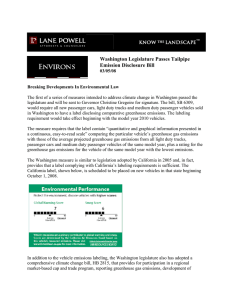
Washington Legislature Passes Tailpipe Emission Disclosure Bill
... comprehensive climate change bill, HB 2815, that provides for participation in a regional market-based cap and trade program, reporting greenhouse gas emissions, development of ...
... comprehensive climate change bill, HB 2815, that provides for participation in a regional market-based cap and trade program, reporting greenhouse gas emissions, development of ...

Climate change and energy
... Recent surge in CO2 levels Global temperatures have already risen 0.6°C and will probably rise a further 3°, or even up to 4.5-5° by 2100 A rise of more than 2° could be irreversable, requiring action within 10 years at most ...
... Recent surge in CO2 levels Global temperatures have already risen 0.6°C and will probably rise a further 3°, or even up to 4.5-5° by 2100 A rise of more than 2° could be irreversable, requiring action within 10 years at most ...

Resource Challenge - Global Climate Change
... • Evidence from Pleistocene glaciations indicates that most species responded ...
... • Evidence from Pleistocene glaciations indicates that most species responded ...

CLIMATE CHANGE: EXAM REVIEW Short/Long Written Answers
... between water temperature, salinity, and density. greenhouse effect and climate change. a. How does salinity affect the density of water? b. How does temperature affect the density of water? c. How do the salinity and temperature of water lead 28. Is it possible that climate change could occur in on ...
... between water temperature, salinity, and density. greenhouse effect and climate change. a. How does salinity affect the density of water? b. How does temperature affect the density of water? c. How do the salinity and temperature of water lead 28. Is it possible that climate change could occur in on ...


SNC2DClimateChangeExamReview
... between water temperature, salinity, and density. greenhouse effect and climate change. a. How does salinity affect the density of water? b. How does temperature affect the density of water? c. How do the salinity and temperature of water lead 28. Is it possible that climate change could occur in on ...
... between water temperature, salinity, and density. greenhouse effect and climate change. a. How does salinity affect the density of water? b. How does temperature affect the density of water? c. How do the salinity and temperature of water lead 28. Is it possible that climate change could occur in on ...

Source: Climate Change in the Pacific
... associated with environmental determinants, and transmission dynamics tend to favour warmer, wetter environments. Historically experienced relatively few malaria outbreaks and the population has limited immunity to the disease and less awareness of its prevention than lowland populations. ...
... associated with environmental determinants, and transmission dynamics tend to favour warmer, wetter environments. Historically experienced relatively few malaria outbreaks and the population has limited immunity to the disease and less awareness of its prevention than lowland populations. ...
Effects of global warming on humans

Climate change has brought about possibly permanent alterations to our planet’s geological, biological and ecological systems. The Intergovernmental Panel on Climate Change (IPCC) contended in 2003 that “there is new and stronger evidence that most of the warming observed over the last 50 years is attributable to human activities”. These changes have led to the emergence of large-scale environmental hazards to human health, such as extreme weather, ozone depletion, increased danger of wildland fires, loss of biodiversity, stresses to food-producing systems and the global spread of infectious diseases. The World Health Organization (WHO) estimates that 160,000 deaths, since 1950, are directly attributable to climate change. Many believe this to be a conservative estimate.To date, a neglected aspect of the climate change debate, much less research has been conducted on the impacts of climate change on health, food supply, economic growth, migration, security, societal change, and public goods, such as drinking water, than on the geophysical changes related to global warming. Human impacts can be both negative and positive. Climatic changes in Siberia, for instance, are expected to improve food production and local economic activity, at least in the short to medium term. Numerous studies suggest, however, that the current and future impacts of climate change on human society are and will continue to be overwhelmingly negative.The majority of the adverse effects of climate change are experienced by poor and low-income communities around the world, who have much higher levels of vulnerability to environmental determinants of health, wealth and other factors, and much lower levels of capacity available for coping with environmental change. A report on the global human impact of climate change published by the Global Humanitarian Forum in 2009, estimated more than 300,000 deaths and about $125 billion in economic losses each year, and indicating that most climate change induced mortality is due to worsening floods and droughts in developing countries. This also raises questions of climate justice, since the 50 least developed countries of the world account for not more than 1% of worldwide emissions of greenhouse gases.