
Risks and threats on water availability in WB (Anita Pirc Velkavrh
... global community as a whole is increasingly jeopardised because of unpremeditated environmental, non-military, threats. Environmental security is seen as protection capability of societal systems (communities) to withstand threats of (1) environmental asset scarcity, (2) environmental risks or adver ...
... global community as a whole is increasingly jeopardised because of unpremeditated environmental, non-military, threats. Environmental security is seen as protection capability of societal systems (communities) to withstand threats of (1) environmental asset scarcity, (2) environmental risks or adver ...

CRS Report for Congress Global Climate Change: Received through the CRS Web
... In June 1997, the Administration announced a $1 billion 5-year Developing Country Climate Change Initiative that would seek to reduce greenhouse gas emissions and help countries meet the goals of the climate change treaty. It consists of three elements. First, it would provide a minimum of $750 mill ...
... In June 1997, the Administration announced a $1 billion 5-year Developing Country Climate Change Initiative that would seek to reduce greenhouse gas emissions and help countries meet the goals of the climate change treaty. It consists of three elements. First, it would provide a minimum of $750 mill ...

Climate Change Country Risk Assessment
... Building code and its enforcement: Bhutan does not have standard codes for buildings such that it is built to withstand impacts of natural disasters, such as earthquakes. Instead, Bhutan draws upon the codal provisions of Indian Standards. The Government of Bhutan made the relevant seismic codes man ...
... Building code and its enforcement: Bhutan does not have standard codes for buildings such that it is built to withstand impacts of natural disasters, such as earthquakes. Instead, Bhutan draws upon the codal provisions of Indian Standards. The Government of Bhutan made the relevant seismic codes man ...

Climate Change in Antarctica
... from the oceans onto the Peninsula. Those warm winds have led to a marked decrease in sea ice cover and increased precipitation there, and approximately 90% of the Peninsula’s glaciers have retreated over recent years. The loss of sea ice along the Peninsula balances the growth in the Ross Sea, the ...
... from the oceans onto the Peninsula. Those warm winds have led to a marked decrease in sea ice cover and increased precipitation there, and approximately 90% of the Peninsula’s glaciers have retreated over recent years. The loss of sea ice along the Peninsula balances the growth in the Ross Sea, the ...

Climate Change in Antarctica - Understanding the Facts
... from the oceans onto the Peninsula. Those warm winds have led to a marked decrease in sea ice cover and increased precipitation there, and approximately 90% of the Peninsula’s glaciers have retreated over recent years. The loss of sea ice along the Peninsula balances the growth in the Ross Sea, the ...
... from the oceans onto the Peninsula. Those warm winds have led to a marked decrease in sea ice cover and increased precipitation there, and approximately 90% of the Peninsula’s glaciers have retreated over recent years. The loss of sea ice along the Peninsula balances the growth in the Ross Sea, the ...

Climate change impacts on fisheries trade, and implications
... • The indicators of adaptive capacity for both Kenya and the Solomon Islands provide considerable cause for alarm . Maldives, despite its greater dependency on fisheries, may not necessarily be more vulnerable given its greater ability for adaptation ...
... • The indicators of adaptive capacity for both Kenya and the Solomon Islands provide considerable cause for alarm . Maldives, despite its greater dependency on fisheries, may not necessarily be more vulnerable given its greater ability for adaptation ...

Climate Change
... of use of the Thames Barrier in London provides one insight into the effects of some of the changes that have occurred over the last 25 years. From an initial use of once every two years in the 1980s the barrier is now used on average six times per year and its use has peaked at ten times per year i ...
... of use of the Thames Barrier in London provides one insight into the effects of some of the changes that have occurred over the last 25 years. From an initial use of once every two years in the 1980s the barrier is now used on average six times per year and its use has peaked at ten times per year i ...

Predicting and understanding ecosystem responses to climate
... seaboard. Dust emitted from drought-stricken areas can century. Historical temperature records show this change have substantial impacts on downwind ecosystems; for most clearly in daily minima, with the steepest increase instance, dust that falls on alpine snow as a result of beginning in the early ...
... seaboard. Dust emitted from drought-stricken areas can century. Historical temperature records show this change have substantial impacts on downwind ecosystems; for most clearly in daily minima, with the steepest increase instance, dust that falls on alpine snow as a result of beginning in the early ...

Climate
... seaboard. Dust emitted from drought-stricken areas can century. Historical temperature records show this change have substantial impacts on downwind ecosystems; for most clearly in daily minima, with the steepest increase instance, dust that falls on alpine snow as a result of beginning in the early ...
... seaboard. Dust emitted from drought-stricken areas can century. Historical temperature records show this change have substantial impacts on downwind ecosystems; for most clearly in daily minima, with the steepest increase instance, dust that falls on alpine snow as a result of beginning in the early ...

ITU-T’s activities on Environmental Sustainability
... ITU-T SG5/WP3’s work areas: Q 17/5 - Energy efficiency for ICT equipment and Climate Change standards harmonization Q 18/5 - Methodology of environmental impact assessment of ICT Q 19/5 - Power feeding systems Q 21/5 - Environmental protection and recycling of ICT equipment/facilities Q 22 ...
... ITU-T SG5/WP3’s work areas: Q 17/5 - Energy efficiency for ICT equipment and Climate Change standards harmonization Q 18/5 - Methodology of environmental impact assessment of ICT Q 19/5 - Power feeding systems Q 21/5 - Environmental protection and recycling of ICT equipment/facilities Q 22 ...

quantification of physical impacts on the nsw coastal zone due to
... It is recognised that future climate change has a significant potential to impact coastal communities and ecosystems. In addition to sea level rise, variations in the local wave climate, resulting from climate change, are likely to modify long-shore and cross-shore sediment transport patterns. This ...
... It is recognised that future climate change has a significant potential to impact coastal communities and ecosystems. In addition to sea level rise, variations in the local wave climate, resulting from climate change, are likely to modify long-shore and cross-shore sediment transport patterns. This ...

Even if warming is inevitable, action can be taken to prevent its worst
... parts per million of atmospheric carbon dioxide, the principal gas associated with global warming. (Levels are 390 ppm now, and rising at about 2 ppm each year.) ...
... parts per million of atmospheric carbon dioxide, the principal gas associated with global warming. (Levels are 390 ppm now, and rising at about 2 ppm each year.) ...

OTBA material for class VIII - Kendriya Vidyalaya Anantapuram
... our lives. As the temperature rises more farmland will be open towards the poles and the length of the growing season will also lengthen. Increasing amounts of greenhouse gases in the atmosphere and global warming could also lead to more health concerns. As temperature increase towards the poles, si ...
... our lives. As the temperature rises more farmland will be open towards the poles and the length of the growing season will also lengthen. Increasing amounts of greenhouse gases in the atmosphere and global warming could also lead to more health concerns. As temperature increase towards the poles, si ...

... retention being chalked out till 2020, the total spill-over beyond the current Plan will be in the range of Rs. 54,000 crore. Under consideration for sometime now in the wake of an anticipated demand for secondary education as a result of SSA, the RMSA was conceived on the premise that eight years o ...

Counter-Argument
... closer to the Equator, such as the tropics, ARID AND SEMI ARID REGIONS –where most of the world´s poor people live- will lead to declines in yield. Declining crop yields are likely to leave hundreds of millions without the ability to produce or purchase sufficient food *Ocean acidification. Adverse ...
... closer to the Equator, such as the tropics, ARID AND SEMI ARID REGIONS –where most of the world´s poor people live- will lead to declines in yield. Declining crop yields are likely to leave hundreds of millions without the ability to produce or purchase sufficient food *Ocean acidification. Adverse ...


7 LAGOS STATE CLIMATE CHANGE SUMMIT COMMUNIQUE
... delineated above and had outcomes of recommendations for Future Agenda. OBSERVATIONS: From the papers that were delivered, the Summit made the following observations: i. ...
... delineated above and had outcomes of recommendations for Future Agenda. OBSERVATIONS: From the papers that were delivered, the Summit made the following observations: i. ...

effects of climate change: the global concern
... Background: Climate change which is the consequence of global warming is one of the major factors of hazards in Nepal and all over the world. Variable geo-climatic conditions, young geology, unplanned settlements, deforestation environmental degradation and increasing population are other causes of ...
... Background: Climate change which is the consequence of global warming is one of the major factors of hazards in Nepal and all over the world. Variable geo-climatic conditions, young geology, unplanned settlements, deforestation environmental degradation and increasing population are other causes of ...

Climate Change: Why Worry?
... b) What important effects are already evident? • Shifting ice and weather conditions are already altering the range and availability of animals such as polar bears, walrus, seals and caribou • Hunters can no longer rely on traditional knowledge to guide them • Thinning ice has become a hazard to hun ...
... b) What important effects are already evident? • Shifting ice and weather conditions are already altering the range and availability of animals such as polar bears, walrus, seals and caribou • Hunters can no longer rely on traditional knowledge to guide them • Thinning ice has become a hazard to hun ...
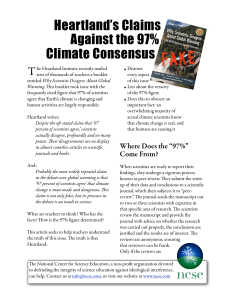
Heartland`s Claims Against the 97% Climate Consensus
... examined the abstracts of 928 papers published in scientific journals between 1993 -2003; the papers were selected because they contained the keywords “climate change.” ...
... examined the abstracts of 928 papers published in scientific journals between 1993 -2003; the papers were selected because they contained the keywords “climate change.” ...

Michael Dettinger - Scripps Institution of Oceanography
... Hanson, R.T., & Dettinger, M.D., 2005, Ground-water/surface-water responses to ensembles of global climate simulations, Santa Clara-Calleguas basin, Ventura County, California, 1950-93: Journal of the American Water Resources Association, 41, 517-536. ** Stewart, I., Cayan, D., & Dettinger, M., 2005 ...
... Hanson, R.T., & Dettinger, M.D., 2005, Ground-water/surface-water responses to ensembles of global climate simulations, Santa Clara-Calleguas basin, Ventura County, California, 1950-93: Journal of the American Water Resources Association, 41, 517-536. ** Stewart, I., Cayan, D., & Dettinger, M., 2005 ...

Development of an Environmental Geoportal
... electricity use goes to pump, heat and treat water. ...
... electricity use goes to pump, heat and treat water. ...


Predictions of Future Climate Change
... It will be noted in the following Digimap representations that a considerable area of the island would already be subject to flooding at high water spring tides if it were not for the island’s existing sea defences. As a consequence, a small rise in sea levels might make little difference to the cur ...
... It will be noted in the following Digimap representations that a considerable area of the island would already be subject to flooding at high water spring tides if it were not for the island’s existing sea defences. As a consequence, a small rise in sea levels might make little difference to the cur ...
Effects of global warming on humans

Climate change has brought about possibly permanent alterations to our planet’s geological, biological and ecological systems. The Intergovernmental Panel on Climate Change (IPCC) contended in 2003 that “there is new and stronger evidence that most of the warming observed over the last 50 years is attributable to human activities”. These changes have led to the emergence of large-scale environmental hazards to human health, such as extreme weather, ozone depletion, increased danger of wildland fires, loss of biodiversity, stresses to food-producing systems and the global spread of infectious diseases. The World Health Organization (WHO) estimates that 160,000 deaths, since 1950, are directly attributable to climate change. Many believe this to be a conservative estimate.To date, a neglected aspect of the climate change debate, much less research has been conducted on the impacts of climate change on health, food supply, economic growth, migration, security, societal change, and public goods, such as drinking water, than on the geophysical changes related to global warming. Human impacts can be both negative and positive. Climatic changes in Siberia, for instance, are expected to improve food production and local economic activity, at least in the short to medium term. Numerous studies suggest, however, that the current and future impacts of climate change on human society are and will continue to be overwhelmingly negative.The majority of the adverse effects of climate change are experienced by poor and low-income communities around the world, who have much higher levels of vulnerability to environmental determinants of health, wealth and other factors, and much lower levels of capacity available for coping with environmental change. A report on the global human impact of climate change published by the Global Humanitarian Forum in 2009, estimated more than 300,000 deaths and about $125 billion in economic losses each year, and indicating that most climate change induced mortality is due to worsening floods and droughts in developing countries. This also raises questions of climate justice, since the 50 least developed countries of the world account for not more than 1% of worldwide emissions of greenhouse gases.