
Paris, for the People and the Planet
... food security, amplifying existing risks and creating new ones. The poorest and most vulnerable communities are being hit hardest, as they have limited capacity to adapt. Climate change risks pushing people and communities back into poverty, undoing decades of development gains. According to the Int ...
... food security, amplifying existing risks and creating new ones. The poorest and most vulnerable communities are being hit hardest, as they have limited capacity to adapt. Climate change risks pushing people and communities back into poverty, undoing decades of development gains. According to the Int ...

Rate of change, how can it be included in emission metrics?
... gas concentrations in the atmosphere at a level that would prevent dangerous anthropogenic interference with the climate system. Such a level should be achieved within a time-frame sufficient to allow ecosystems to adapt naturally to climate change, to ensure that food production is not threatened a ...
... gas concentrations in the atmosphere at a level that would prevent dangerous anthropogenic interference with the climate system. Such a level should be achieved within a time-frame sufficient to allow ecosystems to adapt naturally to climate change, to ensure that food production is not threatened a ...

Africa Case Study - global change SysTem for Analysis, Research
... A: “We were limited mainly by the development of the science. We did not have good information or training to provide, but after we got into the program, some countries began to agitate for the inclusion of health. At about the same time, some influential scientists were beginning to produce empiric ...
... A: “We were limited mainly by the development of the science. We did not have good information or training to provide, but after we got into the program, some countries began to agitate for the inclusion of health. At about the same time, some influential scientists were beginning to produce empiric ...

PDF
... Change, CLP Green Studio Eco Carnival” on 14 and 15 May at Olympian City. During the twoday event, the revamped Green Studio mobile classroom will be open to the public and will premiere a new movie titled The Amazing 4D Green Adventure. The fun-packed weekend carnival will also feature a number of ...
... Change, CLP Green Studio Eco Carnival” on 14 and 15 May at Olympian City. During the twoday event, the revamped Green Studio mobile classroom will be open to the public and will premiere a new movie titled The Amazing 4D Green Adventure. The fun-packed weekend carnival will also feature a number of ...

Long_Beach_Aquarium
... Approaches to Addressing Sea Level Rise Through Planning, Permitting and Partnerships Western Coastal Program Managers Meeting ...
... Approaches to Addressing Sea Level Rise Through Planning, Permitting and Partnerships Western Coastal Program Managers Meeting ...

2NC Impact Calc
... will not, contrary to popular belief, gradually kill billions of people everywhere in the world.” Of course, delayed fallout would increase the number of people dying of lymphatic cancer, leukemia, and cancer of the thyroid. “However,” says Pry, “these deaths would probably be far fewer than deaths ...
... will not, contrary to popular belief, gradually kill billions of people everywhere in the world.” Of course, delayed fallout would increase the number of people dying of lymphatic cancer, leukemia, and cancer of the thyroid. “However,” says Pry, “these deaths would probably be far fewer than deaths ...

Climate change presents increased potential for
... Coastal Plain, including much of Florida. These changes are consistent with an overall warming, more frequent heat waves (Diffenbaugh and Ashfaq, 2010), and diminished soil moisture during the ...
... Coastal Plain, including much of Florida. These changes are consistent with an overall warming, more frequent heat waves (Diffenbaugh and Ashfaq, 2010), and diminished soil moisture during the ...
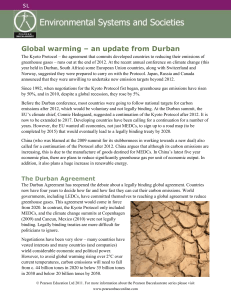
1 - contentextra
... now have four years to decide how far and how fast they can cut their carbon emissions. World governments, including LEDCs, have committed themselves to reaching a global agreement to reduce greenhouse gases. This agreement would come in force from 2020. In contrast, the Kyoto Protocol only included ...
... now have four years to decide how far and how fast they can cut their carbon emissions. World governments, including LEDCs, have committed themselves to reaching a global agreement to reduce greenhouse gases. This agreement would come in force from 2020. In contrast, the Kyoto Protocol only included ...

Climate change and infectious diseases in Europe
... Climate exerts both direct and indirect effects on the appearance and spread of human and animal infectious diseases. The impact of climate change on the transmission and geographical distribution of vector-borne diseases, including zoonoses (infections transmissible between vertebrate animals and h ...
... Climate exerts both direct and indirect effects on the appearance and spread of human and animal infectious diseases. The impact of climate change on the transmission and geographical distribution of vector-borne diseases, including zoonoses (infections transmissible between vertebrate animals and h ...

Global Environmental Challenges, Law, Spring 2006
... international level and will hold moot negotiations representing the positions of different countries. These positions will be based on the history and predictions of future negotiations and the policies of the United States, the European Union, and developing countries. Two other global challenges ...
... international level and will hold moot negotiations representing the positions of different countries. These positions will be based on the history and predictions of future negotiations and the policies of the United States, the European Union, and developing countries. Two other global challenges ...
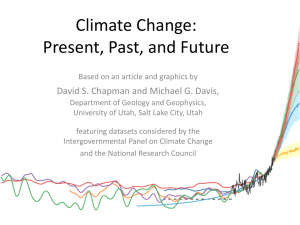
Intergovernmental Panel on Climate Change (IPCC)
... Future Climate Projections: Intergovernmental Panel on Climate Change (IPCC) For its Fourth Assessment Report released in 2007, the IPCC considered several possible futures based on factors including population growth, economic development, and technological change. Each scenario was linked to esti ...
... Future Climate Projections: Intergovernmental Panel on Climate Change (IPCC) For its Fourth Assessment Report released in 2007, the IPCC considered several possible futures based on factors including population growth, economic development, and technological change. Each scenario was linked to esti ...

The Economics of Climate Change in East Asia
... Impact of climate change on crop supply and demand after adaptation in East Asia, 2050 ...
... Impact of climate change on crop supply and demand after adaptation in East Asia, 2050 ...
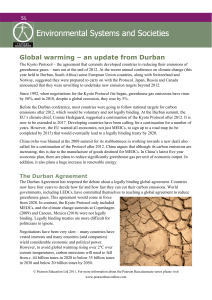
Global warming – an update from Durban
... now have four years to decide how far and how fast they can cut their carbon emissions. World governments, including LEDCs, have committed themselves to reaching a global agreement to reduce greenhouse gases. This agreement would come in force from 2020. In contrast, the Kyoto Protocol only included ...
... now have four years to decide how far and how fast they can cut their carbon emissions. World governments, including LEDCs, have committed themselves to reaching a global agreement to reduce greenhouse gases. This agreement would come in force from 2020. In contrast, the Kyoto Protocol only included ...

Climate change and infectious diseases in Europe
... Climate exerts both direct and indirect effects on the appearance and spread of human and animal infectious diseases. The impact of climate change on the transmission and geographical distribution of vector-borne diseases, including zoonoses (infections transmissible between vertebrate animals and h ...
... Climate exerts both direct and indirect effects on the appearance and spread of human and animal infectious diseases. The impact of climate change on the transmission and geographical distribution of vector-borne diseases, including zoonoses (infections transmissible between vertebrate animals and h ...

Into Unknown Territory. The Limits to Adaptation and Reality of Loss
... could rise by up to two metres by 2100.16 In such a scenario there will be devastating impacts for many low lying countries, coastal regions and cities. For example, most of the Maldives would be uninhabitable and its population would have to relocate. Analysis shows that in developing countries, ev ...
... could rise by up to two metres by 2100.16 In such a scenario there will be devastating impacts for many low lying countries, coastal regions and cities. For example, most of the Maldives would be uninhabitable and its population would have to relocate. Analysis shows that in developing countries, ev ...

PowerPoint Presentation - European Academy of Sciences
... policy Attilio Gambardella 'Climate Action and Earth Observation' European Commission - DG Research and Innovation ...
... policy Attilio Gambardella 'Climate Action and Earth Observation' European Commission - DG Research and Innovation ...

Climate Change Resilient Transport, May 2011
... increase by approx. 70% until 2030 (prognosis for German motorways). The entire transport infrastructure (road, rail, sea and inland waters) will be significantly impacted by climate change, affecting the way Europe’s transportation sector plan, design, construct and maintain infrastructure in the f ...
... increase by approx. 70% until 2030 (prognosis for German motorways). The entire transport infrastructure (road, rail, sea and inland waters) will be significantly impacted by climate change, affecting the way Europe’s transportation sector plan, design, construct and maintain infrastructure in the f ...

How Companies Think About Climate Change: A Global Survey.
... new products, or even managing environmental issues. And more than one-third of global executives say their companies seldom or never factor climate change into their companies’ overall strategy. When asked how well their companies do take climate change into consideration in strategy, more than hal ...
... new products, or even managing environmental issues. And more than one-third of global executives say their companies seldom or never factor climate change into their companies’ overall strategy. When asked how well their companies do take climate change into consideration in strategy, more than hal ...

G20 Climate Finance Study Group Progress report to G20 Leaders I
... additional work is also needed to reduce the methodological uncertainty and thereby the range of estimates of private flows. Concerning tracking in general, some participants warned of inconsistencies between different existing tracking systems which make it difficult to ensure comparability. It was ...
... additional work is also needed to reduce the methodological uncertainty and thereby the range of estimates of private flows. Concerning tracking in general, some participants warned of inconsistencies between different existing tracking systems which make it difficult to ensure comparability. It was ...

Here is the Richmond 350 Resolution
... WHEREAS, the decade from 2000 to 2010 was the warmest on record1, 2005 and 2010 tied for the hottest years on record2, and 2012 was the warmest year on record for the United States and among the ten warmest globally3; and WHEREAS, in 2013 the level of CO2 in the atmosphere averaged 396 parts per mil ...
... WHEREAS, the decade from 2000 to 2010 was the warmest on record1, 2005 and 2010 tied for the hottest years on record2, and 2012 was the warmest year on record for the United States and among the ten warmest globally3; and WHEREAS, in 2013 the level of CO2 in the atmosphere averaged 396 parts per mil ...

exploratory team report - Water Environment Research Foundation
... Foundation. Each of these federal agencies has a research agenda that is oriented towards the mission of their organizations. The USGCRP was created by Congress in 1990 with the mandate to develop a coordinated federal interagency research program. The USGCRP published a summary of climate change im ...
... Foundation. Each of these federal agencies has a research agenda that is oriented towards the mission of their organizations. The USGCRP was created by Congress in 1990 with the mandate to develop a coordinated federal interagency research program. The USGCRP published a summary of climate change im ...

Climate Change and Marine Mammals
... Contribution of mountain and subpolar glaciers to sea level. Shown are sea level change (mm/year, red) and sea level rise (mm, blue). [From M. ...
... Contribution of mountain and subpolar glaciers to sea level. Shown are sea level change (mm/year, red) and sea level rise (mm, blue). [From M. ...


PDF
... factors); in income distribution; in the function of rural areas and in heritage and life style. The agricultural land-use change is not only caused by increasing food demand due to population growth, but also by changes in food preferences and lifestyles which are driven by economic growth, moderni ...
... factors); in income distribution; in the function of rural areas and in heritage and life style. The agricultural land-use change is not only caused by increasing food demand due to population growth, but also by changes in food preferences and lifestyles which are driven by economic growth, moderni ...

Patterns of Natural Selection
... showing the frequency of one trait of the species on their card that might be affected by climate change. Students should draw one line representing the current trait frequencies and then add a second line showing how that trait might be acted upon by evolution to help the species survive the challe ...
... showing the frequency of one trait of the species on their card that might be affected by climate change. Students should draw one line representing the current trait frequencies and then add a second line showing how that trait might be acted upon by evolution to help the species survive the challe ...
Effects of global warming on humans

Climate change has brought about possibly permanent alterations to our planet’s geological, biological and ecological systems. The Intergovernmental Panel on Climate Change (IPCC) contended in 2003 that “there is new and stronger evidence that most of the warming observed over the last 50 years is attributable to human activities”. These changes have led to the emergence of large-scale environmental hazards to human health, such as extreme weather, ozone depletion, increased danger of wildland fires, loss of biodiversity, stresses to food-producing systems and the global spread of infectious diseases. The World Health Organization (WHO) estimates that 160,000 deaths, since 1950, are directly attributable to climate change. Many believe this to be a conservative estimate.To date, a neglected aspect of the climate change debate, much less research has been conducted on the impacts of climate change on health, food supply, economic growth, migration, security, societal change, and public goods, such as drinking water, than on the geophysical changes related to global warming. Human impacts can be both negative and positive. Climatic changes in Siberia, for instance, are expected to improve food production and local economic activity, at least in the short to medium term. Numerous studies suggest, however, that the current and future impacts of climate change on human society are and will continue to be overwhelmingly negative.The majority of the adverse effects of climate change are experienced by poor and low-income communities around the world, who have much higher levels of vulnerability to environmental determinants of health, wealth and other factors, and much lower levels of capacity available for coping with environmental change. A report on the global human impact of climate change published by the Global Humanitarian Forum in 2009, estimated more than 300,000 deaths and about $125 billion in economic losses each year, and indicating that most climate change induced mortality is due to worsening floods and droughts in developing countries. This also raises questions of climate justice, since the 50 least developed countries of the world account for not more than 1% of worldwide emissions of greenhouse gases.