
Universe and Solar System
... plans to announce the probe at a middle school. Your school is one of three being considered. To be chosen, students must use a variety of media to illustrate the probe’s mission: scale models of planets and other objects and a short presentations explaining 1) the historical development of thinking ...
... plans to announce the probe at a middle school. Your school is one of three being considered. To be chosen, students must use a variety of media to illustrate the probe’s mission: scale models of planets and other objects and a short presentations explaining 1) the historical development of thinking ...
PART 1 OBJECTS IN THE SOLAR SYSTEM 4.1 INTRODUCTION
... First proposed by Gerard Kuiper in 1951, many small icy objects, which have also been called “trans-Neptunian” objects and “ice dwarfs,” have now been observed beyond the orbit of Neptune. There are thousands of Kuiper belt objects known to exist including several discovered more recently that rival ...
... First proposed by Gerard Kuiper in 1951, many small icy objects, which have also been called “trans-Neptunian” objects and “ice dwarfs,” have now been observed beyond the orbit of Neptune. There are thousands of Kuiper belt objects known to exist including several discovered more recently that rival ...

Science 9 Unit 5: Space Name
... remote-controlled ‘landers’ that put equipment on or close to planets where no human has gone before. Probes have done remote sensing on Mercury and Jupiter, taken soil samples on Mars, landed on Venus, and studied Saturn’s rings up close. The most recent probes to explore Mars are still there. The ...
... remote-controlled ‘landers’ that put equipment on or close to planets where no human has gone before. Probes have done remote sensing on Mercury and Jupiter, taken soil samples on Mars, landed on Venus, and studied Saturn’s rings up close. The most recent probes to explore Mars are still there. The ...

KEPLER`S LAWS OF PLANETARY MOTION NAME: Date: Purpose
... Purpose: To understand Kepler’s Laws describing the movements of planets in the solar system. Background: In the 1500s, Nicolaus Copernicus challenged the GEOCENTRIC (earth-centered) model of the solar system that had been promoted and accepted by philosophers and astronomers such as Aristotle and P ...
... Purpose: To understand Kepler’s Laws describing the movements of planets in the solar system. Background: In the 1500s, Nicolaus Copernicus challenged the GEOCENTRIC (earth-centered) model of the solar system that had been promoted and accepted by philosophers and astronomers such as Aristotle and P ...

Lec37
... Kepler tried long and hard to find a circular orbit around the Sun that would match Brahe’s observations of Mars. Up to that time everyone from Ptolemy to Copernicus believed that celestial objects moved in circular paths of one sort or another. Though the orbit of Mars was exasperatingly close to ...
... Kepler tried long and hard to find a circular orbit around the Sun that would match Brahe’s observations of Mars. Up to that time everyone from Ptolemy to Copernicus believed that celestial objects moved in circular paths of one sort or another. Though the orbit of Mars was exasperatingly close to ...

Solar System Book solarsystem3
... planets interrupted, but between Mars and Jupiter lies a large area full of asteroids that also orbit the Sun. This area is called the asteroid belt. Asteroids are chunks of rock left over from the birth of the solar system. They are probably material that never managed to form a planet. Asteroids r ...
... planets interrupted, but between Mars and Jupiter lies a large area full of asteroids that also orbit the Sun. This area is called the asteroid belt. Asteroids are chunks of rock left over from the birth of the solar system. They are probably material that never managed to form a planet. Asteroids r ...

Part5Unit2TheoryofSolarSystem
... Stripped the inner planets of their first atmosphere The outer planets held their helium and hydrogen atmospheres ...
... Stripped the inner planets of their first atmosphere The outer planets held their helium and hydrogen atmospheres ...
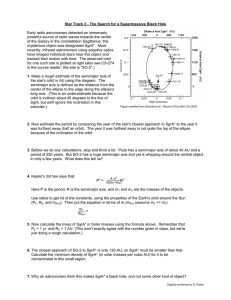
Star Track 2 - The Search for a Supermassive Black... Early radio astronomers detected an immensely
... Use ratios to get rid of the constants, using the properties of the Earth's orbit around the Sun (PE, RE, and mSun). Then put the equation in terms of m1/mSun (assume m2 << m1). m1 ...
... Use ratios to get rid of the constants, using the properties of the Earth's orbit around the Sun (PE, RE, and mSun). Then put the equation in terms of m1/mSun (assume m2 << m1). m1 ...

29.1 Models of the Solar System
... This is because when moon gets back to its original position in 27.3 days, the earth has moved 1°/day or about 27°. The moon moving at l3°/day takes about 2 days to catch up with Earth and align with it and the sun in a new moon phase. ...
... This is because when moon gets back to its original position in 27.3 days, the earth has moved 1°/day or about 27°. The moon moving at l3°/day takes about 2 days to catch up with Earth and align with it and the sun in a new moon phase. ...

Scale Model of the Solar System
... calculate the answer. Light travels at 300,000 km per second, and it takes light from the Sun 8 minutes to reach the Earth. 2. Before students go outside, have them draw a picture of how they think the planets in our solar system are spaced. After they finish the activity, have them draw another pic ...
... calculate the answer. Light travels at 300,000 km per second, and it takes light from the Sun 8 minutes to reach the Earth. 2. Before students go outside, have them draw a picture of how they think the planets in our solar system are spaced. After they finish the activity, have them draw another pic ...

1 1. The Solar System
... block) from the Earth. Jupiter is 15 cm in diameter (the size of a large grapefruit) and 5 blocks away from the Sun. Saturn (the size of an orange) is 10 blocks away; Uranus and Neptune (lemons) are 20 and 30 blocks away. A human on this scale is the size of an atom; the nearest star would be over 4 ...
... block) from the Earth. Jupiter is 15 cm in diameter (the size of a large grapefruit) and 5 blocks away from the Sun. Saturn (the size of an orange) is 10 blocks away; Uranus and Neptune (lemons) are 20 and 30 blocks away. A human on this scale is the size of an atom; the nearest star would be over 4 ...

Extrasolar planets Topics to be covered Planets and brown dwarfs
... shorter lifetimes: so their larger HZ’s might be counteracted by HZs for two different luminosity stars. the fact they die Stars between 0.7 and 1.5 solar before life can masses might live long enough for life evolve? to develop and have HZs far enough ...
... shorter lifetimes: so their larger HZ’s might be counteracted by HZs for two different luminosity stars. the fact they die Stars between 0.7 and 1.5 solar before life can masses might live long enough for life evolve? to develop and have HZs far enough ...

Solar System Review
... A fragment of rock, ice, or metal that has broken off colliding comets or asteroids and burns up in Earth’s atmosphere is known as a(n) a. asteroid. b. meteor. c. satellite. d. minor planets. ...
... A fragment of rock, ice, or metal that has broken off colliding comets or asteroids and burns up in Earth’s atmosphere is known as a(n) a. asteroid. b. meteor. c. satellite. d. minor planets. ...

Astro 205 Ch. 2
... • Using Tycho Brahe’s data, discovered that planets do not move in circles around the Sun, rather, they follow ellipses with the Sun located at one of the two foci! • Astronomers use the term ecc ...
... • Using Tycho Brahe’s data, discovered that planets do not move in circles around the Sun, rather, they follow ellipses with the Sun located at one of the two foci! • Astronomers use the term ecc ...

Are there Earth-like planets around other stars?
... lines from the star and is most sensitive to very big planets in very small orbits. Most of the many other techniques that are now used to search for extrasolar planets are also mainly sensitive to planets that are very different from the planets in our Solar System. Therefore we continue to find ma ...
... lines from the star and is most sensitive to very big planets in very small orbits. Most of the many other techniques that are now used to search for extrasolar planets are also mainly sensitive to planets that are very different from the planets in our Solar System. Therefore we continue to find ma ...

Science 9: Unit 4 Review
... 4. American astronomer Edwin Hubble noticed that the light from distant galaxies was shifted toward the red part of the spectrum. What explanation did he give for this? ...
... 4. American astronomer Edwin Hubble noticed that the light from distant galaxies was shifted toward the red part of the spectrum. What explanation did he give for this? ...
here - Next Wave
... advancing at a breakneck pace. In less than a decade we may well know whether we’re the cosmos’ first and only living progeny, or if there are others. Since the 1990s, we have known what we had long suspected: our solar system is not unique. There are other worlds—more than 700 at last count—shuttli ...
... advancing at a breakneck pace. In less than a decade we may well know whether we’re the cosmos’ first and only living progeny, or if there are others. Since the 1990s, we have known what we had long suspected: our solar system is not unique. There are other worlds—more than 700 at last count—shuttli ...

Planetary System Formation, Extrasolar Planets, Life in the Universe
... snow line, in parts of the disk cool enough for ice to be present • Higher surface density -> more rapid formation of planets • In the outer Solar System, planets grew to ~20 MEarth while gas was still present, captured gas to form gas giants • In inner Solar System, no gas was captured • All circul ...
... snow line, in parts of the disk cool enough for ice to be present • Higher surface density -> more rapid formation of planets • In the outer Solar System, planets grew to ~20 MEarth while gas was still present, captured gas to form gas giants • In inner Solar System, no gas was captured • All circul ...

power_point_slides
... conditions? • Near a moderate-sized, stable, third-generation star neither too close nor too far from the galactic center. • A planet like Earth, in the “habitable zone” of the star for the right temperature range, big enough to have an atmosphere and plate tectonics, not so big as to be a “gas gian ...
... conditions? • Near a moderate-sized, stable, third-generation star neither too close nor too far from the galactic center. • A planet like Earth, in the “habitable zone” of the star for the right temperature range, big enough to have an atmosphere and plate tectonics, not so big as to be a “gas gian ...

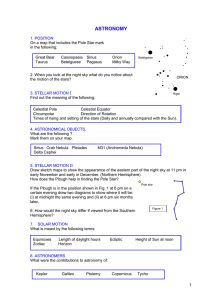
Astronomy work sheet
... the night sky which planets are closer to the Sun than the Earth? 11. ASTRONOMICAL TERMS What is meant by the following: Galaxy Magnitude Red Shift Black Hole ...
... the night sky which planets are closer to the Sun than the Earth? 11. ASTRONOMICAL TERMS What is meant by the following: Galaxy Magnitude Red Shift Black Hole ...

instructor notes: week 2
... gravitational forces, i.e. zero gravity, it would have to be an infinite distance away from every other object, which is not possible. So the term “zero gravity” cannot apply anywhere in the known universe. ...
... gravitational forces, i.e. zero gravity, it would have to be an infinite distance away from every other object, which is not possible. So the term “zero gravity” cannot apply anywhere in the known universe. ...

Extrasolar Planetary Systems » American Scientist
... larger objects. Once these bodies attain a certain size, several kilometers, say, they become safe from the drag force exerted by the surrounding gas and do not spiral inward. By such mechanisms, trillions of kilometer-size planetesimals might emerge in a protostellar disk 100,000 years or so after ...
... larger objects. Once these bodies attain a certain size, several kilometers, say, they become safe from the drag force exerted by the surrounding gas and do not spiral inward. By such mechanisms, trillions of kilometer-size planetesimals might emerge in a protostellar disk 100,000 years or so after ...

Universal Gravitation
... The paths of the planets are ellipses with the sun at one focus. Planets move faster when they are closer to the sun. The square of the ratio of the periods of any two planets revolving about the sun ( TA/TB )2, is equal to the cube of the ratio of their average distances from the sun ( RA/RB)3. ...
... The paths of the planets are ellipses with the sun at one focus. Planets move faster when they are closer to the sun. The square of the ratio of the periods of any two planets revolving about the sun ( TA/TB )2, is equal to the cube of the ratio of their average distances from the sun ( RA/RB)3. ...

CST Prep- 8th Grade Astronomy
... 22. The apparent shift of position of a star in outer space due to observing it from different positions of the Earth is called a __________________. 23. The shapes of stars in outer space that make different figures (i.e. Orion) are called __________________. 24. A star in the process of being born ...
... 22. The apparent shift of position of a star in outer space due to observing it from different positions of the Earth is called a __________________. 23. The shapes of stars in outer space that make different figures (i.e. Orion) are called __________________. 24. A star in the process of being born ...
IAU definition of planet

The definition of planet set in Prague in 2006 by the International Astronomical Union (IAU) states that, in the Solar System, a planet is a celestial body which: is in orbit around the Sun, has sufficient mass to assume hydrostatic equilibrium (a nearly round shape), and has ""cleared the neighborhood"" around its orbit.A non-satellite body fulfilling only the first two of these criteria is classified as a ""dwarf planet"". According to the IAU, ""planets and dwarf planets are two distinct classes of objects"". A non-satellite body fulfilling only the first criterion is termed a ""small Solar System body"" (SSSB). Initial drafts planned to include dwarf planets as a subcategory of planets, but because this could potentially have led to the addition of several dozens of planets into the Solar System, this draft was eventually dropped. The definition was a controversial one and has drawn both support and criticism from different astronomers, but has remained in use.According to this definition, there are eight planets in the Solar System. The definition distinguishes planets from smaller bodies and is not useful outside the Solar System, where smaller bodies cannot be found yet. Extrasolar planets, or exoplanets, are covered separately under a complementary 2003 draft guideline for the definition of planets, which distinguishes them from dwarf stars, which are larger.