
ppt
... Apparently the fine tuning of the laws of nature, the physical constants, the initial density and rate of expansion of the universe God established was sufficient over time to bring about a cosmos with unnumbered star systems that God could choose from to populate In this period God established many ...
... Apparently the fine tuning of the laws of nature, the physical constants, the initial density and rate of expansion of the universe God established was sufficient over time to bring about a cosmos with unnumbered star systems that God could choose from to populate In this period God established many ...

File
... own planets a billion years ago. THE CONCEPT of a habitable zone, when broadened, simply requires an energy source of any variety to liquefy water. One of Jupiter’s moons, icy Europa, is heated by the tidal forces of Jupiter’s gravitational field. Like a racquetball that heats up after the continuou ...
... own planets a billion years ago. THE CONCEPT of a habitable zone, when broadened, simply requires an energy source of any variety to liquefy water. One of Jupiter’s moons, icy Europa, is heated by the tidal forces of Jupiter’s gravitational field. Like a racquetball that heats up after the continuou ...

2- Origin of the Universe
... • Contain thousands of icy and rocky objects • Kuiper Belt – Neptune to about 30 to 55 AU • Oort Cloud – from 5000 AU to 100000 AU Pluto and Eris are the best known dwarf planets found in Kuiper belt Pluto was reclassified as a dwarf planet in ...
... • Contain thousands of icy and rocky objects • Kuiper Belt – Neptune to about 30 to 55 AU • Oort Cloud – from 5000 AU to 100000 AU Pluto and Eris are the best known dwarf planets found in Kuiper belt Pluto was reclassified as a dwarf planet in ...

friends of the planetarium newsletter - june 2010
... South Equatorial Belt (SEB), the brown cloudy band is twice as wide as Earth and more than twenty times as long. The loss of such an enormous "stripe" can be seen with ease halfway across the solar system. "In any size telescope, or even in large binoculars, Jupiter's signature appearance has always ...
... South Equatorial Belt (SEB), the brown cloudy band is twice as wide as Earth and more than twenty times as long. The loss of such an enormous "stripe" can be seen with ease halfway across the solar system. "In any size telescope, or even in large binoculars, Jupiter's signature appearance has always ...
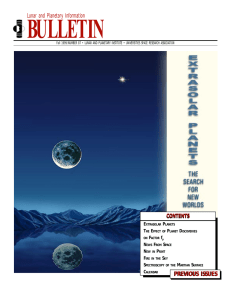
Issue #87 of Lunar and Planetary Information Bulletin
... in our galaxy once harbored close-orbiting gas giant planets like Jupiter or brown dwarfs that were doomed to be gobbled up by their parent stars. STScI astronomer Mario Livio and postdoctoral fellow Lionel Siess say they did not directly observe the planets, because they had already been swallowed ...
... in our galaxy once harbored close-orbiting gas giant planets like Jupiter or brown dwarfs that were doomed to be gobbled up by their parent stars. STScI astronomer Mario Livio and postdoctoral fellow Lionel Siess say they did not directly observe the planets, because they had already been swallowed ...

6 Scale Model of the Solar System
... for Spring Break, you travel ∼ 1,300 kilometers (∼ 800 miles), where the ‘∼’ symbol means “approximately.” These are all distances we can mentally comprehend. Now, how large is the Earth? If you wanted to take a trip to the center of the Earth (the very hot “core”), you would travel 6,378 kilometers ...
... for Spring Break, you travel ∼ 1,300 kilometers (∼ 800 miles), where the ‘∼’ symbol means “approximately.” These are all distances we can mentally comprehend. Now, how large is the Earth? If you wanted to take a trip to the center of the Earth (the very hot “core”), you would travel 6,378 kilometers ...

6 Scale Model of the Solar System
... for Spring Break, you travel ⇠ 1,300 kilometers (⇠ 800 miles), where the ‘⇠’ symbol means “approximately.” These are all distances we can mentally comprehend. Now, how large is the Earth? If you wanted to take a trip to the center of the Earth (the very hot “core”), you would travel 6,378 kilometers ...
... for Spring Break, you travel ⇠ 1,300 kilometers (⇠ 800 miles), where the ‘⇠’ symbol means “approximately.” These are all distances we can mentally comprehend. Now, how large is the Earth? If you wanted to take a trip to the center of the Earth (the very hot “core”), you would travel 6,378 kilometers ...

Astronomy Notes
... *PLUTO Was considered the 9th planet but is now considered a dwarf planet. Orbits the Sun but is too small to clear other objects out of its path ...
... *PLUTO Was considered the 9th planet but is now considered a dwarf planet. Orbits the Sun but is too small to clear other objects out of its path ...

A report of the SEEDS Direct Imaging Survey
... (oldest among imaged planets; less model dependence) ...
... (oldest among imaged planets; less model dependence) ...
Science 9 – Space Exploration
... 1. Many dates in the celestial calendar are marked by the amount of daylight. In the Northern Hemisphere the longest day occurs on June 21 and is called ... A. Vernal equinox B. Autumnal equinox C. Summer solstice D. Winter solstice 2. The Mayans of Central America built an enormous cylinder-shaped ...
... 1. Many dates in the celestial calendar are marked by the amount of daylight. In the Northern Hemisphere the longest day occurs on June 21 and is called ... A. Vernal equinox B. Autumnal equinox C. Summer solstice D. Winter solstice 2. The Mayans of Central America built an enormous cylinder-shaped ...

THE BALTIMORE SUN, Feb. 3, 2004, "Hubble sees key elements in
... last week to review the decision. Gehman was the chairman of the panel that reviewed safety concerns after the Columbia disaster. The Hubble’s latest discovery will appear in the forthcoming issue of Astrophysical Journal Letters, reported by a team of French, American, Canadian and Swiss astronomer ...
... last week to review the decision. Gehman was the chairman of the panel that reviewed safety concerns after the Columbia disaster. The Hubble’s latest discovery will appear in the forthcoming issue of Astrophysical Journal Letters, reported by a team of French, American, Canadian and Swiss astronomer ...

Astronomy - cloudfront.net
... Thinking about the formation of the solar system, what trend in composition would you expect to see from the inside to the outside of the asteroid belt? ...
... Thinking about the formation of the solar system, what trend in composition would you expect to see from the inside to the outside of the asteroid belt? ...


AST 101 Final Exam DO NOT open the exam until
... 20.) You are watching TV in the year 3014, and an ad for a new weight less plan comes on. The plan has you go to the distant planet ”Weightlossian”, which is larger in size than the Earth, but has a much smaller mass than the Earth. The advertisement boasts that you’ll have shed pounds the moment yo ...
... 20.) You are watching TV in the year 3014, and an ad for a new weight less plan comes on. The plan has you go to the distant planet ”Weightlossian”, which is larger in size than the Earth, but has a much smaller mass than the Earth. The advertisement boasts that you’ll have shed pounds the moment yo ...

Microlensing
... • Triple lens, with finite source effects, parallaxe, & taking into account rotation of planets • Ultimate nightmare for normal microlensing planet hunters. • Two other multiple systems « in stock », modeling underway. • One has been giving headaches to Bennett since late 2004. • The other one is mu ...
... • Triple lens, with finite source effects, parallaxe, & taking into account rotation of planets • Ultimate nightmare for normal microlensing planet hunters. • Two other multiple systems « in stock », modeling underway. • One has been giving headaches to Bennett since late 2004. • The other one is mu ...


Completing the Census of Exoplanetary Systems with
... • A complete census is likely needed to understand planet formation and evolution. – Most giant planets likely formed beyond the snow line. – Place our solar system in context. – Water for habitable planets likely delivered from beyond the snow line. – Understand the frequency of planet formation in ...
... • A complete census is likely needed to understand planet formation and evolution. – Most giant planets likely formed beyond the snow line. – Place our solar system in context. – Water for habitable planets likely delivered from beyond the snow line. – Understand the frequency of planet formation in ...

PTYS/ASTR 206 – Section 2 – Spring 2006 Practice Exam 1 Note
... B. at its smallest C. Venus's angular size remains constant. 27. What can the lines in a spectrum primarily reveal about a solar system object? A. its temperature B. its size C. its composition D. its velocity 28. As the Solar System was forming, which of the following best describes the formation o ...
... B. at its smallest C. Venus's angular size remains constant. 27. What can the lines in a spectrum primarily reveal about a solar system object? A. its temperature B. its size C. its composition D. its velocity 28. As the Solar System was forming, which of the following best describes the formation o ...

Chapter 16: The Origin of the Solar System RQ 16
... solids. At these inner orbits, material with lower boiling points (lighter elements) could not be collected, since it still was in its gaseous state. This way the inner planets selectively were made out of heavy elements and thus have now high densities. At greater distance from the center, matter l ...
... solids. At these inner orbits, material with lower boiling points (lighter elements) could not be collected, since it still was in its gaseous state. This way the inner planets selectively were made out of heavy elements and thus have now high densities. At greater distance from the center, matter l ...

ASTR 1010 – Spring 2016 – Study Notes Dr. Magnani
... the Greeks were intrigued by the problem of the motions of the visible planets. The word planet in classical Greek means “wanderer” because the planets change their position with respect to the star ...
... the Greeks were intrigued by the problem of the motions of the visible planets. The word planet in classical Greek means “wanderer” because the planets change their position with respect to the star ...

The Copernican Model (1543)
... The Copernican Model (1543) The Copernican Model is Heliocentric and Geodynamic Heliocentric = “Sun Centered” Geodynamic = “Earth in motion” (The Ptolemaic Cosmology was Geocentric and Geostatic.) ...
... The Copernican Model (1543) The Copernican Model is Heliocentric and Geodynamic Heliocentric = “Sun Centered” Geodynamic = “Earth in motion” (The Ptolemaic Cosmology was Geocentric and Geostatic.) ...

Merit - NZQA
... Surrounding our sun was a huge cloud of gas and dust, this cloud was spinning around the sun. It caused matter to stick together and eventually gravity held it together and formed planets orbiting around the huge sun in the centre. Moons and satellites formed around the planets. ...
... Surrounding our sun was a huge cloud of gas and dust, this cloud was spinning around the sun. It caused matter to stick together and eventually gravity held it together and formed planets orbiting around the huge sun in the centre. Moons and satellites formed around the planets. ...

Early Astronomy and Gravity
... From Ptolemy to Copernicus • Ptolemy’s geocentric system was very complicated, but also very accurate. It lasted for nearly 1500 years! • But most people still thought that the “perfect reality” was a bunch of “nested spheres” as Aristotle originally suggested. • Copernicus wrote about heliocentric ...
... From Ptolemy to Copernicus • Ptolemy’s geocentric system was very complicated, but also very accurate. It lasted for nearly 1500 years! • But most people still thought that the “perfect reality” was a bunch of “nested spheres” as Aristotle originally suggested. • Copernicus wrote about heliocentric ...


Document
... notably) by Hipparchus to explain the observed motions of the stars and planets. Copernicus (1473-1543) proposed a heliocentric model of planetary motion. Simpler and more elegant. Model could order planets e.g. Mercury and Venus are never seen more than 28 and 47deg. E or W of the Sun => inside orb ...
... notably) by Hipparchus to explain the observed motions of the stars and planets. Copernicus (1473-1543) proposed a heliocentric model of planetary motion. Simpler and more elegant. Model could order planets e.g. Mercury and Venus are never seen more than 28 and 47deg. E or W of the Sun => inside orb ...
IAU definition of planet

The definition of planet set in Prague in 2006 by the International Astronomical Union (IAU) states that, in the Solar System, a planet is a celestial body which: is in orbit around the Sun, has sufficient mass to assume hydrostatic equilibrium (a nearly round shape), and has ""cleared the neighborhood"" around its orbit.A non-satellite body fulfilling only the first two of these criteria is classified as a ""dwarf planet"". According to the IAU, ""planets and dwarf planets are two distinct classes of objects"". A non-satellite body fulfilling only the first criterion is termed a ""small Solar System body"" (SSSB). Initial drafts planned to include dwarf planets as a subcategory of planets, but because this could potentially have led to the addition of several dozens of planets into the Solar System, this draft was eventually dropped. The definition was a controversial one and has drawn both support and criticism from different astronomers, but has remained in use.According to this definition, there are eight planets in the Solar System. The definition distinguishes planets from smaller bodies and is not useful outside the Solar System, where smaller bodies cannot be found yet. Extrasolar planets, or exoplanets, are covered separately under a complementary 2003 draft guideline for the definition of planets, which distinguishes them from dwarf stars, which are larger.