
Buoyancy and Archimedes` principle
... useful model of fluid behaviour. An ideal fluid is Incompressible – the density is constant Irrotational – the flow is smooth, no turbulence Nonviscous – fluid has no internal friction (η=0) Steady flow – the velocity of the fluid at each point is constant in time. ...
... useful model of fluid behaviour. An ideal fluid is Incompressible – the density is constant Irrotational – the flow is smooth, no turbulence Nonviscous – fluid has no internal friction (η=0) Steady flow – the velocity of the fluid at each point is constant in time. ...


Atmospheric Dynamics - Buffalo State College
... While entering the bath he noticed that when he placed his legs in, water spilled over the edge. Struck by a moment of realisation, he shouted "Eureka!" He informed the king that there was a way to positively tell if the smith was cheating him. Knowing that gold has a higher density than silver, he ...
... While entering the bath he noticed that when he placed his legs in, water spilled over the edge. Struck by a moment of realisation, he shouted "Eureka!" He informed the king that there was a way to positively tell if the smith was cheating him. Knowing that gold has a higher density than silver, he ...

Chapter8.Presentation.ICAM.Hydrostatics.Rev_April2015
... pressure P of a fluid at any point in a tube. ii. According to Bernoulli’s Equation: for an inviscid flow of a non-conducting fluid, an increase in the speed of the fluid occurs simultaneously with a decrease in pressure or a decrease in the fluid's potential energy. The principle is named after Dan ...
... pressure P of a fluid at any point in a tube. ii. According to Bernoulli’s Equation: for an inviscid flow of a non-conducting fluid, an increase in the speed of the fluid occurs simultaneously with a decrease in pressure or a decrease in the fluid's potential energy. The principle is named after Dan ...



Planck`s Constant and the Photon
... Authors Note: Our understanding of nature is in a phase of transition from an Empty Space to the Absolute Space of Reality, mistakenly called a "Vacuum" which means nothing. In the 17th Century, a Vortex Theory was introduced by Rene Descartes (1596-1650), referred to as the Great French Mathematic ...
... Authors Note: Our understanding of nature is in a phase of transition from an Empty Space to the Absolute Space of Reality, mistakenly called a "Vacuum" which means nothing. In the 17th Century, a Vortex Theory was introduced by Rene Descartes (1596-1650), referred to as the Great French Mathematic ...

AP Physics Test: May 12 in the Afternoon
... a pencil and you are provided with a constants sheet (not an equations sheet). You cannot use a calculator. The questions test the breadth of your knowledge and understanding of the basic principles of physics. There are between 6 and 8 free response questions on the exam. You will be allowed to use ...
... a pencil and you are provided with a constants sheet (not an equations sheet). You cannot use a calculator. The questions test the breadth of your knowledge and understanding of the basic principles of physics. There are between 6 and 8 free response questions on the exam. You will be allowed to use ...

Lecture-21-11
... The same force applied over a smaller area results in greater pressure – think of poking a balloon with your finger and then with a needle. Pressure is a useful concept for discussing fluids, because fluids distribute their force over an area ...
... The same force applied over a smaller area results in greater pressure – think of poking a balloon with your finger and then with a needle. Pressure is a useful concept for discussing fluids, because fluids distribute their force over an area ...
Fluids
... A. Steady flow: In steady (or laminar) flow, the velocity of the moving fluid at any fixed point does not change with time. B. Incompressible flow: We assume, as for fluids at rest, that our ideal fluid is incompressible; that is, its density has a constant, uniform value. C. Nonviscous flow: T ...
... A. Steady flow: In steady (or laminar) flow, the velocity of the moving fluid at any fixed point does not change with time. B. Incompressible flow: We assume, as for fluids at rest, that our ideal fluid is incompressible; that is, its density has a constant, uniform value. C. Nonviscous flow: T ...
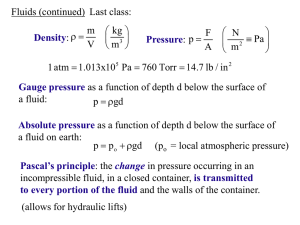
Gauge pressure as a function of depth d below the surface of a fluid
... B) The water level actually goes down Fully submerged the block displaces a quantity of water equal to its volume. On the float, the block displaces a quantity of water equal to its mass. That displaced water raises the level in the pool Since iron has greater density than water, it displaces more w ...
... B) The water level actually goes down Fully submerged the block displaces a quantity of water equal to its volume. On the float, the block displaces a quantity of water equal to its mass. That displaced water raises the level in the pool Since iron has greater density than water, it displaces more w ...
Full-text
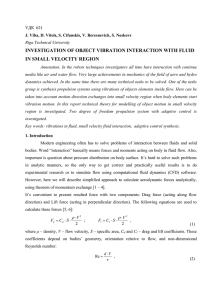
... However, using (5) or (7) in practice don’t give corresponding results. Even for a simple object like plate (5) gives 20% error. That’s because drag and lift coefficients are used. They show how much real force differs from calculated with (5). Some examples of drag coefficients for several basic sh ...
... However, using (5) or (7) in practice don’t give corresponding results. Even for a simple object like plate (5) gives 20% error. That’s because drag and lift coefficients are used. They show how much real force differs from calculated with (5). Some examples of drag coefficients for several basic sh ...

Fluid mechanics and transfer phenomena.
... - Measurement laboratory(ies) will be organized to confront the student to the practical and physical aspects of fluid mechanics and transfers, to the measurement techniques (methods, constraints, precision) and to the order of magnitude of the measured quantities. The personal implication of the st ...
... - Measurement laboratory(ies) will be organized to confront the student to the practical and physical aspects of fluid mechanics and transfers, to the measurement techniques (methods, constraints, precision) and to the order of magnitude of the measured quantities. The personal implication of the st ...

03
... energy < E >nT over a cycle nT ≤ t ≤ (n + 1)T , after n cycles.( You can leave the answer in terms of an integral over time) T is the time period. Use the result to show m ...
... energy < E >nT over a cycle nT ≤ t ≤ (n + 1)T , after n cycles.( You can leave the answer in terms of an integral over time) T is the time period. Use the result to show m ...
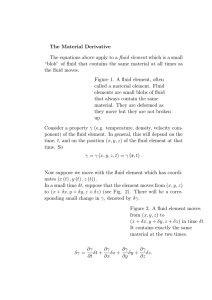
The Material Derivative The equations above apply to a fluid
... air is approximately 1.4×10⁻⁵ m2 s−1 at atmospheric pressure and for water it is roughly 10−6 m2 s−1 . The mass of a fluid element cannot change, therefore ...
... air is approximately 1.4×10⁻⁵ m2 s−1 at atmospheric pressure and for water it is roughly 10−6 m2 s−1 . The mass of a fluid element cannot change, therefore ...


Forces and Motion
... Identify the two factors that speed depends on. Determine the difference between speed and velocity Analyze the relationship of velocity to acceleration Interpret a graph showing acceleration Determine the net force on an object Compare balanced and unbalanced forces Explain why friction occurs Defi ...
... Identify the two factors that speed depends on. Determine the difference between speed and velocity Analyze the relationship of velocity to acceleration Interpret a graph showing acceleration Determine the net force on an object Compare balanced and unbalanced forces Explain why friction occurs Defi ...

Lecture01 - Lcgui.net
... Body force - acts throughout the volume - e.g. gravity and electromagnetic forces Surface force - acts across an internal or external surface element - decomposed in to two perpendicular components ...
... Body force - acts throughout the volume - e.g. gravity and electromagnetic forces Surface force - acts across an internal or external surface element - decomposed in to two perpendicular components ...

Pressure Pressure
... – the relevant density is that of the fluid, not of the object itself – the relevant volume is that of the fluid which the object has displaced (equal to the volume of the object for total immersion) – the buoyant for is not the total force; you need to add (at least) the weight of the object iself ...
... – the relevant density is that of the fluid, not of the object itself – the relevant volume is that of the fluid which the object has displaced (equal to the volume of the object for total immersion) – the buoyant for is not the total force; you need to add (at least) the weight of the object iself ...