

ME3560 Tentative ScheduleâSummer I 2015
... SP 2.15. An inverted U-tube manometer containing oil (SG = 2.3) is located between two reservoirs as shown in the figure below. The reservoir on the left, which contains carbon tetrachloride, is closed and pressurized to 9 psi. The reservoir on the right contains water and is open to the atmosphere ...
... SP 2.15. An inverted U-tube manometer containing oil (SG = 2.3) is located between two reservoirs as shown in the figure below. The reservoir on the left, which contains carbon tetrachloride, is closed and pressurized to 9 psi. The reservoir on the right contains water and is open to the atmosphere ...



Slide 1
... 6. Which of these objects are in projectile motion? A. a rocket being launched B. a thrown baseball C. a cat jumping down from the roof D. a wheel falling from the landing gear of an airplane E. a pecan nut falling off the limb of a pecan ...
... 6. Which of these objects are in projectile motion? A. a rocket being launched B. a thrown baseball C. a cat jumping down from the roof D. a wheel falling from the landing gear of an airplane E. a pecan nut falling off the limb of a pecan ...

Fluid Mechanics
... honey vs. water. Two quantities: viscosity and kinematic viscosity (do not worry about distinguishing between them, nor should you worry about the units) It can be thought of as the effect of friction in a fluid Friction (sometimes called skin friction) is a resistance to motion created by ...
... honey vs. water. Two quantities: viscosity and kinematic viscosity (do not worry about distinguishing between them, nor should you worry about the units) It can be thought of as the effect of friction in a fluid Friction (sometimes called skin friction) is a resistance to motion created by ...


Notes and Hints for AP Physics Summer Assignment
... and gases behave the same way except for one key point: GASES CAN BE COMPRESSED, WHILE LIQUIDS CAN NOT (liquids have a definite volume). One key property when dealing with fluids is DENSITY, which is the amount of mass a substance has per unit of volume. Density is given by the equation: ρ=m/V densi ...
... and gases behave the same way except for one key point: GASES CAN BE COMPRESSED, WHILE LIQUIDS CAN NOT (liquids have a definite volume). One key property when dealing with fluids is DENSITY, which is the amount of mass a substance has per unit of volume. Density is given by the equation: ρ=m/V densi ...

buoyant force - Trinity Regional School
... Archimedes’ Principle states that the buoyant force of a fluid is equal to the weight of the fluid displaced by the object. If an object can displace (push away) enough fluid to equal its weight, it will float. This is why a tremendous ship made of iron can float but a cannonball would sink. The sh ...
... Archimedes’ Principle states that the buoyant force of a fluid is equal to the weight of the fluid displaced by the object. If an object can displace (push away) enough fluid to equal its weight, it will float. This is why a tremendous ship made of iron can float but a cannonball would sink. The sh ...

FLUIDS notes
... 1. A stream of water emerges from a pipe. The cross-sectional area of the water stream at the tap is 1.2 cm2 and 43 mm lower than the tap is 0.35 cm2. At what volume rate of flow does the water flow from the tap? Ans: 3.21 x 10⁻⁵ m3/s 2. Water is pumped from a pipeline 2 m above the ground to a wate ...
... 1. A stream of water emerges from a pipe. The cross-sectional area of the water stream at the tap is 1.2 cm2 and 43 mm lower than the tap is 0.35 cm2. At what volume rate of flow does the water flow from the tap? Ans: 3.21 x 10⁻⁵ m3/s 2. Water is pumped from a pipeline 2 m above the ground to a wate ...

Chapter 9: Fluids
... a fluid with another object (container walls for example). There is a momentum change (impulse) that is away from the container walls. There must be a force exerted on the particle by the wall. ...
... a fluid with another object (container walls for example). There is a momentum change (impulse) that is away from the container walls. There must be a force exerted on the particle by the wall. ...


AP Physics Free Response Practice – Torque – ANSWERS
... a) The force on the plug from the water inherently includes the atmosphere above it, so we use the absolute pressure. Pabs = Po + ρgh = 1.01x10⁵ + (1025)(9.8)(20m) = 3x10⁵ Pa The force is then found with P = F/A 3x105 = F / (4x10⁻⁵) F = 12 N Note: This calculation of pressure (ρgh) only works sinc ...
... a) The force on the plug from the water inherently includes the atmosphere above it, so we use the absolute pressure. Pabs = Po + ρgh = 1.01x10⁵ + (1025)(9.8)(20m) = 3x10⁵ Pa The force is then found with P = F/A 3x105 = F / (4x10⁻⁵) F = 12 N Note: This calculation of pressure (ρgh) only works sinc ...

J Surg Res
... Bioengineering and Structural Engineering Department, Politecnico di Milano, Milan, Italy. [email protected] OBJECTIVES AND BACKGROUND: In the Fontan circulation, pulmonary and systemic vascular resistances are in series. The influence of various inferior vena cava to pulmonary artery connections in thi ...
... Bioengineering and Structural Engineering Department, Politecnico di Milano, Milan, Italy. [email protected] OBJECTIVES AND BACKGROUND: In the Fontan circulation, pulmonary and systemic vascular resistances are in series. The influence of various inferior vena cava to pulmonary artery connections in thi ...


Figure 1 Figure 2
... square or a circle. However, in this pre-recitation we want to describe to you how, by defining area as a vector (that is, by giving area a mathematically convenient direction in addition to its magnitude), we can make the descriptions of flux and other important physical quantities simpler and more ...
... square or a circle. However, in this pre-recitation we want to describe to you how, by defining area as a vector (that is, by giving area a mathematically convenient direction in addition to its magnitude), we can make the descriptions of flux and other important physical quantities simpler and more ...

Millikan`s Oil Drop Experiment
... Be able to state and explain Stokes Law for bodies moving through fluids Be able to identify the forces acting on a stationary charged object in an electric field Recall and explain how Millikan was experimentally able to determine the charge on the electron ...
... Be able to state and explain Stokes Law for bodies moving through fluids Be able to identify the forces acting on a stationary charged object in an electric field Recall and explain how Millikan was experimentally able to determine the charge on the electron ...

Document
... Examples of ports: (i) end of a pipe or tube (ii) threaded hole in a hydraulic pump ...
... Examples of ports: (i) end of a pipe or tube (ii) threaded hole in a hydraulic pump ...

Hydraulics Solution Sheet 7 – Conservation of energy
... Cavitation is not a danger here for typical water temperatures – only when the height of a pipe approaches 10 m above the hydraulic grade line – which we will look at later. 4. The highest residential area in a town is at an elevation of 250 m. It is local regulations that the minimum static supply ...
... Cavitation is not a danger here for typical water temperatures – only when the height of a pipe approaches 10 m above the hydraulic grade line – which we will look at later. 4. The highest residential area in a town is at an elevation of 250 m. It is local regulations that the minimum static supply ...

Chapter 10 Simple Harmonic Motion and Elasticity continued
... ARCHIMEDES’ PRINCIPLE Any fluid applies a buoyant force to an object that is partially or completely immersed in it; the magnitude of the buoyant force equals the weight of the fluid that the object displaces: ...
... ARCHIMEDES’ PRINCIPLE Any fluid applies a buoyant force to an object that is partially or completely immersed in it; the magnitude of the buoyant force equals the weight of the fluid that the object displaces: ...
Length and Flow Rate
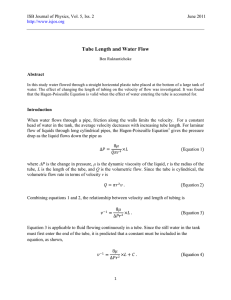
... figure 2, the predicted velocity of water flowing through a hole in the side of the tank is the inverse of 0.8 s/m, or 1.25 m/s. This is inconsistent with the known value, just below 2.9 m/s. As the tube length approaches zero, the flow becomes turbulent, as the Reynolds number approaches 14,000, an ...
... figure 2, the predicted velocity of water flowing through a hole in the side of the tank is the inverse of 0.8 s/m, or 1.25 m/s. This is inconsistent with the known value, just below 2.9 m/s. As the tube length approaches zero, the flow becomes turbulent, as the Reynolds number approaches 14,000, an ...

