
Chapter 13 - cloudfront.net
... Pepin III’s coronation established the Carolingians Carolingians- new line of Frankish rulers. Pope confirmation of Pepin’s rule, strengthened the legitimacy of the new Carolingian dynasty. European Christians believed that the pope’s blessing ...
... Pepin III’s coronation established the Carolingians Carolingians- new line of Frankish rulers. Pope confirmation of Pepin’s rule, strengthened the legitimacy of the new Carolingian dynasty. European Christians believed that the pope’s blessing ...
FROM THE FALL OF ROME TO CHARLEMAGNE
... • Established in Gaul (modern France) in the late 400s by Clovis – Merovingian family – He converted to Christianity around 500 when his troops won a difficult battle • First Germanic ruler to do so – Massive public baptism of Clovis and 3,000 Franks ...
... • Established in Gaul (modern France) in the late 400s by Clovis – Merovingian family – He converted to Christianity around 500 when his troops won a difficult battle • First Germanic ruler to do so – Massive public baptism of Clovis and 3,000 Franks ...
The Rise of the Middle Ages A.D. 432 – A.D. 1328
... European development known as the Middle Ages. During this transition period many Germanic tribes plundered Europe and established small kingdoms. The Franks were one Germanic tribe that did much to shape Western culture in post-Roman Europe. ...
... European development known as the Middle Ages. During this transition period many Germanic tribes plundered Europe and established small kingdoms. The Franks were one Germanic tribe that did much to shape Western culture in post-Roman Europe. ...
The Frankish Kingdom and Charlemagne
... area in the Netherlands and northern Germany Friesland inhabited by Frisians ...
... area in the Netherlands and northern Germany Friesland inhabited by Frisians ...
Chapter 17
... Capital city at Aachen (in modern Germany) Relied on aristocratic deputies, known as counts Used missi dominici to oversee local authorities Pope Leo III proclaimed Charlemagne emperor, 800 ...
... Capital city at Aachen (in modern Germany) Relied on aristocratic deputies, known as counts Used missi dominici to oversee local authorities Pope Leo III proclaimed Charlemagne emperor, 800 ...
Feudalism
... • Charlemagne ruled for 28 years… from 786 – 814 A.D. • He not only ruled this Frankish (mostly France) Kingdom… he also expanded it! • By 800 A.D. Charlemagne had become the Roman Emperor (remember… bringing those 3 elements together!) • In 841 A.D. Charlemagne died and the Carolingian Empire fell ...
... • Charlemagne ruled for 28 years… from 786 – 814 A.D. • He not only ruled this Frankish (mostly France) Kingdom… he also expanded it! • By 800 A.D. Charlemagne had become the Roman Emperor (remember… bringing those 3 elements together!) • In 841 A.D. Charlemagne died and the Carolingian Empire fell ...

Middle Ages
... – By 870 the middle kingdom divided between eastern and western kingdom – Invasions of different people hindered the empire • Muslims from Africa invaded the Mediterranean coast • Slavs from the east raided central Europe • Nomadic Magyars settled in what is now Hungary – Terrorized Europe for about ...
... – By 870 the middle kingdom divided between eastern and western kingdom – Invasions of different people hindered the empire • Muslims from Africa invaded the Mediterranean coast • Slavs from the east raided central Europe • Nomadic Magyars settled in what is now Hungary – Terrorized Europe for about ...

The Early middle ages
... • 1. Charlemagne’s Conquests – conquered the Lombards in northern Italy, the Muslims in the Spanish March, a strip of land just south of the Pyrenees Mountains in Spain, the Slavs in Bohemia and the Saxons, a pagan Germanic people in northwestern Germany • 2. Effects of Charlemagne’s Conquests – Inc ...
... • 1. Charlemagne’s Conquests – conquered the Lombards in northern Italy, the Muslims in the Spanish March, a strip of land just south of the Pyrenees Mountains in Spain, the Slavs in Bohemia and the Saxons, a pagan Germanic people in northwestern Germany • 2. Effects of Charlemagne’s Conquests – Inc ...
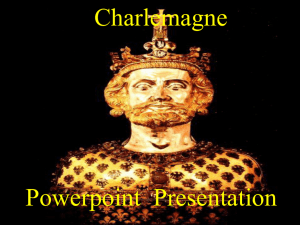
CharlemagnePPT
... • Charlemagne's empire did not have a strong central government like the Roman empire. Local nobles eventually took over where his ...
... • Charlemagne's empire did not have a strong central government like the Roman empire. Local nobles eventually took over where his ...
Duchy of Gascony

The Duchy of Gascony (also Vasconia; French: duché de Gascogne, duché de Vasconie; Basque: Baskoniako dukerria) was a duchy in present southwestern France, roughly corresponding to the modern region of Gascony after 824. The Duchy of Gascony, then known as Wasconia, was originally a Frankish march formed to hold sway over the Basques (Vascones). However, the Duchy went through different periods, from its early years with its distinctively Basque element to the merge in personal union with the Duchy of Aquitaine to the later period as a dependency of the Plantagenet kings of England.In the Hundred Years' War, Charles V of France conquered most of Gascony by 1380, and under Charles VII of France it was incorporated into the kingdom of France in its entirety in 1453.