
Climate change and pollution - University of Reading, Meteorology
... • Increases in global mean temperature of 1.4 - 5.8 C by the year 2100 • Greater warming over land than over ocean, especially in North America and northern and central Asia during the cold season • Probably an increase in number of hot days and decrease in cold days • Night-time increase more than ...
... • Increases in global mean temperature of 1.4 - 5.8 C by the year 2100 • Greater warming over land than over ocean, especially in North America and northern and central Asia during the cold season • Probably an increase in number of hot days and decrease in cold days • Night-time increase more than ...


Exam1_Key - Gamon Lab
... warming. Depending upon how these are implemented in models, one scenario that results is a “runaway greenhouse” (rapid and accelerating climate warming) due to the large reservoir of stored carbon locked ...
... warming. Depending upon how these are implemented in models, one scenario that results is a “runaway greenhouse” (rapid and accelerating climate warming) due to the large reservoir of stored carbon locked ...

NRDC: Miami and the Keys, Florida: Identifying and Becoming More
... aquifers. Sea level rise could also leave many of Miami’s sandy beaches, and parts of the nearby Everglades, including the sensitive habitats that depend on that ecosystem, underwater by mid-century. These impacts would cause Miami’s tourism economy to suffer. Storm Events and Coastal and Inland Flo ...
... aquifers. Sea level rise could also leave many of Miami’s sandy beaches, and parts of the nearby Everglades, including the sensitive habitats that depend on that ecosystem, underwater by mid-century. These impacts would cause Miami’s tourism economy to suffer. Storm Events and Coastal and Inland Flo ...

Review National Climate Assessment First Draft 2013 Report
... • Adverse impacts to crops and livestock over the next 100 years are expected. Over the next 25 years or so, the agriculture sector is projected to be relatively resilient, even though there will be increasing disruptions from extreme heat, drought, and heavy downpours. U.S. food security and farm i ...
... • Adverse impacts to crops and livestock over the next 100 years are expected. Over the next 25 years or so, the agriculture sector is projected to be relatively resilient, even though there will be increasing disruptions from extreme heat, drought, and heavy downpours. U.S. food security and farm i ...

Climate Variability and Change: Introduction
... physical understanding of key processes. These sections are required for a basic understanding of the climate system and processes before we can attempt to consider its variability. Many textbooks exist that cover these areas. ...
... physical understanding of key processes. These sections are required for a basic understanding of the climate system and processes before we can attempt to consider its variability. Many textbooks exist that cover these areas. ...

Hindu Kush-Himalaya-Tibetan Plateau Future Water
... temperature across the Himalayas between 1988 and 2008; temps stable in western region • Increased regional industrialization and energy use expected to continue • Snow cover in the Himalayas declined by about 5 to 10 percent during the period 1990 to 2001 • Monsoon rains in east and central region ...
... temperature across the Himalayas between 1988 and 2008; temps stable in western region • Increased regional industrialization and energy use expected to continue • Snow cover in the Himalayas declined by about 5 to 10 percent during the period 1990 to 2001 • Monsoon rains in east and central region ...

Working Group III Mitigation of Climate Change
... for interview, 7:00 AM PET onwards, in person or by phone. Requests for interviews can be made online. Contact: Mr Jonathan Lynn, IPCC Senior Communications Officer, [email protected] and Ms Noemie Leprince-Ringuet, Synthesis Report Technical Support Unit, [email protected] ...
... for interview, 7:00 AM PET onwards, in person or by phone. Requests for interviews can be made online. Contact: Mr Jonathan Lynn, IPCC Senior Communications Officer, [email protected] and Ms Noemie Leprince-Ringuet, Synthesis Report Technical Support Unit, [email protected] ...

IPCC-XLII/INF. 10
... 1) Socio-economic modeling related to climate change; 2) Climate and water; 3) Climate and the oceans; and 4) Underlying science of climate change. A total of 175 applications were received by the 15 February 2015 deadline. The Secretariat performed the first technical screening of the applications ...
... 1) Socio-economic modeling related to climate change; 2) Climate and water; 3) Climate and the oceans; and 4) Underlying science of climate change. A total of 175 applications were received by the 15 February 2015 deadline. The Secretariat performed the first technical screening of the applications ...

Climate Challenge - The Science Spot
... 20. Which side of the mountains get more rain? West side gets 4 times more rain than the east side. ...
... 20. Which side of the mountains get more rain? West side gets 4 times more rain than the east side. ...


A Skeptic`s Guide to Climate Change
... we know that CO2 is coming from human burning of fossil fuels. While climate has changed in the past, possibly even as quickly and dramatically as it is changing today, we nevertheless can tell from the unique carbon fingerprint that today’s warming is human caused. The Human Effect - The smooth, si ...
... we know that CO2 is coming from human burning of fossil fuels. While climate has changed in the past, possibly even as quickly and dramatically as it is changing today, we nevertheless can tell from the unique carbon fingerprint that today’s warming is human caused. The Human Effect - The smooth, si ...

Photo Album - California Municipal Utilities Association
... warming climate involve the same adaptations. South of the Delta: • Increased storage south-of-Delta to take advantage of diversions when available. • Stabilize groundwater levels in the San Joaquin Valley so conjunctive use opportunities are available in dry years for multiple uses. • Broader utili ...
... warming climate involve the same adaptations. South of the Delta: • Increased storage south-of-Delta to take advantage of diversions when available. • Stabilize groundwater levels in the San Joaquin Valley so conjunctive use opportunities are available in dry years for multiple uses. • Broader utili ...

Climate change in Cyprus: projections from regional climate model
... Health effects of extreme heat and cold Vulnerability to extremes of the hydrologic cycle Exposure to infectious diseases Changes in aeroallergen and allergic airway diseases Air and water quality changes Climate change and the built environment Compounding effects of economic discrepancy and hards ...
... Health effects of extreme heat and cold Vulnerability to extremes of the hydrologic cycle Exposure to infectious diseases Changes in aeroallergen and allergic airway diseases Air and water quality changes Climate change and the built environment Compounding effects of economic discrepancy and hards ...
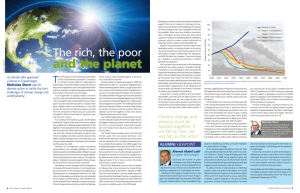
The rich, the poor and the planet
... to the United Nations Framework Convention on Climate Change (UNFCCC), taking place in Copenhagen in December 2009, provides the climax to two years of negotiations over a new global framework to limit concentrations of greenhouse gases and deal with those impacts that cannot now be avoided. Such an ...
... to the United Nations Framework Convention on Climate Change (UNFCCC), taking place in Copenhagen in December 2009, provides the climax to two years of negotiations over a new global framework to limit concentrations of greenhouse gases and deal with those impacts that cannot now be avoided. Such an ...

appendix a: the greenhouse effect, greenhouse
... a regional and local problem, with serious impacts foreseen for California, the Southern California Area, and Pasadena. The impacts of climate change will be variable and widespread. Global and local climate change will impact weather, sea-level rise, water resources, ecosystems, human health, econo ...
... a regional and local problem, with serious impacts foreseen for California, the Southern California Area, and Pasadena. The impacts of climate change will be variable and widespread. Global and local climate change will impact weather, sea-level rise, water resources, ecosystems, human health, econo ...

Kyoto Protocol
... EU bolstered significant reductions; however the JUCANZ (Japan, US, Canada, Australia, & New Zealand) constituted a new veto union, restricted negotiations for decreased emissions (Watson et al., 2000). There were numerous gatherings of the Ad Hoc Working Group occurred between the years 1995-1997. ...
... EU bolstered significant reductions; however the JUCANZ (Japan, US, Canada, Australia, & New Zealand) constituted a new veto union, restricted negotiations for decreased emissions (Watson et al., 2000). There were numerous gatherings of the Ad Hoc Working Group occurred between the years 1995-1997. ...

download PDF
... speed of expected change, there is no doubt that change is underway. The far North is now experiencing some of the most rapid and severe climate change on Earth. In the last century, average annual temperatures in the Arctic have increased at almost twice the rate as the rest of the planet. Climate ...
... speed of expected change, there is no doubt that change is underway. The far North is now experiencing some of the most rapid and severe climate change on Earth. In the last century, average annual temperatures in the Arctic have increased at almost twice the rate as the rest of the planet. Climate ...

introduction to climate change
... Group read and share Working in groups of three or four students read one article on climate change (BLM 1.1,1.2,1.3,1.4). Tell groups to be prepared to explain what they have learned from the reading. Allow students three minutes to record by drawing, labeling or writing what they have learned in t ...
... Group read and share Working in groups of three or four students read one article on climate change (BLM 1.1,1.2,1.3,1.4). Tell groups to be prepared to explain what they have learned from the reading. Allow students three minutes to record by drawing, labeling or writing what they have learned in t ...

3.1.3 Intensification of the hydrological cycle – An important signal of
... are carried out which are analysed directly on the one hand were conducted within PRUDENCE. An analysis of their and which are used as input for the regional model results for different river catchments shows significant calculations on the other. differences between the projected changes over north ...
... are carried out which are analysed directly on the one hand were conducted within PRUDENCE. An analysis of their and which are used as input for the regional model results for different river catchments shows significant calculations on the other. differences between the projected changes over north ...

Cloud Nasara Presentation - Pacific Climate Change Science
... There is a La Niña in the Pacific. The VMGD forecasts above average rainfall for the coming three months in your province. High rainfall and floods may be possible. Scenario 2: Below average rainfall There is an El Niño in the Pacific. The VMGD forecasts below average rainfall for the coming three m ...
... There is a La Niña in the Pacific. The VMGD forecasts above average rainfall for the coming three months in your province. High rainfall and floods may be possible. Scenario 2: Below average rainfall There is an El Niño in the Pacific. The VMGD forecasts below average rainfall for the coming three m ...

Document-Based Question: What is Causing Climate Change?
... remains of living things. Fossil fuels include coal, natural gas, and petroleum. For example, the gasoline in cars comes from petroleum, natural gas provides heat for homes, and many power plants burn coal to create electric power. Fossil fuels provide a tremendous amount of energy. In fact, most of ...
... remains of living things. Fossil fuels include coal, natural gas, and petroleum. For example, the gasoline in cars comes from petroleum, natural gas provides heat for homes, and many power plants burn coal to create electric power. Fossil fuels provide a tremendous amount of energy. In fact, most of ...

Focus on nutrients
... 2. The advisor always have to relate to how measures taken will influence farm economy 3. It is important to inform farmers about the progress and make them proud of their achievements – preferably through the press 4. To inspire change the visits need to be voluntary for the farmer ...
... 2. The advisor always have to relate to how measures taken will influence farm economy 3. It is important to inform farmers about the progress and make them proud of their achievements – preferably through the press 4. To inspire change the visits need to be voluntary for the farmer ...


EAUC
... • What do we want to be able to do with the data? – Better understanding of the actual quantity and sources of emissions – Knowledge of targets relating to climate change and progress against these – Understand what projects are being undertaken and planned – Understand how the public sector is resp ...
... • What do we want to be able to do with the data? – Better understanding of the actual quantity and sources of emissions – Knowledge of targets relating to climate change and progress against these – Understand what projects are being undertaken and planned – Understand how the public sector is resp ...
Effects of global warming on humans

Climate change has brought about possibly permanent alterations to our planet’s geological, biological and ecological systems. The Intergovernmental Panel on Climate Change (IPCC) contended in 2003 that “there is new and stronger evidence that most of the warming observed over the last 50 years is attributable to human activities”. These changes have led to the emergence of large-scale environmental hazards to human health, such as extreme weather, ozone depletion, increased danger of wildland fires, loss of biodiversity, stresses to food-producing systems and the global spread of infectious diseases. The World Health Organization (WHO) estimates that 160,000 deaths, since 1950, are directly attributable to climate change. Many believe this to be a conservative estimate.To date, a neglected aspect of the climate change debate, much less research has been conducted on the impacts of climate change on health, food supply, economic growth, migration, security, societal change, and public goods, such as drinking water, than on the geophysical changes related to global warming. Human impacts can be both negative and positive. Climatic changes in Siberia, for instance, are expected to improve food production and local economic activity, at least in the short to medium term. Numerous studies suggest, however, that the current and future impacts of climate change on human society are and will continue to be overwhelmingly negative.The majority of the adverse effects of climate change are experienced by poor and low-income communities around the world, who have much higher levels of vulnerability to environmental determinants of health, wealth and other factors, and much lower levels of capacity available for coping with environmental change. A report on the global human impact of climate change published by the Global Humanitarian Forum in 2009, estimated more than 300,000 deaths and about $125 billion in economic losses each year, and indicating that most climate change induced mortality is due to worsening floods and droughts in developing countries. This also raises questions of climate justice, since the 50 least developed countries of the world account for not more than 1% of worldwide emissions of greenhouse gases.