
Global Warming and Climate Change in a Nutshell
... Avoiding Catastrophic Global Warming: Climate scientists believe that a serious effort to control global warming would require that the temperature increase from 1880 to 2100 not exceed 2° Celsius (3.6° F) of which the 0.85 degrees has already occurred. (Some scientists, including James Hansen, bel ...
... Avoiding Catastrophic Global Warming: Climate scientists believe that a serious effort to control global warming would require that the temperature increase from 1880 to 2100 not exceed 2° Celsius (3.6° F) of which the 0.85 degrees has already occurred. (Some scientists, including James Hansen, bel ...

Leftovers from Presentations
... • 455 ppm CO2-eq in 2005, 379 ppm CO2 conc • I: CO2-eq stabilisation at 445-490 ppm, emissions peak in 2000-2015, global CO2 emissions -85% to -50% in 2050, warming of 2.0 to 2.4C above pi • II: CO2-eq stabilisation at 490-535 ppm, emissions peak in 2000-2020, global CO2 emissions -60% to -30% in 2 ...
... • 455 ppm CO2-eq in 2005, 379 ppm CO2 conc • I: CO2-eq stabilisation at 445-490 ppm, emissions peak in 2000-2015, global CO2 emissions -85% to -50% in 2050, warming of 2.0 to 2.4C above pi • II: CO2-eq stabilisation at 490-535 ppm, emissions peak in 2000-2020, global CO2 emissions -60% to -30% in 2 ...

Global warming: predictions versus reality
... century. The data come from weather stations, most of them on land close to towns and cities. These data show warming in the range 0.3–0.6º C over the past century. Modification of the land by human activity can have a significant effect on climate near the ground. The best-documented example is the ...
... century. The data come from weather stations, most of them on land close to towns and cities. These data show warming in the range 0.3–0.6º C over the past century. Modification of the land by human activity can have a significant effect on climate near the ground. The best-documented example is the ...

GLOBAL WARMING: PERSONAL SOLUTIONS FOR A HEALTHY
... “experts” to deny there is a problem and to lobby the politicians on Capitol Hill— some of whom have worked in the industry themselves. Vested interests and political lobbying have slowed down action on the problem. It has also confused the public. In the middle of this political storm where billion ...
... “experts” to deny there is a problem and to lobby the politicians on Capitol Hill— some of whom have worked in the industry themselves. Vested interests and political lobbying have slowed down action on the problem. It has also confused the public. In the middle of this political storm where billion ...

September 7, 2016 Keith Stewart, Ph.D. c/o Greenpeace Canada 33
... Modernize the National Energy Board to ensure that its composition reflects regional views and has sufficient expertise in fields such as environmental science, community development, and Indigenous traditional knowledge.” The mandate letter also states “No relationship is more important to me and t ...
... Modernize the National Energy Board to ensure that its composition reflects regional views and has sufficient expertise in fields such as environmental science, community development, and Indigenous traditional knowledge.” The mandate letter also states “No relationship is more important to me and t ...

(0°C) for at least two years. Permafrost is typically characterized by
... assessment of climate change in California. They based their assessment on the results from two global climate models, one with a relatively low sensitivity to CO2 doubling (PCM), and the other with a relatively high sensitivity (HADCM3). They looked at outcomes in California for two scenarios. One ...
... assessment of climate change in California. They based their assessment on the results from two global climate models, one with a relatively low sensitivity to CO2 doubling (PCM), and the other with a relatively high sensitivity (HADCM3). They looked at outcomes in California for two scenarios. One ...

Ecuador`s Intended Nationally Determined Contribution
... include the following: the application of actions to reduce the vulnerability of the impacts of draughts, floods, frosts and other climate change impacts in local ...
... include the following: the application of actions to reduce the vulnerability of the impacts of draughts, floods, frosts and other climate change impacts in local ...

Preparing for climate change: does continental Southeast Europe
... Irrespective of origin (northern, central and southern), all populations responded to increase of temperature sum with significant slowing down of growth (analysis: Mátyás and Nagy, in: Strelcova et al. 2008) ...
... Irrespective of origin (northern, central and southern), all populations responded to increase of temperature sum with significant slowing down of growth (analysis: Mátyás and Nagy, in: Strelcova et al. 2008) ...

Global Warming: Man-Made or Natural?
... have the potential of distorting energy policies in a way that will severely damage national economies, decrease standards of living, and increase poverty. This misdirection of resources will adversely affect human health and welfare in industrialized nations, and even more in developing nations. Th ...
... have the potential of distorting energy policies in a way that will severely damage national economies, decrease standards of living, and increase poverty. This misdirection of resources will adversely affect human health and welfare in industrialized nations, and even more in developing nations. Th ...

Student Fact Sheet - New Zealand Wind Energy Association
... • The Greenhouse Effect has existed for millions of years and is a natural process. The Greenhouse Effect is caused by the interaction of the sun with greenhouse gases in the Earth’s atmosphere. Without the natural greenhouse gas effect the Earth would be too cold for humans, plants and other animal ...
... • The Greenhouse Effect has existed for millions of years and is a natural process. The Greenhouse Effect is caused by the interaction of the sun with greenhouse gases in the Earth’s atmosphere. Without the natural greenhouse gas effect the Earth would be too cold for humans, plants and other animal ...

Invasive humans - Brian O`Meara Lab
... low levels of exploitation concomitant with a small initial human population, coupled with the habitat loss induced by those people. For the model to be conservative and not to underestimate the time to moa extinction, we used an initial population of 100 people. We also selected low to medium human ...
... low levels of exploitation concomitant with a small initial human population, coupled with the habitat loss induced by those people. For the model to be conservative and not to underestimate the time to moa extinction, we used an initial population of 100 people. We also selected low to medium human ...

Primary Teachers` notes
... You have the power to create a sustainable future These teachers’ notes are to be used with Project Pull-out #52, which is found in issue 105 of DMAG. Students will develop an understanding and appreciation for our world by learning about climate change and its effects on our natural environment and ...
... You have the power to create a sustainable future These teachers’ notes are to be used with Project Pull-out #52, which is found in issue 105 of DMAG. Students will develop an understanding and appreciation for our world by learning about climate change and its effects on our natural environment and ...

What causes global climate change?
... climate on all temporal and spatial scales beyond that of individual weather events. Variability may be due to natural internal processes within the climate system, or to variations in natural or anthropogenic (human-driven) external forcing. Global climate change indicates a change in either the me ...
... climate on all temporal and spatial scales beyond that of individual weather events. Variability may be due to natural internal processes within the climate system, or to variations in natural or anthropogenic (human-driven) external forcing. Global climate change indicates a change in either the me ...

St. Francis Xavier University Thermoregulation
... Every animal’s physiological functions are linked to temperature. The temperature range for an organism has shaped its enzyme evolution so that the optimum temperature reflects that temperature at which its enzymes are fully functional (i.e., its metabolism operates most efficiently at this temperat ...
... Every animal’s physiological functions are linked to temperature. The temperature range for an organism has shaped its enzyme evolution so that the optimum temperature reflects that temperature at which its enzymes are fully functional (i.e., its metabolism operates most efficiently at this temperat ...

REGISTER NOW! Environmental Change Institute Annual Summit
... I-Hotel and Conference Center University of Illinois Urbana-Champaign 1900 South First Street, Champaign, IL 7:45 a.m. breakfast and registration The Environmental Change Institute at the University of Illinois is assembling a colloquium of research scholars, business leaders, and policy makers to d ...
... I-Hotel and Conference Center University of Illinois Urbana-Champaign 1900 South First Street, Champaign, IL 7:45 a.m. breakfast and registration The Environmental Change Institute at the University of Illinois is assembling a colloquium of research scholars, business leaders, and policy makers to d ...

rules based system
... Provide framework conditions to accelerate investment into low carbon development while worsening framework conditions for the carbon intensive production & consumption Proof equity and fairness of the agreement Ensure climate resilience, human rights and well being of climate vulnerable people ...
... Provide framework conditions to accelerate investment into low carbon development while worsening framework conditions for the carbon intensive production & consumption Proof equity and fairness of the agreement Ensure climate resilience, human rights and well being of climate vulnerable people ...

No Slide Title
... climate simulation using the T85 CAM atmospheric model with CCSM2.0 (all previous simulations have used T42), which will provide more regional climate change detail ...
... climate simulation using the T85 CAM atmospheric model with CCSM2.0 (all previous simulations have used T42), which will provide more regional climate change detail ...
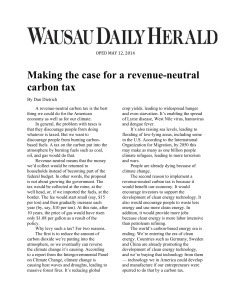
Making the case for a revenue-neutral carbon tax
... atmosphere by burning fuels such as coal, oil, and gas would do that. Revenue-neutral means that the money we’d collect would be returned to households instead of becoming part of the federal budget. In other words, the proposal is not about growing the government. The tax would be collected at the ...
... atmosphere by burning fuels such as coal, oil, and gas would do that. Revenue-neutral means that the money we’d collect would be returned to households instead of becoming part of the federal budget. In other words, the proposal is not about growing the government. The tax would be collected at the ...

What are the key population issues in Africa
... • About 20% of land in Kenya is suitable for agricultural production. • The country’s economy is driven by agriculture, which contributes about 25% of GDP, 60% of the country’s export earnings, and supports 75% of the population. • Kenya’s predominantly rain-fed agricultural is highly susceptible to ...
... • About 20% of land in Kenya is suitable for agricultural production. • The country’s economy is driven by agriculture, which contributes about 25% of GDP, 60% of the country’s export earnings, and supports 75% of the population. • Kenya’s predominantly rain-fed agricultural is highly susceptible to ...

Chapter 3. Climate and climate change 1.1 Climate
... leaf number, area, weight and weight per unit area of broad-leaved trees and conifers increased by 20 to 120% (Earnus & Jarvis, 1989). La Marche et al, (1984) found increased widths of annual rings of trees in subalpine habitats in the western United States during recent decades. The increased tree ...
... leaf number, area, weight and weight per unit area of broad-leaved trees and conifers increased by 20 to 120% (Earnus & Jarvis, 1989). La Marche et al, (1984) found increased widths of annual rings of trees in subalpine habitats in the western United States during recent decades. The increased tree ...

The Impact of Climate Change on Cities
... attributes of cites. These strengths of place can, however, become liabilities if the local ecosystems that they are based on are unable to adapt to the climate-induced changes. Climate change poses serious threats to urban infrastructure, quality of life, and entire urban systems. Not only poor cou ...
... attributes of cites. These strengths of place can, however, become liabilities if the local ecosystems that they are based on are unable to adapt to the climate-induced changes. Climate change poses serious threats to urban infrastructure, quality of life, and entire urban systems. Not only poor cou ...

Country-Specific Market Impacts of Climate Change
... reduced-form model predicts a $348 billion loss. This nine-fold difference is largely due to the different predictions about agriculture made by the two impact models. Given these regional results, it is no surprise that some countries are winners and others are losers. Table 5 presents net market r ...
... reduced-form model predicts a $348 billion loss. This nine-fold difference is largely due to the different predictions about agriculture made by the two impact models. Given these regional results, it is no surprise that some countries are winners and others are losers. Table 5 presents net market r ...

f(x) - Isaac Newton Institute for Mathematical Sciences
... • Global sea level rises • Global water vapour rises • Global precipitation rises • Rate of precip. rise is slower than water vapour • Hadley Circulation weakens and expands ...
... • Global sea level rises • Global water vapour rises • Global precipitation rises • Rate of precip. rise is slower than water vapour • Hadley Circulation weakens and expands ...

- b2match
... - CLIMAX: Climate Services Through Knowledge Co-Production: A Euro-South American Initiative For Strengthening Societal Adaptation Response to Extreme Events (Brazil, France, Germany, The Netherlands) - HIWAVES3: High Impact Weather Events in EurAsia Selected, Simulated and Storified (China, India, ...
... - CLIMAX: Climate Services Through Knowledge Co-Production: A Euro-South American Initiative For Strengthening Societal Adaptation Response to Extreme Events (Brazil, France, Germany, The Netherlands) - HIWAVES3: High Impact Weather Events in EurAsia Selected, Simulated and Storified (China, India, ...

Effects of global warming on humans

Climate change has brought about possibly permanent alterations to our planet’s geological, biological and ecological systems. The Intergovernmental Panel on Climate Change (IPCC) contended in 2003 that “there is new and stronger evidence that most of the warming observed over the last 50 years is attributable to human activities”. These changes have led to the emergence of large-scale environmental hazards to human health, such as extreme weather, ozone depletion, increased danger of wildland fires, loss of biodiversity, stresses to food-producing systems and the global spread of infectious diseases. The World Health Organization (WHO) estimates that 160,000 deaths, since 1950, are directly attributable to climate change. Many believe this to be a conservative estimate.To date, a neglected aspect of the climate change debate, much less research has been conducted on the impacts of climate change on health, food supply, economic growth, migration, security, societal change, and public goods, such as drinking water, than on the geophysical changes related to global warming. Human impacts can be both negative and positive. Climatic changes in Siberia, for instance, are expected to improve food production and local economic activity, at least in the short to medium term. Numerous studies suggest, however, that the current and future impacts of climate change on human society are and will continue to be overwhelmingly negative.The majority of the adverse effects of climate change are experienced by poor and low-income communities around the world, who have much higher levels of vulnerability to environmental determinants of health, wealth and other factors, and much lower levels of capacity available for coping with environmental change. A report on the global human impact of climate change published by the Global Humanitarian Forum in 2009, estimated more than 300,000 deaths and about $125 billion in economic losses each year, and indicating that most climate change induced mortality is due to worsening floods and droughts in developing countries. This also raises questions of climate justice, since the 50 least developed countries of the world account for not more than 1% of worldwide emissions of greenhouse gases.